
How Big Will My Cat Get Calculator
Estimate your kitten’s adult weight from its age and current weight.
Your Results
Enter your values and press Calculate to see your results.
What Is a How Big Will My Cat Get Calculator?
A how big will my cat get calculator estimates your kitten’s adult weight from its current weight and age. Kittens grow quickly in a fairly predictable pattern: most reach about a quarter of their adult weight by two months, half by four to five months and nearly all of it by their first birthday. Large breeds such as Maine Coons are the exception and keep growing for several years.
Enter your kitten’s weight and age in months to see the estimated adult weight, a likely range and how much of its growth is already complete. It is a fun, useful way to plan for the right carrier, litter box and food portions.
How to Use the How Big Will My Cat Get Calculator
- Weigh your kitten on a kitchen or baby scale.
- Enter the current weight in kg or lb.
- Enter the kitten’s age in months – between 2 and 12.
- Choose domestic or large breed.
- Press Calculate to see the estimated adult size.
How Adult Weight Is Estimated
The how big will my cat get calculator uses an average kitten growth curve that shows the typical percentage of adult weight at each month of age.
Adult weight = Current weight ÷ (% of adult weight at this age)- 2 months – about 25 % of adult weight
- 4 months – about 45 %
- 6 months – about 65 %
- 9 months – about 86 %
- 12 months – fully grown for most cats
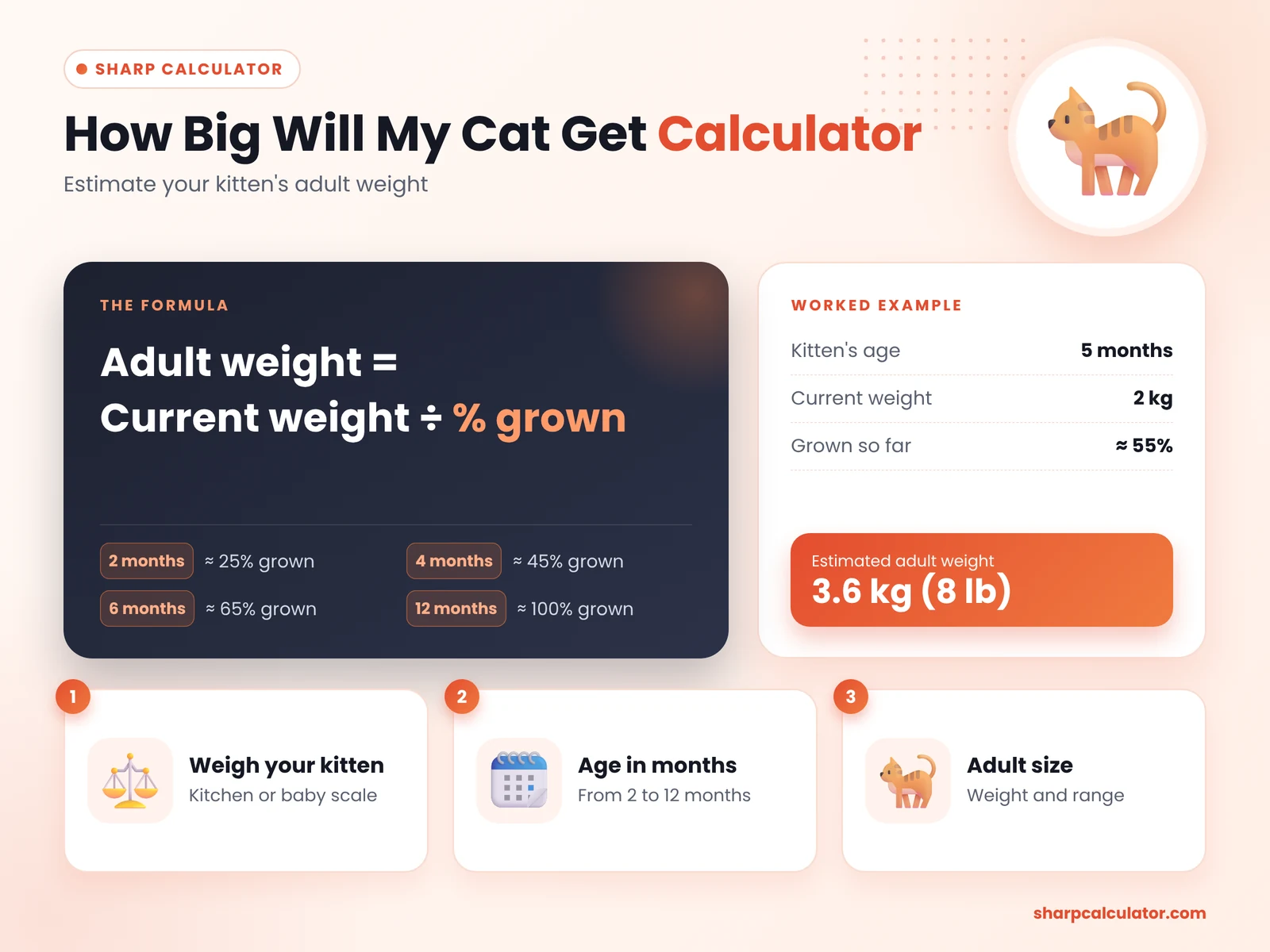
Between the listed months the calculator interpolates, so you can enter values such as 4.5 months. Estimates are most reliable after about four months.
Worked example
A 5-month-old kitten weighs 2 kg.
At five months a typical kitten has reached about 55 % of its adult weight, so the estimated adult weight is 2 ÷ 0.55 = 3.6 kg (about 8 lb), with a likely range of 3.3–4.0 kg.

Average Adult Cat Weights by Breed
Most domestic shorthair and longhair cats weigh between 3.5 and 5.5 kg as adults, but breed makes a big difference. Males are usually heavier than females, and neutered cats can gain weight easily if portions are not adjusted.
Mixed-breed and domestic cats usually fall within the middle of these ranges. If your kitten’s parents were large or small, expect a similar adult size, and remember that males generally finish heavier than females from the same litter.
Breed is not the only factor. Nutrition in the first year, neutering age and genetics from both parents all play a part, and some domestic cats carry Maine Coon or other large-breed ancestry without showing it obviously. Weighing your kitten every two weeks and running the calculator again helps refine the estimate as growth continues. Once your cat reaches adult size, keep an eye on body condition rather than the number on the scale, since a healthy weight depends on frame size.
| Breed | Typical adult weight | Fully grown by |
|---|---|---|
| Singapura | 2–4 kg | 12 months |
| Siamese | 3–5 kg | 12 months |
| Domestic shorthair | 3.5–5.5 kg | 12 months |
| British Shorthair | 4–8 kg | 2–3 years |
| Ragdoll | 4.5–9 kg | 3–4 years |
| Maine Coon | 5–11 kg | 3–5 years |
Feeding a Growing Kitten
Kittens need a complete kitten food that is higher in calories, protein and certain nutrients than adult food. Young kittens do best with three to four small meals a day, moving to two or three meals by six months. Switch to adult food at around 12 months for most cats, or later for large breeds. Weigh your kitten every couple of weeks: steady gain of roughly 100 g per week in the early months is a good sign of healthy growth.
Signs of Healthy Growth
- Steady weekly weight gain
- Bright eyes, clean ears and a glossy coat
- Playful, curious behaviour
- Firm, regular stools
- Ribs easy to feel but not visible
Male vs Female Kittens
Male cats usually end up 10–30 % heavier than females of the same breed, and the difference becomes noticeable from about four to six months of age. If you know your kitten’s sex, expect males toward the upper end of the predicted range and females toward the lower end. Early neutering does not stunt growth, but neutered cats need fewer calories, so watch portions after surgery to keep your cat at a healthy weight.
Tips for Accurate Estimates
- Weigh consistently.Use the same scale at the same time of day.
- Use exact age.Ask your breeder or shelter for the birth date.
- Re-check monthly.Predictions improve as your kitten grows.
- Don’t overfeed.A chubby kitten can become an overweight adult.
- Consider breed.Large breeds continue growing long after 12 months.
- Ask your vet.Your vet can track growth at vaccination visits.
Why Predicting Adult Size Is Useful
Knowing your kitten’s likely adult size helps you choose the right carrier, cat tree, litter box and harness, and plan food budgets. It also lets you spot unusual growth early. A how big will my cat get calculator gives you a quick, friendly estimate.
Who Can Use This Tool?
This tool is for new kitten owners, foster carers, breeders and shelter staff. It works on any phone or computer.
Note: This how big will my cat get calculator gives an estimate based on average growth. Genetics, sex, neutering and diet all affect adult size.
Frequently Asked Questions
How can I tell how big my kitten will get?
Use the kitten’s weight and age with an average growth curve, as this calculator does. The parents’ size is also a useful guide.
When do cats stop growing?
Most cats reach adult size at about 12 months. Large breeds like Maine Coons can keep growing for 3–5 years.
How much should a 6-month-old kitten weigh?
Many 6-month-old kittens weigh 2–3 kg (4.5–6.5 lb), depending on breed and sex.
Do male cats get bigger than females?
Yes, males are usually heavier and larger-framed than females of the same breed.
Does neutering affect a cat’s size?
Neutering can slightly affect growth plates and metabolism; neutered cats may gain weight if overfed.
Can I predict the size of a mixed-breed kitten?
Yes, roughly. The calculator works for domestic and mixed-breed kittens.