
Rat Cage Calculator
Find out how many pet rats your cage can comfortably hold.
Your Results
Enter your values and press Calculate to see your results.
What Is a Rat Cage Calculator?
A rat cage calculator tells you how many pet rats a cage can house comfortably. Rats are intelligent, active and social animals that need space to climb, explore and play. A widely used guideline is about 2.5 cubic feet of cage volume per rat. Enter your cage’s width, depth and height and the calculator works out the volume and the maximum number of rats it should hold.
Whether you are buying a new cage or checking the one you already have, this tool helps you avoid overcrowding, which can lead to stress, fighting and respiratory problems.
How to Use the Rat Cage Calculator
- Measure the cage’s width, depth and height on the inside.
- Choose inches or centimetres.
- Press Calculate.
- Read the cage volume and the number of rats it can house.
- Check bar spacing and floor type, too – volume is only part of a good cage.
Rat Cage Formula
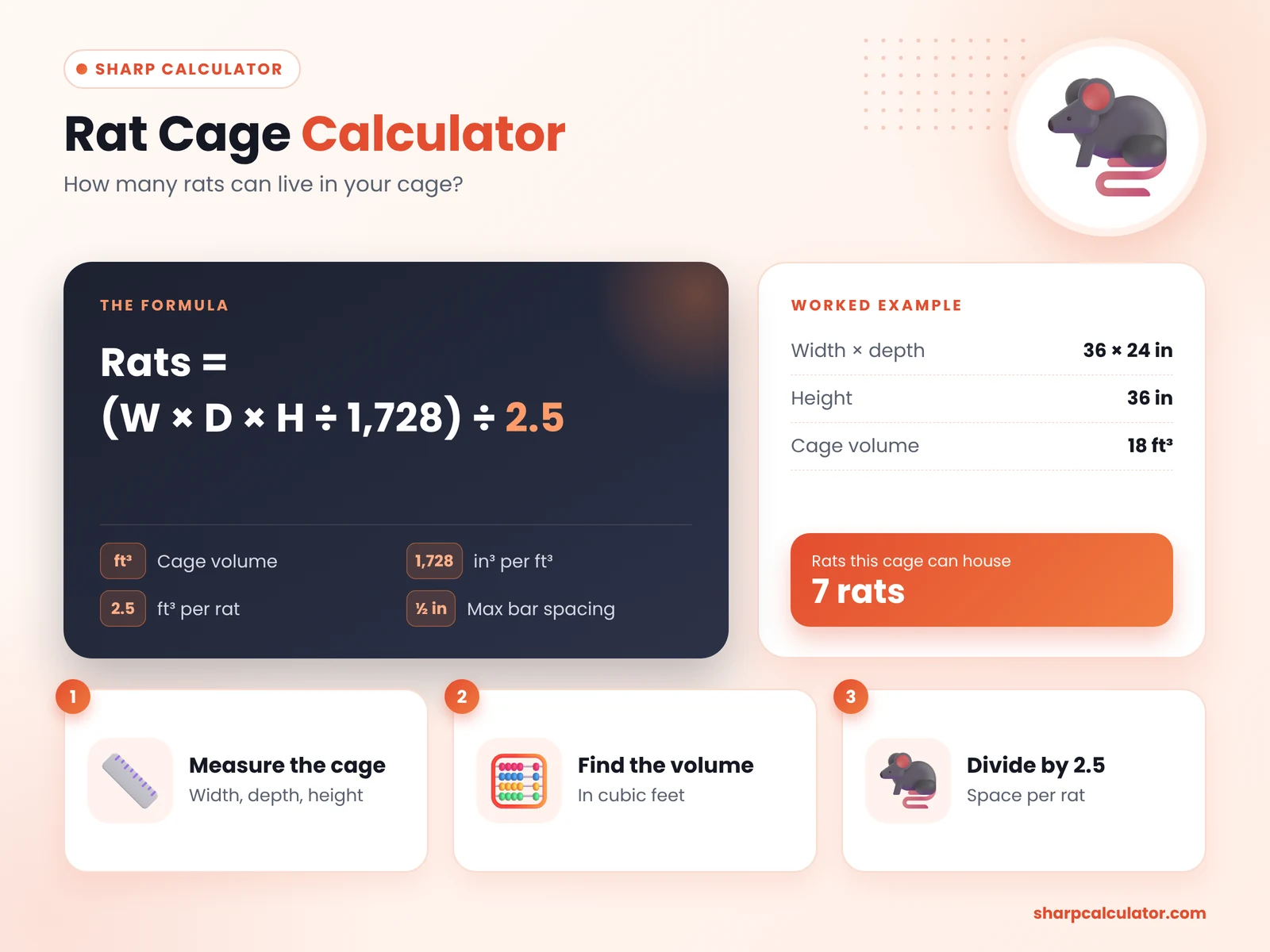
The rat cage calculator converts the cage dimensions into cubic feet, then divides by the space each rat needs.
Volume (ft³) = Width × Depth × Height (in) ÷ 1,728Rats = Volume ÷ 2.5- 1,728 – cubic inches in one cubic foot
- 2.5 ft³ – space per rat used by many rat welfare groups
- Rounded down – the result is always rounded to a whole rat
- Metric – centimetres are converted automatically
Shelves, hammocks and levels do not add volume, but they make the space far more usable. A tall cage with several levels suits rats better than a low, wide one of the same volume.
Worked example
A cage measures 36 inches wide, 24 inches deep and 36 inches high.
Volume = 36 × 24 × 36 ÷ 1,728 = 18 cubic feet. 18 ÷ 2.5 = 7.2, so the cage can house up to 7 rats.

What Makes a Good Rat Cage
Volume matters, but so does design. Rats love to climb, so a tall cage with platforms is ideal. Wire floors and shelves can cause foot sores (bumblefoot), so cover them with fabric or plastic. Ventilation is important to avoid ammonia build-up, which irritates rats’ sensitive airways.
Even a large cage needs regular care. Spot-clean soiled bedding every day, wash food bowls frequently and do a full clean each week with a mild, pet-safe cleaner. Rearranging hammocks and toys during cleaning keeps your rats curious and active.
Rats are clever and need daily enrichment. Rotate toys, hide treats in paper or cardboard for foraging and add new climbing routes regularly. Many owners also provide a dig box filled with shredded paper. A stimulated rat is calmer, healthier and easier to handle. Place the cage in a living area where the rats can see and hear the family, away from direct sunlight, drafts and loud electronics. Supervised free-range time outside the cage for at least an hour a day completes a healthy routine.
| Feature | Recommendation |
|---|---|
| Space | About 2.5 ft³ per rat |
| Bar spacing | 1/2 inch or less for adults, 3/8 inch for young rats |
| Floors and shelves | Solid surfaces, not bare wire |
| Height | At least 18–24 inches for climbing |
| Doors | Large doors for easy cleaning |
| Ventilation | Wire sides rather than glass tanks |
Setting Up Your Rat Cage
- Use dust-free bedding such as paper-based litter or fleece liners
- Add hammocks, ropes, tunnels and hides at different heights
- Provide a heavy food bowl and a water bottle (plus a bowl if possible)
- Include chew toys to keep teeth healthy
- Place the cage away from drafts, direct sun and loud noise
- Spot-clean daily and do a full clean weekly
Why Rats Need Company
Rats are highly social and can become lonely, bored and stressed when kept alone. Keep at least two rats of the same sex, or neutered pairs, and introduce new rats gradually on neutral ground. Even with plenty of human attention, a companion rat provides grooming, play and warmth that people cannot. Use the rat cage calculator to make sure your cage has room for a group.
Choosing Between Cage Types
Popular rat cages include tall multi-level wire cages, converted wardrobes and large modular cages. Multi-level wire cages are easy to clean and offer plenty of climbing; converted furniture can look great in a living room but needs mesh panels for ventilation. Whatever the design, check the internal measurements, bar spacing and door size before buying, then use the rat cage calculator to confirm the cage will suit the number of rats you plan to keep.
Tips for Happy, Healthy Rats
- Measure the inside.Use internal dimensions, not the outer frame.
- Go tall.Rats use vertical space for climbing and exploring.
- Check bar spacing.Young or small rats can squeeze through wide bars.
- Cover wire floors.Prevent bumblefoot with solid surfaces.
- Allow free-range time.Rats need at least an hour of supervised play outside the cage daily.
- Avoid aquariums.Glass tanks trap ammonia and lack ventilation.
Why Cage Size Matters
Overcrowded rats are more likely to fight, become stressed and develop respiratory infections. A spacious, well-designed cage supports natural behaviours such as climbing, nesting and foraging. A rat cage calculator gives you a quick, objective check before you buy or add new rats.
Who Can Use This Tool?
This tool is for pet rat owners, adopters, rescue volunteers and pet shop staff. It works on mobile and desktop.
Note: This rat cage calculator uses a common guideline of 2.5 cubic feet per rat. Active males, large rats and young rats may need more space.
Frequently Asked Questions
How much space does a rat need?
A common guideline is about 2.5 cubic feet of cage volume per rat, plus daily time outside the cage.
How many rats can live in a 36 × 24 × 36 inch cage?
About 7 rats, since the cage has 18 cubic feet of space.
What bar spacing is safe for rats?
1/2 inch or less for adult rats, and 3/8 inch or less for young or small rats.
Can a rat live alone?
Rats are social and should be kept in pairs or groups of the same sex.
Are multi-level cages better?
Yes. Rats love climbing, so tall cages with shelves and hammocks are ideal.
Is a glass tank suitable for rats?
Generally no – tanks have poor ventilation and allow ammonia to build up.