
Cat Pregnancy Calculator
Find when your queen is due and follow her pregnancy week by week.
Your Results
Enter your values and press Calculate to see your results.
What Is a Cat Pregnancy Calculator?
A cat pregnancy calculator estimates when your queen will give birth based on the date she mated. Cats are pregnant for about nine weeks – usually 63 to 67 days, with 65 days as a reliable average. Knowing the expected due date helps you plan vet visits, change her diet at the right time and prepare a safe, quiet nest before the kittens arrive.
Enter the mating date and the calculator shows the estimated due date, the earliest and latest likely dates, how many days pregnant your cat is today and a timeline of the key milestones from early pregnancy to queening.
How to Use the Cat Pregnancy Calculator
- Find the mating date. If your cat mated over several days, use the first day.
- Enter the date in the calculator.
- Press Calculate.
- Read the estimated due date and the normal range.
- Use the timeline to plan vet checks, diet changes and nesting preparations.
How Cat Gestation Is Calculated
Cats are induced ovulators, which means they release eggs in response to mating. This makes the mating date a fairly good starting point. The cat pregnancy calculator simply adds the average gestation length to that date.
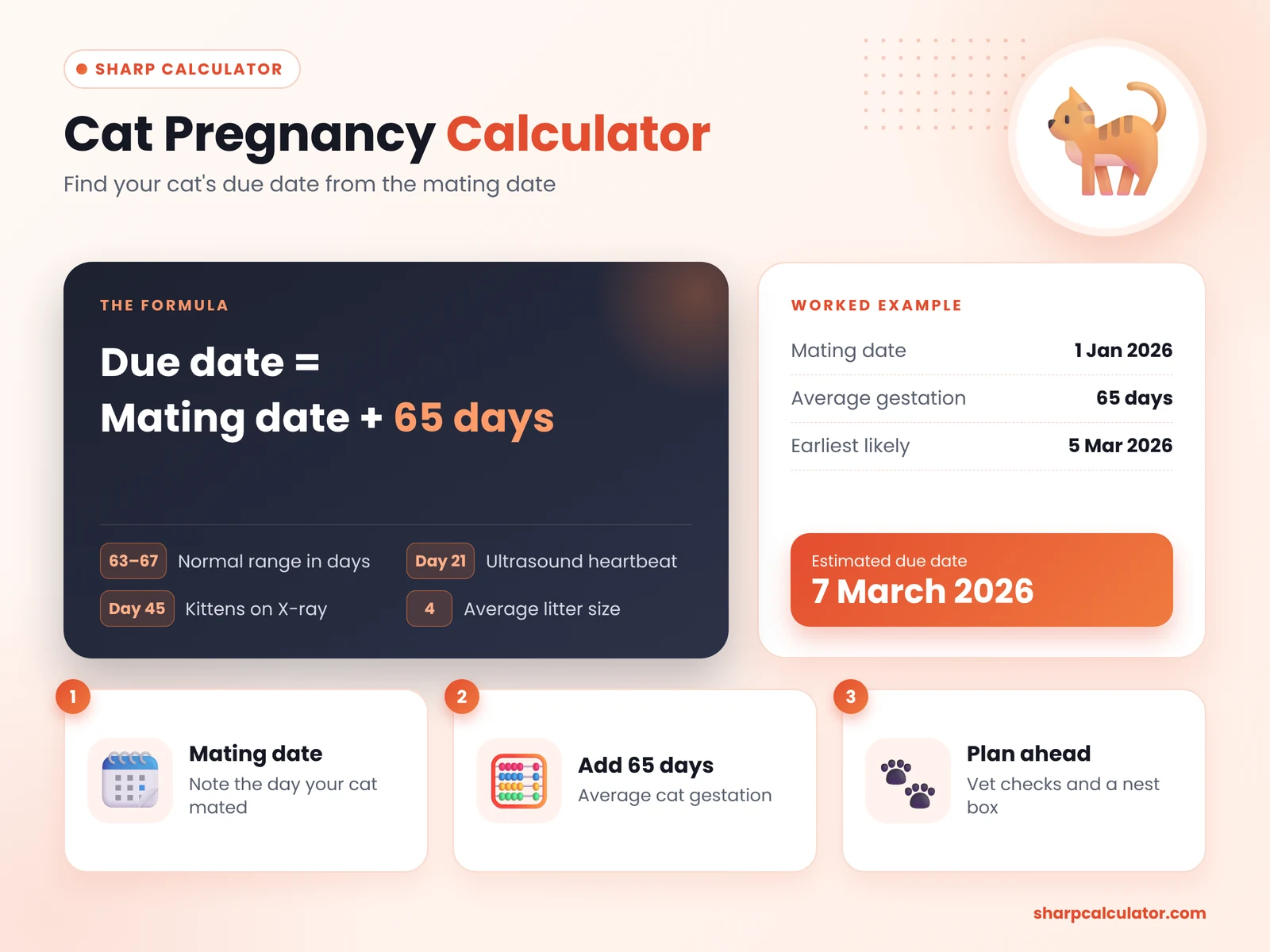
Due date = Mating date + 65 daysNormal window = 63 to 67 days- Average gestation – 65 days (about 9 weeks)
- Earliest normal birth – around day 61–63
- Latest normal birth – around day 67–70
- Overdue – contact a vet if there are no kittens by day 70
If your cat had access to a tom over several days, the true conception date is uncertain. Use the first mating date and watch for signs of labour from day 60 onward.
Worked example
Your cat mated on 1 January 2026.
Adding 65 days gives an estimated due date of 7 March 2026, with kittens most likely between 5 and 9 March. Her nipples should pink up around 16–22 January, and a vet ultrasound can confirm pregnancy from about 22 January.

Cat Pregnancy Week by Week
Pregnancy in cats moves quickly. In the first two weeks there are few visible changes. Around week three the nipples become pink and enlarged, a sign known as “pinking up”. From week four the belly starts to round out, and by week six or seven your cat will eat noticeably more and gain weight. In the final week she will look for a quiet, warm spot to give birth.
Throughout pregnancy, keep your cat indoors, let her rest as much as she wants and avoid handling her belly. Gentle play is fine, but she should not be lifted by the abdomen. Regular weight checks are a good sign of progress – most queens gain steadily from the fourth week onwards.
Weigh her once a week and switch gradually to kitten food from mid-pregnancy so she has the extra energy she needs for growing kittens and later milk. Schedule a vet check around the third or fourth week to confirm pregnancy and discuss safe parasite control and vaccinations.
| Week | What happens |
|---|---|
| 1–2 | Fertilisation and implantation; few visible signs |
| 3 | Pinking up of nipples, possible mild morning sickness |
| 4 | Vet can feel kittens; belly begins to swell |
| 5–6 | Appetite rises; weight gain of 1–2 kg in total |
| 7 | Kittens move; skeletons visible on X-ray |
| 8–9 | Nesting behaviour, restlessness, labour |
Signs Your Cat Is About to Give Birth
- Restlessness and searching for a hidden nesting place
- Loss of appetite in the final 24 hours
- Rectal temperature dropping below about 37.8 °C (100 °F)
- Excessive grooming of the belly and genital area
- Purring, vocalising or pacing as contractions start
Most kittens are born 10 to 60 minutes apart. Call your vet if your cat strains hard for more than 30 minutes without producing a kitten, if more than two hours pass between kittens, or if you see heavy bleeding or a foul-smelling discharge.
Feeding a Pregnant Cat
A pregnant cat’s energy needs rise steadily, reaching about 1.5 times her normal intake by the end of pregnancy and up to two to four times during peak lactation. The easiest way to meet this is to switch gradually to a complete kitten food from around week four, offered in small, frequent meals or free-fed if she is not overweight. Fresh water should always be available. Avoid supplements such as extra calcium unless your vet recommends them, because they can upset her mineral balance and increase the risk of problems around birth.
Tips for Caring for a Pregnant Cat
- Confirm with a vet.An ultrasound from about day 21 confirms pregnancy and checks that kittens are healthy.
- Switch to kitten food.From mid-pregnancy, high-calorie kitten food supports growing kittens and later milk production.
- Avoid medication.Do not give flea, worming or other treatments without checking with your vet first.
- Prepare a nest early.Place a box lined with clean towels in a warm, quiet room about a week before the due date.
- Keep her indoors.Pregnant cats may look for hidden places outdoors to give birth.
- Plan for after birth.Discuss spaying with your vet so she does not become pregnant again soon after weaning.
Why Knowing Your Cat’s Due Date Matters
An accurate due date lets you book a pre-birth vet check, change her diet at the right time and be at home when labour starts. It also tells you when a delay becomes a concern. A cat pregnancy calculator turns one date into a complete plan so you and your cat are ready for a safe delivery.
Who Can Use This Tool?
This tool is helpful for cat owners, breeders, rescue volunteers, foster carers and veterinary students. It works on phones and computers and needs no sign-up.
Note: This cat pregnancy calculator gives estimates only. Every cat is different – always consult a veterinarian for pregnancy confirmation and care.
Frequently Asked Questions
How long are cats pregnant?
Cats are usually pregnant for 63 to 67 days, about nine weeks, with an average of 65 days.
How can I tell if my cat is pregnant?
Early signs include pink, enlarged nipples around week three, increased appetite and a gradually rounder belly. A vet can confirm pregnancy by ultrasound from about day 21.
How many kittens will my cat have?
The average litter is four kittens, but litters of one to nine or more are possible. An X-ray after day 45 gives the most accurate count.
Can a cat get pregnant while nursing?
Yes. Cats can come back into heat a few weeks after giving birth, even while nursing kittens.
When should I worry that my cat is overdue?
Contact your vet if there are no kittens by about day 70, or sooner if she seems unwell or has a discharge without labour.
Is the cat due date always accurate?
No calculator is exact. Use the result as a guide and watch for signs of labour from around day 60.