
Raw Dog Food Calculator
Work out daily raw food portions and the 80/10/10 split.
Your Results
Enter your values and press Calculate to see your results.
What Is a Raw Dog Food Calculator?
A raw dog food calculator tells you how much raw food to feed your dog each day. Raw feeding portions are usually based on a percentage of body weight: most adult dogs eat about 2–3 % of their body weight daily, while growing puppies need a much higher percentage of their current weight. The calculator also splits the daily amount into muscle meat, bone and organs using the popular 80/10/10 ratio.
Enter your dog’s weight, life stage and number of meals. You will see the daily amount, the portion per meal, the weekly and monthly totals and how much of each component to include.
How to Use the Raw Dog Food Calculator
- Enter your dog’s current weight.
- Choose the life stage and activity that best describes your dog.
- Select how many meals per day you feed.
- Press Calculate to see daily and per-meal portions.
- Weigh your dog every two weeks and adjust the percentage if needed.
Raw Dog Food Formula
The raw dog food calculator multiplies body weight by a feeding percentage, then divides the total by the number of meals.
Daily food (g) = Weight (kg) × 1,000 × feeding %- Adults – 2 % (less active or weight loss) to 3 % (very active)
- Puppies – about 9 % at 2–4 months, falling to around 3.5 % by 9–12 months
- 80/10/10 – 80 % muscle meat, 10 % raw edible bone, 10 % organ (half liver)
- Meals – 2 for adults, 3–4 for young puppies
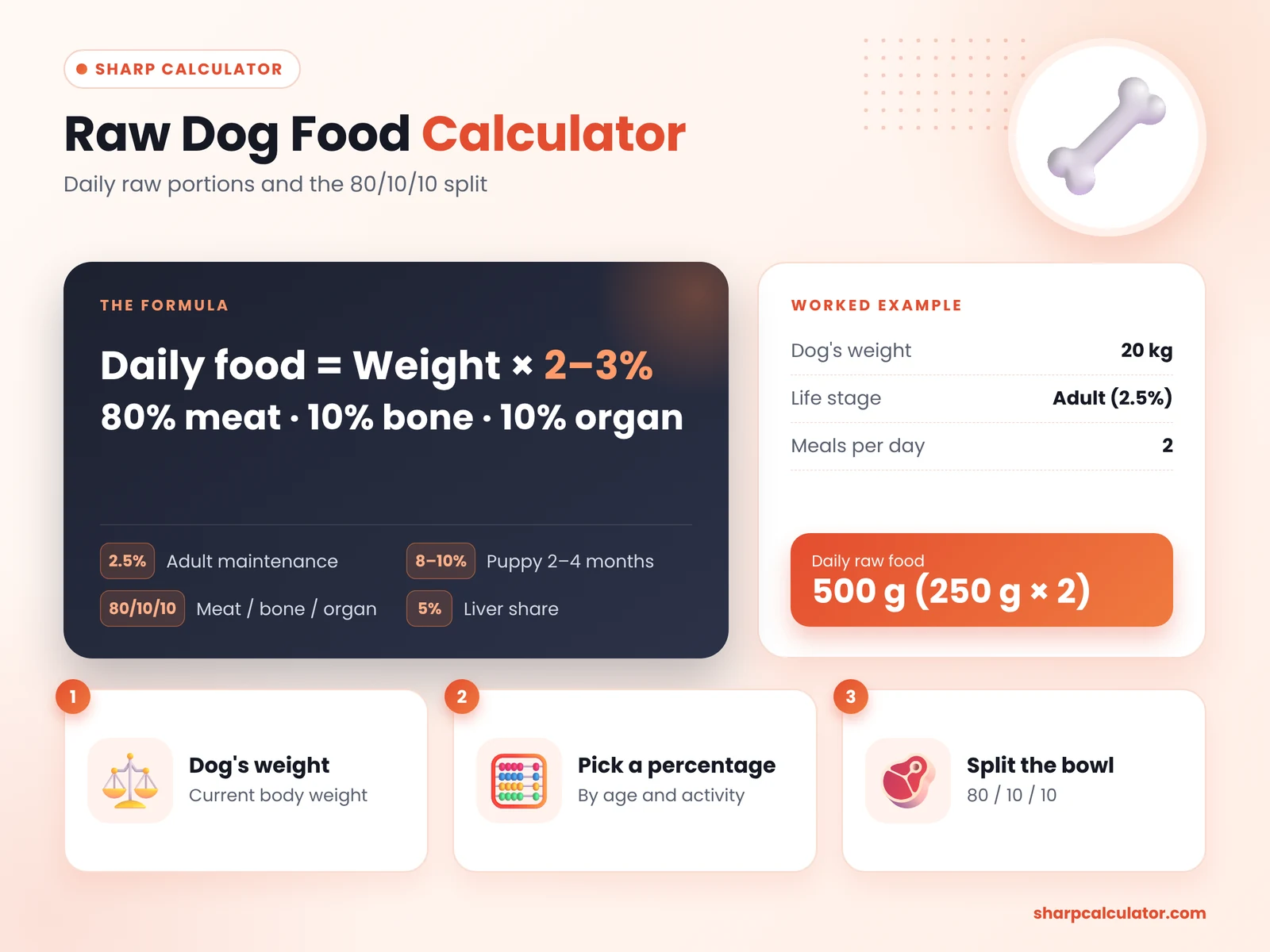
Puppy percentages apply to the puppy’s current weight. Many owners stop increasing portions once the daily amount reaches about 2–3 % of the expected adult weight.
Worked example
A 20 kg adult dog with normal activity is fed twice a day.
Daily food = 20 × 1,000 × 2.5 % = 500 g, or 250 g per meal. Of that, 400 g is muscle meat, 50 g raw edible bone, 25 g liver and 25 g other organ such as kidney or spleen.
Raw Feeding Percentages by Life Stage
Every dog is different. Breed, metabolism, age, neutering and the fat content of the meat all affect how much food a dog needs. Use the percentage as a starting point and adjust in small steps based on body condition: if your dog gains weight, reduce the amount; if ribs and hip bones become prominent, increase it.
These percentages are a starting point. Highly active working dogs, very young puppies and dogs in cold climates may need more, while neutered, older or less active dogs often need less. Fat content also matters: fatty cuts supply far more calories than lean ones, so a dog eating fatty meat may need a lower percentage. Weigh your dog every two weeks and adjust portions in small steps of about 10 % until body condition stays steady with ribs easy to feel and a visible waist. Introduce raw food gradually over a week or two, mixing it with the current diet, to give the digestive system time to adjust.
| Life stage | % of body weight per day |
|---|---|
| Adult, less active or overweight | 2% |
| Adult, normal activity | 2.5% |
| Adult, very active or working | 3% |
| Puppy 2–4 months | 8–10% |
| Puppy 4–6 months | 6–8% |
| Puppy 6–9 months | 4–6% |
| Puppy 9–12 months | 3–4% |
Raw Feeding Safety
- Buy meat from reputable suppliers and keep it frozen until needed
- Thaw in the fridge, never on the counter
- Wash hands, bowls and surfaces after handling raw meat
- Never feed cooked bones – they splinter easily
- Supervise dogs eating bones and choose bones sized for your dog
- Talk to your vet about whether raw feeding suits your household, especially with young children or immune-compromised people
Raw diets made at home can easily become unbalanced. Vitamins, minerals and omega-3 fatty acids need attention, so consider a complete commercial raw food or a recipe reviewed by a veterinary nutritionist.
Raw Feeding Tips
- Start slowly.Transition over 7–10 days to avoid digestive upset.
- Weigh portions.A kitchen scale makes raw feeding far more accurate.
- Rotate proteins.Using different meats improves nutrient variety.
- Watch the stool.Too much bone causes hard, chalky stool; too little can make it loose.
- Monitor body condition.Adjust the percentage every few weeks.
- Plan freezer space.Use the weekly and monthly totals to buy in bulk.
Why Portion Control Matters
Overfeeding leads to weight gain, while underfeeding can cause weight loss and poor coat quality. Raw meats vary in fat and calories, so starting with a reliable estimate and adjusting gradually is the best approach. A raw dog food calculator gives you that starting point and makes meal prep and budgeting easier.
Who Can Use This Tool?
This tool is for raw feeding beginners, experienced BARF and prey-model feeders, puppy owners and breeders. It works on mobile and desktop.
Note: This raw dog food calculator provides general guidance. Consult your veterinarian or a veterinary nutritionist to make sure your dog’s diet is complete and balanced.
Frequently Asked Questions
How much raw food should I feed my dog?
Most adult dogs eat 2–3 % of their body weight per day. A 20 kg dog typically needs 400–600 g.
How much raw food does a puppy need?
Puppies need more – about 8–10 % of current body weight at 2–4 months, decreasing as they grow.
What is the 80/10/10 raw diet?
It is a ratio of 80 % muscle meat, 10 % raw edible bone and 10 % organs, half of which should be liver.
Should I feed my dog once or twice a day?
Most adults do well on two meals; puppies under six months usually need three or four.
How do I know if I am feeding the right amount?
Check body condition: you should feel the ribs easily and see a waist. Adjust the amount if your dog gains or loses weight.
Can I mix raw and kibble?
Some owners do, but feeding them in separate meals may be easier on digestion. Ask your vet for advice.