
Swine Gestation Calculator
Find the farrowing date and plan care for your sow or gilt.
Your Results
Enter your values and press Calculate to see your results.
What Is a Swine Gestation Calculator?
A swine gestation calculator predicts when a sow or gilt will farrow based on her breeding or insemination date. Pigs are pregnant for about 114 days – easy to remember as three months, three weeks and three days – and most sows farrow between day 111 and day 117. Few livestock species have such a predictable pregnancy, which makes accurate dates very useful for planning.
Enter the service date to get the expected farrowing date, the farrowing window, the current day of gestation and a practical timeline of heat checks, pregnancy diagnosis, feed changes, vaccinations and the day to move her into the farrowing crate.
How to Use the Swine Gestation Calculator
- Enter the breeding or AI date.
- Press Calculate.
- Read the expected farrowing date and the normal window.
- Check the timeline for heat checks at day 18–24 and ultrasound at day 25–35.
- Move the sow to a clean farrowing crate about a week before the due date.
How the Farrowing Date Is Calculated
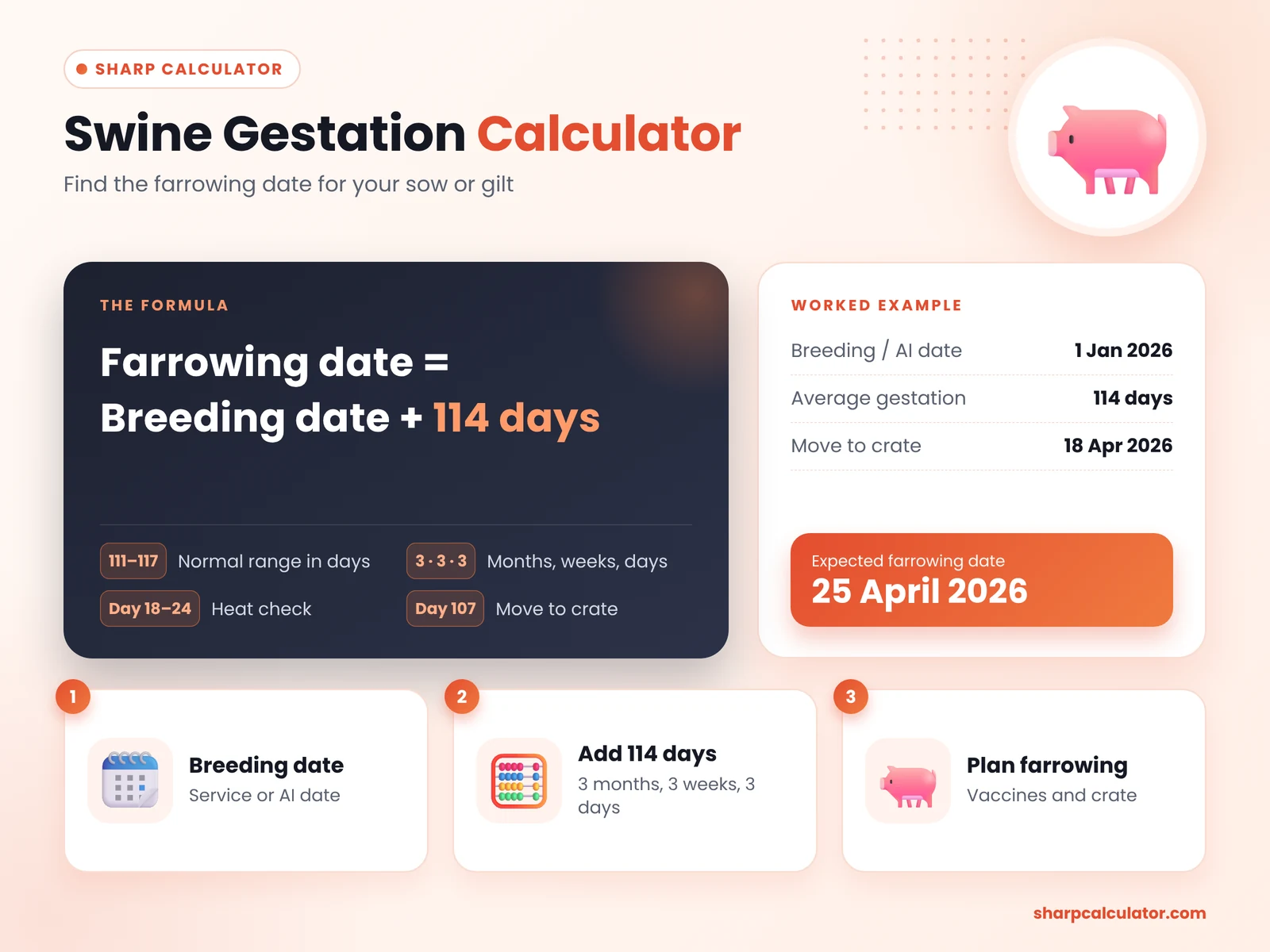
The swine gestation calculator adds the average pig pregnancy length to the breeding date.
Farrowing date = Breeding date + 114 days- Average gestation – 114 days
- Normal range – 111 to 117 days
- Rule of thumb – 3 months, 3 weeks and 3 days
- Sow heat cycle – about 21 days if not pregnant
Large litters are often farrowed a day earlier and small litters a day later. If a sow is more than three days past her due date, consult your vet.
Worked example
A sow was inseminated on 1 January 2026.
114 days later gives an expected farrowing date of 25 April 2026. Check for a return to heat between 19 and 25 January, scan her around 29 January and move her to the farrowing crate around 18 April.
Feeding a Pregnant Sow
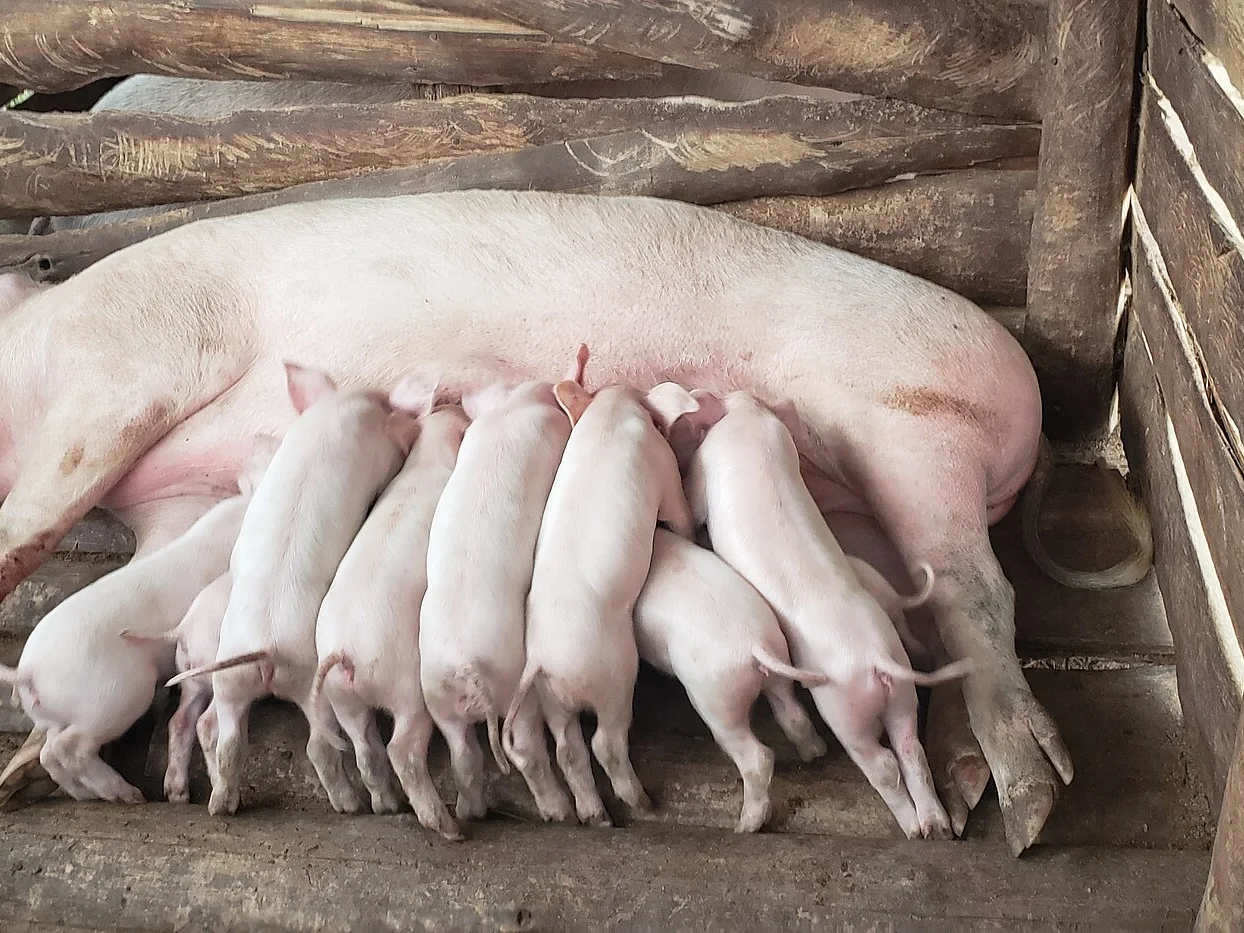
Sows need careful feeding to stay in the right body condition. Overfeeding in early pregnancy can reduce embryo survival and make sows too fat, while underfeeding in late pregnancy lowers piglet birth weight. Most farms keep feed moderate until about day 90, then increase it to support rapid fetal growth in the final month.
Fresh, clean water should always be available, as a pregnant sow can drink 15–25 litres a day.
A high-fibre diet in late pregnancy, using ingredients such as beet pulp or bran, helps prevent constipation and keeps sows content when feed is limited. Avoid sudden diet changes in the final week, and move sows to the farrowing area calmly to reduce stress. Sows that farrow in good body condition, neither too thin nor too fat, usually produce more milk and wean heavier, healthier piglets. Recording each sow’s condition at breeding and farrowing helps fine-tune feeding plans for the whole herd. Good records help spot sows that need extra attention.
| Stage | Days | Feeding focus |
|---|---|---|
| Early | 0 – 30 | Moderate feed; protect embryo implantation |
| Mid | 30 – 90 | Adjust feed to body condition |
| Late | 90 – 110 | Increase feed 0.5–1 kg/day |
| Pre-farrowing | 110 – 114 | Reduce slightly; add fibre to prevent constipation |
Signs a Sow Is About to Farrow
- Vulva swells and reddens in the last few days
- Udder becomes firm and teats point outward
- Milk can be expressed from the teats 12–24 hours before farrowing
- Nest-building behaviour: pawing and rooting at bedding
- Restlessness, lying down and getting up, and a slight vaginal discharge
Farrowing usually takes two to five hours, with piglets born every 15–20 minutes. Call for help if more than 45 minutes pass between piglets while the sow is straining, or if she is distressed and producing no piglets.
Batch Farrowing and Planning
Many pig farms breed sows in groups so they farrow in batches every one, two or three weeks. Batch farrowing simplifies cleaning, cross-fostering of piglets and weaning, and lets staff focus on farrowing for a few concentrated days. A swine gestation calculator is the starting point: enter the service dates for each group to see when the farrowing room must be ready. Because pig gestation is so consistent, batch plans built from accurate service dates are usually reliable to within two or three days.
Tips for Managing Pregnant Sows
- Record every service.Write the date and boar or semen batch on the sow card.
- Check for returns.Exposing sows to a boar at day 18–24 reveals those not in pig.
- Scan to confirm.Real-time ultrasound from day 25 gives fast, accurate pregnancy diagnosis.
- Manage body condition.Aim for a body condition score of about 3 at farrowing.
- Vaccinate before farrowing.Pre-farrowing vaccines protect piglets through colostrum; follow your vet’s plan.
- Prepare the crate.Wash, disinfect and dry the farrowing crate before moving the sow in.
Why the Farrowing Date Matters
Piglet survival depends on good preparation. Knowing the farrowing date lets you schedule vaccinations, move sows on time, set up heat lamps and have staff present during farrowing. On larger farms, a swine gestation calculator supports batch farrowing so that groups of sows farrow together, making management easier.
Who Can Use This Tool?
This tool is made for pig farmers, smallholders keeping a few sows, farm managers, agriculture students and veterinarians. It works on mobile and desktop.
Note: This swine gestation calculator provides estimates. Consult your veterinarian for herd health, vaccinations and farrowing problems.
Frequently Asked Questions
How long are pigs pregnant?
About 114 days on average – three months, three weeks and three days. Most sows farrow between 111 and 117 days.
How can I tell if my sow is pregnant?
If she does not return to heat 18–24 days after breeding, she is probably pregnant. Ultrasound from day 25–35 confirms it.
When should I move a sow to the farrowing crate?
About 5–7 days before the due date, around day 107–109 of gestation.
How many piglets does a sow have?
Commercial sows typically farrow 10–14 piglets; gilts and heritage breeds often have smaller litters.
What are the signs of farrowing?
Swollen vulva, milk in the teats, nest-building and restlessness usually appear within 24 hours of farrowing.
Is a gilt’s pregnancy the same length as a sow’s?
Yes. Gilts and sows both average around 114 days.