
Acres Per Hour Calculator
Work out how many acres your machine covers per hour.
Your Results
Enter your values and press Calculate to see your results.
What Is a Acres Per Hour Calculator?
An acres per hour calculator estimates how much ground a tractor, mower, sprayer, planter or other implement can cover in an hour. Farmers, contractors and landscapers use this figure – known as field capacity – to plan workloads, compare machines, schedule labour and price custom work. It depends on three things: how fast you travel, how wide the implement works and how much time is lost to turns, overlaps and stops.
Enter the ground speed, working width and field efficiency. The calculator gives the effective field capacity in acres and hectares per hour, the theoretical maximum and, if you add the field size, how long the job should take.
How to Use the Acres Per Hour Calculator
- Enter your average ground speed while working.
- Enter the working width of the implement – the width it actually covers per pass.
- Set the field efficiency; use 80 % if unsure.
- Optionally enter the field size in acres.
- Press Calculate to see acres per hour and total time.
Acres Per Hour Formula
The acres per hour calculator uses the standard field capacity equation used in agricultural engineering.
Acres per hour = (Speed (mph) × Width (ft) × Efficiency) ÷ 8.25- Speed – average working speed in miles per hour
- Width – effective working width in feet
- Efficiency – percentage of time actually working (as a decimal)
- 8.25 – conversion constant (43,560 ft² per acre ÷ 5,280 ft per mile)
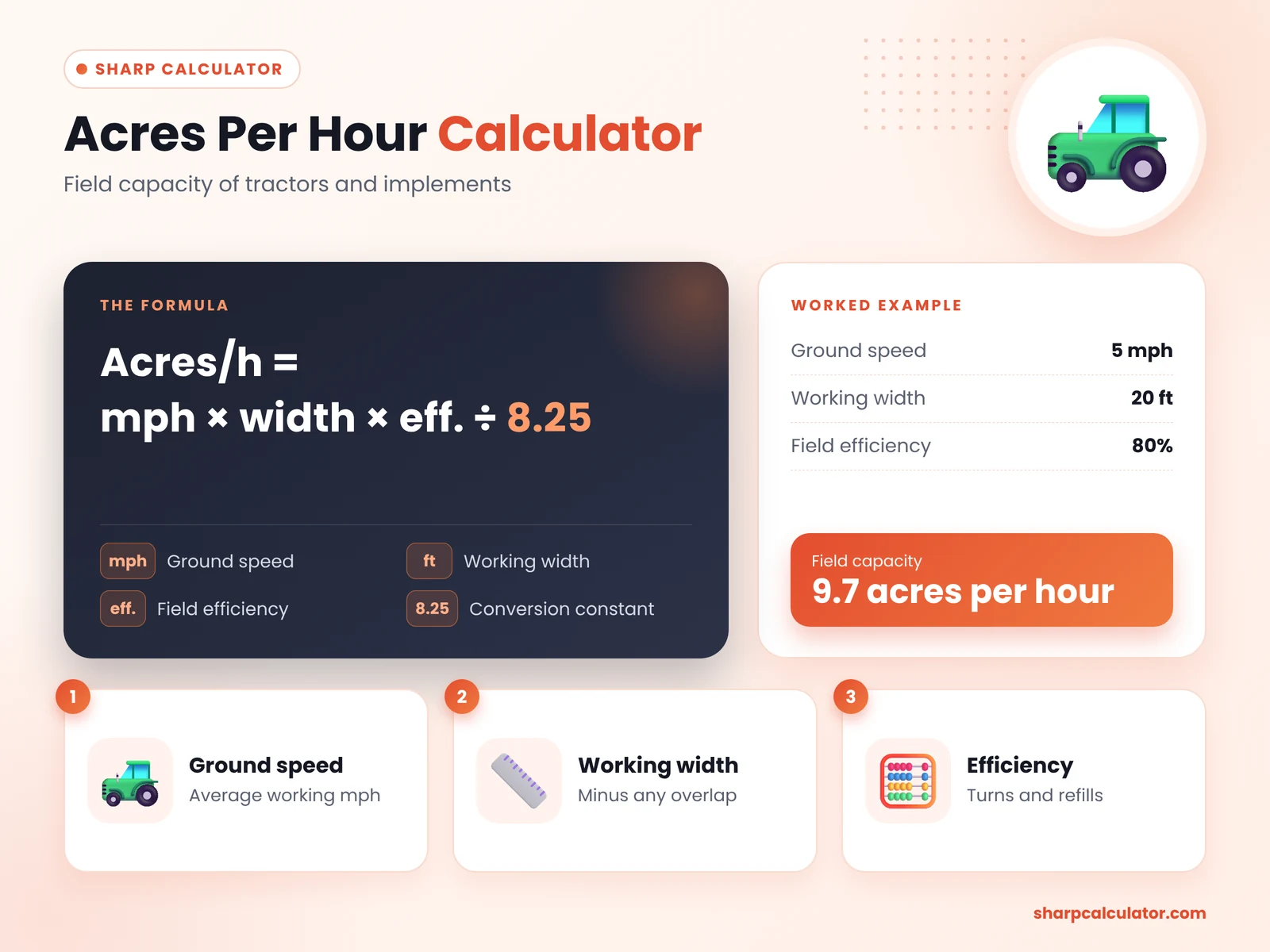
Without efficiency, the formula gives the theoretical field capacity – what you would achieve driving non-stop with no overlap. Real-world efficiency is always lower.
Worked example
A 20 ft disc travels at 5 mph with 80 % field efficiency.
Acres per hour = (5 × 20 × 0.80) ÷ 8.25 = 9.70 acres per hour. A 120-acre field would take about 12 hours 22 minutes.
Typical Speeds and Efficiencies
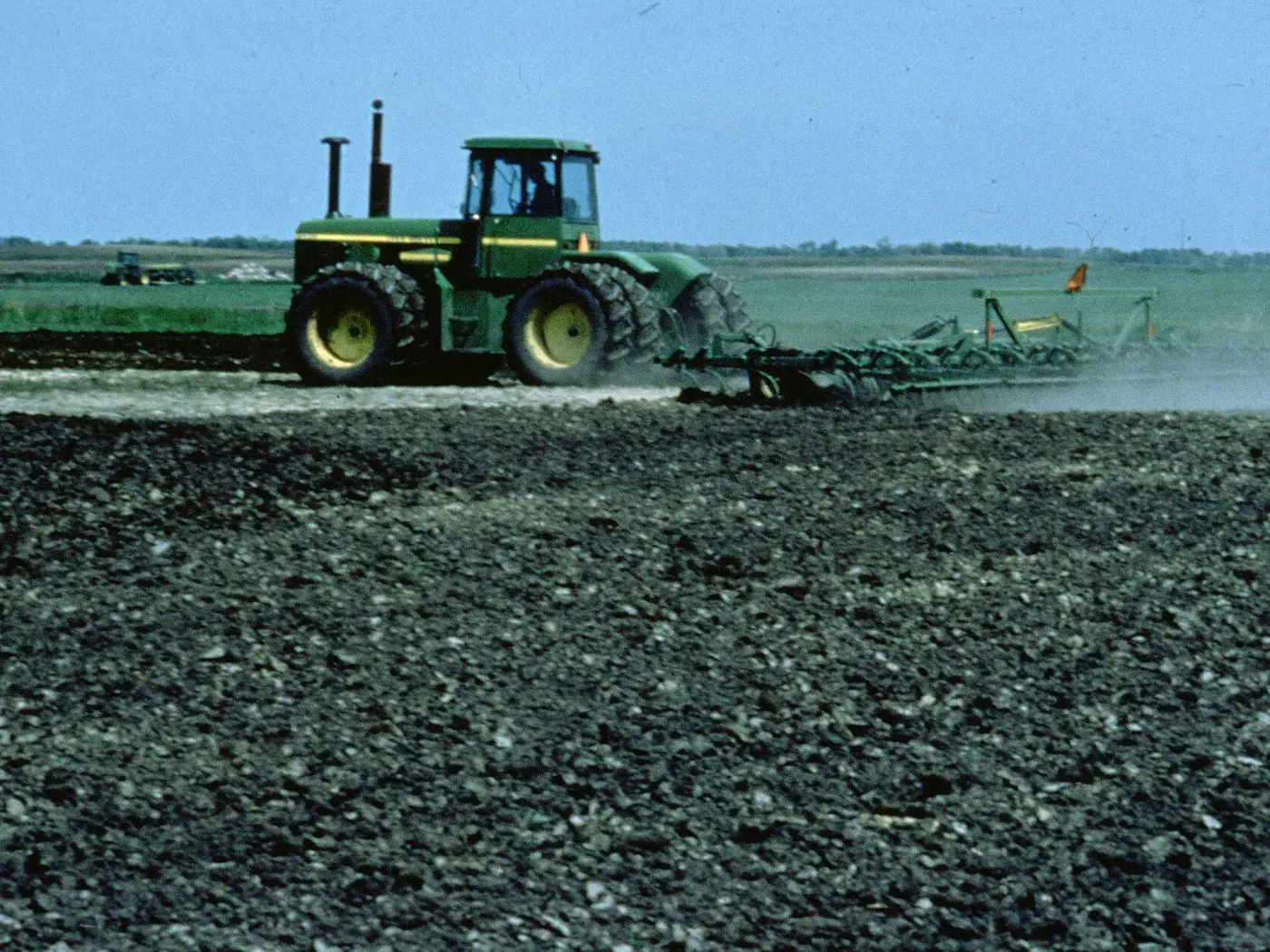
Field efficiency varies with field shape, size, obstacles, operator skill and how often you need to refill seed, fertiliser or spray. Small, irregular fields with many turns have lower efficiency than large rectangular fields. The ranges below, based on agricultural engineering standards, are useful starting points.
These speeds and efficiencies come from typical field conditions. Wet soil, steep slopes, small irregular fields and frequent stops for refilling all push efficiency towards the lower end of each range. Recording your own speed and the acres actually completed during a full day gives you a personal efficiency figure that makes future planning and custom pricing much more reliable.
Upgrading to a wider implement or adding GPS guidance to reduce overlap can raise field capacity more than driving faster, which often increases fuel use and wear. Regular maintenance, well-planned headland turns and keeping seed, fertiliser or spray tanks topped up from a nearby tender all reduce downtime and push your real-world efficiency towards the top of these ranges.
| Operation | Typical speed | Field efficiency |
|---|---|---|
| Moldboard plow | 3–6 mph | 74–85% |
| Disc harrow | 3.5–6 mph | 77–90% |
| Row crop planter | 4–7 mph | 50–75% |
| Boom sprayer | 6–10 mph | 50–80% |
| Mower / conditioner | 3–6 mph | 75–85% |
| Combine harvester | 2–5 mph | 65–80% |
Using Field Capacity to Plan Work
Once you know acres per hour, you can estimate how many days a job will take, whether you need a second machine and how much fuel and labour to budget. For example, if planting must be finished in a five-day window and you can plant 15 acres per hour for 10 hours a day, one planter covers about 750 acres. Contractors also use field capacity to set per-acre custom rates that fairly cover their machine and labour costs.
Effective Width and Overlap
The width you enter should be the effective working width, not the advertised width of the machine. Sprayers and spreaders often overlap passes to avoid gaps, while mowers and tillage tools may overlap by several inches. For example, a 30 ft sprayer driven with a 1 ft overlap covers only 29 ft per pass. GPS guidance and auto-steer reduce overlap, effectively increasing field capacity. Measuring the distance between passes in the field is the best way to find your true width for the acres per hour calculator.
Estimating Daily and Seasonal Capacity
To find how much you can cover in a day, multiply acres per hour by the hours you realistically work, allowing time for travel between fields, maintenance and breaks. For seasonal planning, multiply daily capacity by the number of suitable working days, which depends on weather and soil conditions. Many farm planners assume only 50–70 % of calendar days are workable in spring. These numbers help decide whether one machine is enough or whether a larger implement or second operator would pay off.
Tips for Accurate Estimates
- Measure real speed.Use GPS or time a measured distance rather than trusting the dashboard.
- Use effective width.Subtract overlap – a 30 ft sprayer with 1 ft overlap covers 29 ft.
- Be realistic about efficiency.Include turns, refills and short breaks.
- Plan headlands.Efficient turning patterns can raise efficiency noticeably.
- Compare machines.A wider implement at lower speed may outperform a narrow one at high speed.
- Track actual results.Compare predictions with real acres completed to refine your efficiency value.
Why Field Capacity Matters
Timeliness is critical in farming: planting, spraying and harvesting all have narrow windows. Knowing your machinery’s capacity helps you finish on time, avoid buying more equipment than you need and price custom work accurately. An acres per hour calculator turns basic machine data into practical planning numbers.
Who Can Use This Tool?
This tool is for farmers, custom operators, landscapers, groundskeepers, agricultural students and machinery dealers. It works on mobile in the field.
Note: This acres per hour calculator provides estimates. Actual field capacity depends on conditions, terrain and operator skill.
Frequently Asked Questions
How do you calculate acres per hour?
Multiply speed in mph by working width in feet and field efficiency, then divide by 8.25.
What is field efficiency?
The percentage of time a machine is actually working, after allowing for turns, overlaps, refilling and other stops.
What does the 8.25 constant mean?
It converts mph × feet into acres per hour: 43,560 square feet per acre divided by 5,280 feet per mile.
How many acres per hour can a 15 ft mower cut?
At 5 mph and 80 % efficiency, about 7.3 acres per hour.
Does speed or width matter more?
Both have an equal effect in the formula; doubling either doubles capacity.
Can I use metric units?
Yes. Choose km/h and metres; the calculator converts them automatically.