
Mare Gestation Calculator
Estimate the foaling date and plan care through your mare’s 11-month pregnancy.
Your Results
Enter your values and press Calculate to see your results.
What Is a Mare Gestation Calculator?
A mare gestation calculator predicts when your mare is likely to foal based on her breeding or ovulation date. Horses have one of the longest pregnancies among farm animals – about 340 days, or roughly 11 months – and the normal range is wide. Many healthy mares foal anywhere from 320 to 370 days after breeding, and some individuals foal at a similar point every year.
Enter the last breeding date and the calculator gives the expected foaling date, the earliest and latest likely dates, the days in foal today and a timeline of ultrasound checks, vaccinations and foaling preparations.
How to Use the Mare Gestation Calculator
- Enter the last breeding, AI or ovulation date.
- Press Calculate.
- Read the expected foaling date and the normal foaling window.
- Use the timeline to book ultrasound scans and vaccinations with your vet.
- Check her records: if she foaled early or late before, she may do so again.
How the Foaling Date Is Calculated
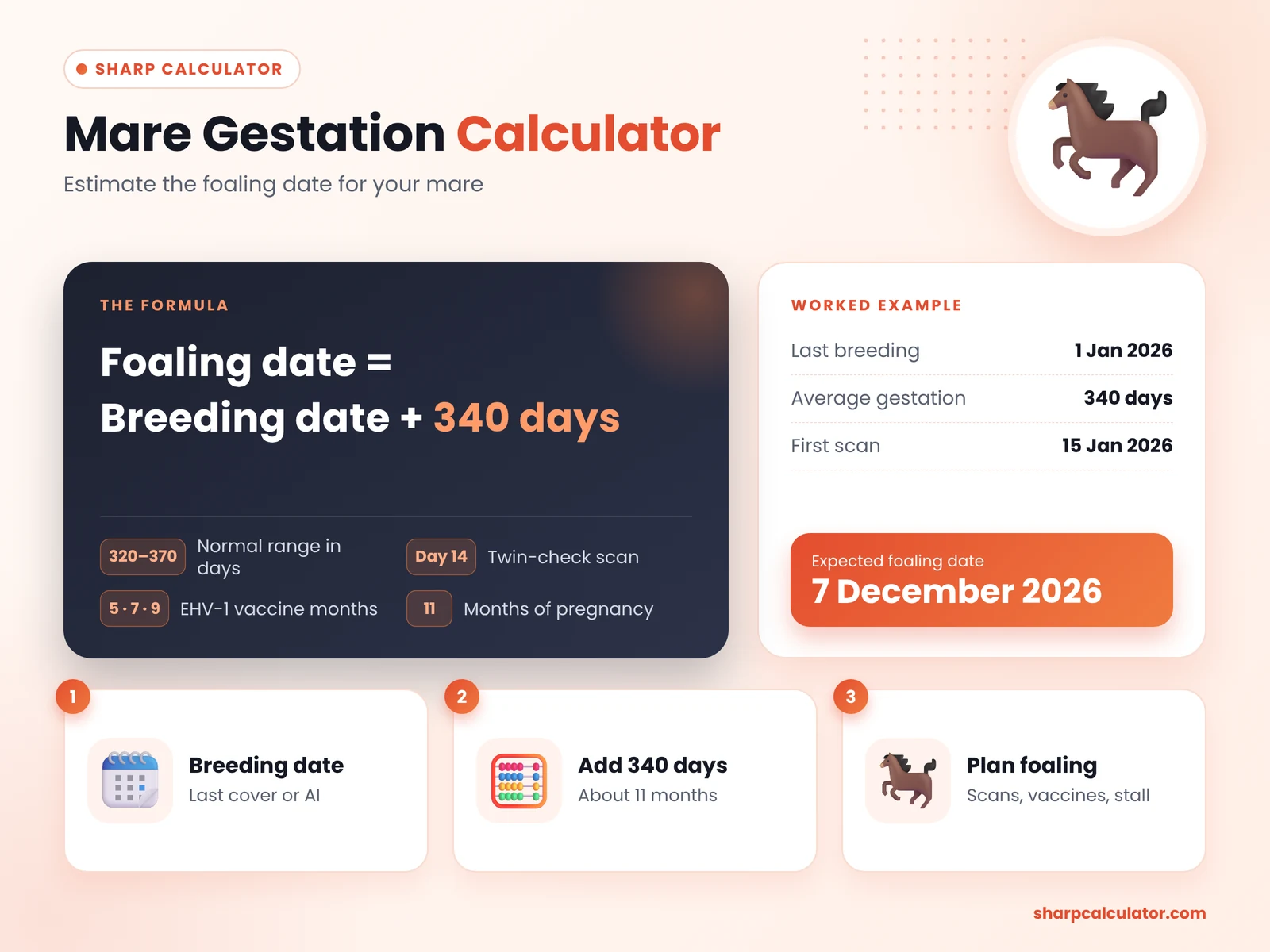
The mare gestation calculator adds the average equine pregnancy length to the last breeding date.
Foaling date = Last breeding date + 340 days- Average gestation – 340 days (about 11 months)
- Normal range – 320 to 370 days
- Premature – foals born before day 320 often need extra care
- Season effect – mares bred early in the year often carry a little longer
A quick rule of thumb: subtract one month and add five days to the breeding date, then move forward one year. For example, a breeding on 1 May gives an estimated foaling date of about 6 April the next year.
Worked example
A mare was bred on 1 January 2026.
Adding 340 days gives an expected foaling date of 7 December 2026. Plan her first twin-check ultrasound around 15 January and her EHV-1 vaccines around months five, seven and nine.

Mare Pregnancy Month by Month
Early pregnancy checks matter most in horses because twin pregnancies are dangerous for both mare and foals, so vets scan at day 14–16 to detect and manage twins. The foal grows slowly for the first six months; most of its weight is gained in the last trimester, when the mare’s nutrition needs rise sharply.
During the final three months, the mare’s energy, protein and mineral needs rise significantly. A balanced ration designed for broodmares, steady exercise and regular dental and hoof care help her stay in good condition and support a strong, healthy foal.
Each mare tends to follow her own pattern, so records from previous pregnancies are valuable. A mare that foaled at 350 days last year is likely to carry a similar length again, which helps you plan foal watch more precisely than averages alone. Keep up regular hoof trimming, dental checks and gentle exercise throughout pregnancy, and discuss a deworming and vaccination plan with your vet so both mare and foal stay healthy right up to foaling.
| Month | What happens |
|---|---|
| 1 | Pregnancy confirmed by ultrasound; twin check |
| 2–3 | Heartbeat and fetal sex can be seen |
| 4–6 | Steady growth; EHV-1 vaccine at month 5 |
| 7–9 | Rapid growth; EHV-1 vaccines at months 7 and 9 |
| 10 | Pre-foaling boosters; udder starts to develop |
| 11 | Waxing of teats; foaling |
Signs Your Mare Will Foal Soon
- Udder enlarges 2–4 weeks before foaling
- Muscles around the tail head relax and soften
- Teats fill and drops of wax (“waxing up”) appear 24–48 hours before foaling
- Milk calcium rises – foaling test strips can help predict the night
- Restlessness, sweating and frequent lying down when labour starts
Most mares foal at night and the second stage of labour is fast – the foal should be delivered within about 20–30 minutes of the water breaking. Call your vet immediately if progress stalls, if a red velvety bag appears first (“red bag delivery”), or if the placenta is not passed within three hours.
Caring for the Mare After Foaling
After a normal birth, the foal should stand within about one hour and nurse within two hours. Make sure it drinks plenty of colostrum, the antibody-rich first milk, in the first 12 hours; many vets check the foal’s IgG level at 12–24 hours to confirm passive transfer. Keep the placenta for your vet to inspect, because a missing piece can cause serious infection in the mare. Most mares come back into “foal heat” seven to ten days after foaling, which some breeders use to rebreed for the next season.
Tips for Caring for a Pregnant Mare
- Scan early for twins.An ultrasound at day 14–16 is the best time to detect and manage twins.
- Follow a vaccine plan.Discuss EHV-1 and pre-foaling boosters with your vet to protect mare and foal.
- Increase nutrition late.Energy, protein and mineral needs rise in the last three months.
- Avoid fescue pasture.Endophyte-infected tall fescue can cause prolonged pregnancy and thick placentas in late gestation.
- Prepare the foaling area.A large, clean, well-bedded stall or small paddock reduces infection risk.
- Watch for waxing.Foaling alarms or cameras help you be present for a fast delivery.
Why the Foaling Date Matters
Horse pregnancies are long and foaling happens quickly, often at night. Knowing the expected date helps you schedule scans and vaccines, adjust feeding and arrange foal watch. Because the normal window is about seven weeks wide, a mare gestation calculator is most useful when combined with close observation of udder and behaviour changes in the final month.
Who Can Use This Tool?
This tool helps horse owners, breeders, stud managers, equine vets and students. It works on mobile in the barn and on desktop in the office.
Note: This mare gestation calculator gives an estimate. Pregnancy length varies widely in horses – always follow your veterinarian’s advice.
Frequently Asked Questions
How long is a horse pregnant?
About 340 days, or roughly 11 months. Healthy foals are commonly born between 320 and 370 days.
Can a mare be overdue?
Yes. Many mares go past 340 days without problems, but if she passes 370 days or shows unusual signs, contact your vet.
When should I scan my mare for pregnancy?
Most vets scan at 14–16 days to check for twins, then again around day 25–30 to confirm a heartbeat.
What vaccines does a pregnant mare need?
Many vets recommend EHV-1 vaccines at months 5, 7 and 9, plus core boosters 4–6 weeks before foaling.
Can I tell the sex of the foal?
An experienced vet can often determine fetal sex by ultrasound between about day 60 and 70, or later by transabdominal scan.
Do mares usually foal at night?
Yes. Most mares foal between late evening and early morning when the stable is quiet.