
Grain Bin Calculator
Work out the bushels and tons stored in a round grain bin.
Your Results
Enter your values and press Calculate to see your results.
What Is a Grain Bin Calculator?
A grain bin calculator estimates how many bushels of grain are stored in a round bin. Farmers use it to track inventory, plan marketing, check scale tickets, manage aeration and estimate the value of stored grain. You only need the bin diameter and the grain depth, plus the peak height if the grain is coned rather than levelled.
Enter the measurements and choose the grain type. The calculator returns the number of bushels, the weight in US tons and metric tonnes, the volume in cubic feet and the bushels per foot of depth – handy for quick checks when you measure the grain level through the roof hatch.
How to Use the Grain Bin Calculator
- Measure the inside diameter of the bin in feet.
- Measure the grain depth from the floor to the level surface (or to the eave for a full bin).
- If the grain is peaked, measure the peak height above the level surface.
- Choose the grain type to use the right test weight.
- Press Calculate to see bushels and tons.
Grain Bin Capacity Formula
The grain bin calculator treats the stored grain as a cylinder plus an optional cone on top.
Volume = π × r² × depth + π × r² × peak ÷ 3Bushels = Volume (ft³) ÷ 1.2445- r – bin radius (diameter ÷ 2) in feet
- Depth – height of the level grain
- Peak – height of the cone above the level surface
- 1.2445 ft³ – one standard bushel (or multiply by 0.8036)
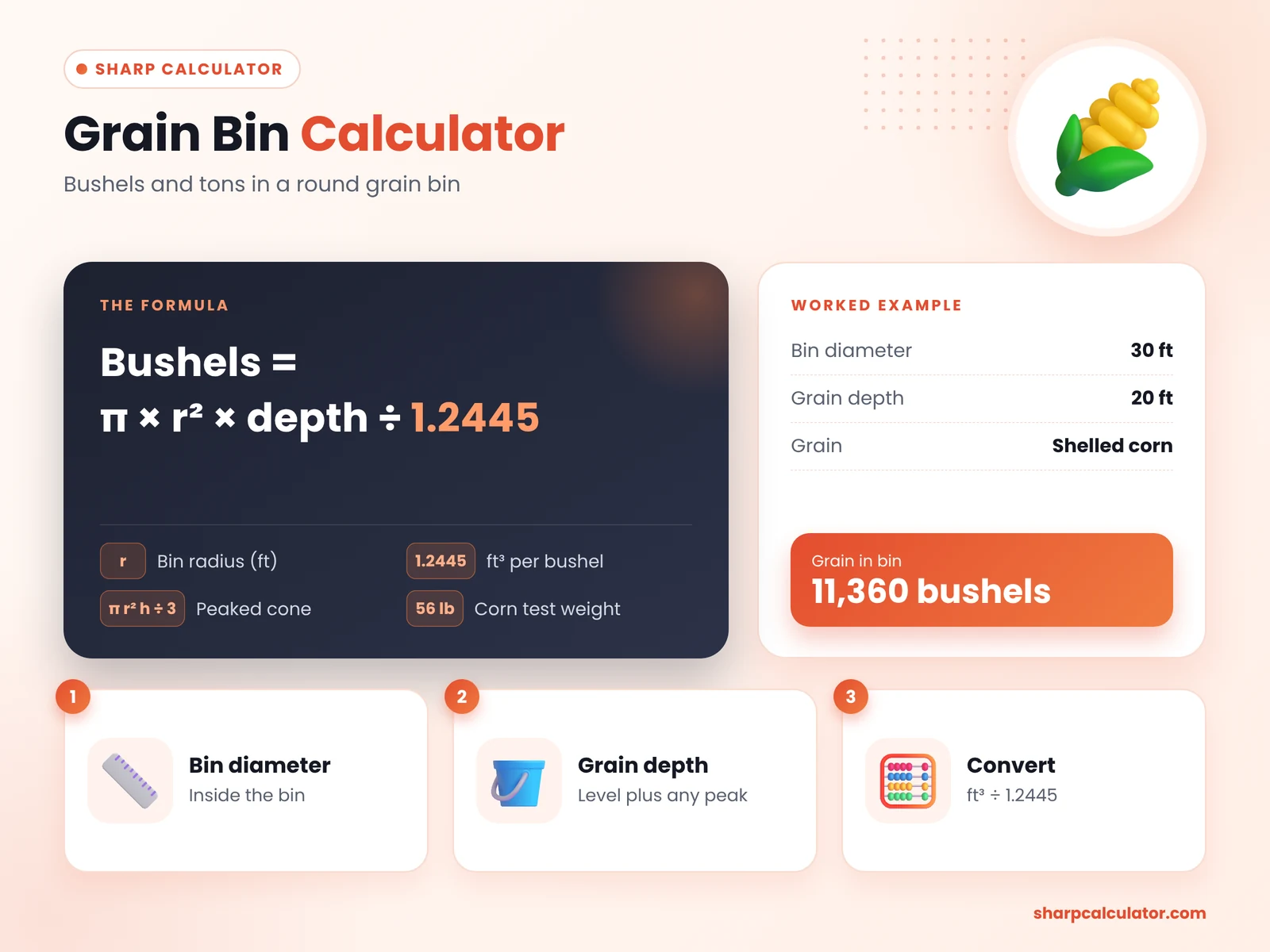
This calculates volume in standard bushels. Grain packs down in tall bins, so actual bushels can be several percent higher than the calculated volume, especially in large, deep bins.
Worked example
A 30 ft diameter bin holds corn levelled at 20 ft deep.
Volume = 3.14 × 15² × 20 = 14,137 ft³. Bushels = 14,137 ÷ 1.2445 = 11,360 bushels, which weighs about 318 US tons at 56 lb per bushel.
Standard Test Weights for Grain
Test weight is the weight of a standard bushel of grain and is used to convert bushels to weight. Actual test weight varies with grain quality and moisture; lower test weight grain may sell at a discount.
Moisture also affects weight. Corn is usually traded at 15.5 % moisture, so wetter grain weighs more per bushel of dry matter and will shrink as it dries. If you are estimating value or comparing bin contents with scale tickets, adjust for moisture and remember that fines and broken kernels pack more tightly than clean grain.
Keep stored grain cool, dry and level. Running aeration fans to hold grain temperature close to the outside average, removing fines from the centre core and checking the bin every two weeks help prevent spoilage, crusting and insect problems throughout the storage season. Monitoring cables that measure temperature at several depths give early warning of hot spots, and good records of what went into each bin make marketing and insurance much easier.
| Grain | Standard test weight | Bushels per US ton |
|---|---|---|
| Corn (shelled) | 56 lb/bu | 35.7 |
| Soybeans | 60 lb/bu | 33.3 |
| Wheat | 60 lb/bu | 33.3 |
| Sorghum | 56 lb/bu | 35.7 |
| Barley | 48 lb/bu | 41.7 |
| Oats | 32 lb/bu | 62.5 |
Grain Bin Safety
Never enter a grain bin while unloading equipment is running, and avoid entering at all when possible. Flowing grain can bury a person in seconds, and crusted or bridged grain can collapse without warning. Use a lifeline, work with a trained observer outside the bin and lock out all equipment before entry. Measuring grain depth from the roof hatch with a weighted tape or a sensor is far safer than entering the bin.
Keeping Stored Grain in Condition
- Dry grain to safe storage moisture before binning
- Level the grain surface and remove fines from the centre core
- Run aeration fans to keep grain temperatures cool and uniform
- Check grain temperature and condition every two weeks
- Watch for crusting, odours or insect activity
Estimating Partly Filled and Coned Bins
When a bin is being emptied, the grain often forms an inverted cone (a funnel) in the centre. Measure the depth at the wall and at the centre, treat the level portion as a cylinder up to the lower measurement and subtract the volume of the inverted cone. For peaked bins, the cone on top can add a large amount: a 30 ft bin with a 7 ft peak holds roughly 1,300 extra bushels. Enter the peak height in the grain bin calculator to include it automatically.
Measuring Tips
- Measure inside diameter.Use the interior, not the outside of the corrugations.
- Measure depth carefully.Check several points if the surface is uneven.
- Account for the peak.Peaked bins can hold thousands of extra bushels.
- Use correct test weight.Different grains have different standard weights.
- Allow for packing.Tall bins may hold more than calculated.
- Stay safe.Measure from outside the bin whenever possible.
Why Calculate Grain Bin Capacity?
Stored grain is a valuable asset. Knowing how many bushels you have helps with marketing decisions, insurance, loan collateral, feed planning and checking that sales match what was in the bin. A grain bin calculator gives quick, consistent numbers from a few simple measurements.
Who Can Use This Tool?
This tool is for grain farmers, elevator staff, crop insurers, agricultural lenders and agriculture students. It works on a phone in the yard.
Note: This grain bin calculator estimates volume in standard bushels. Packing, moisture and test weight affect the true quantity.
Frequently Asked Questions
How many bushels are in a grain bin?
Multiply π × radius² × grain depth to get cubic feet, then divide by 1.2445 to get bushels.
How many bushels does a 30 ft bin hold per foot?
About 568 bushels per foot of depth.
How do I calculate a peaked grain bin?
Add the volume of the cone: π × r² × peak height ÷ 3, then convert to bushels.
How many cubic feet are in a bushel?
One standard bushel is about 1.2445 cubic feet.
How much does a bushel of corn weigh?
The standard test weight is 56 lb per bushel.
Why does my bin hold more than calculated?
Grain packs under its own weight in tall bins, increasing the amount stored.