
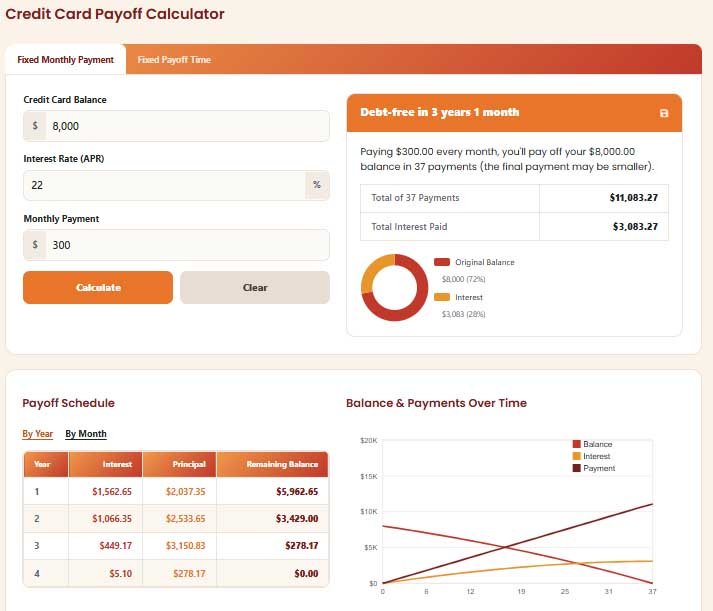
Payoff Schedule
| Year | Interest | Principal | Remaining Balance |
|---|
Balance & Payments Over Time
What is a credit card payoff calculator?
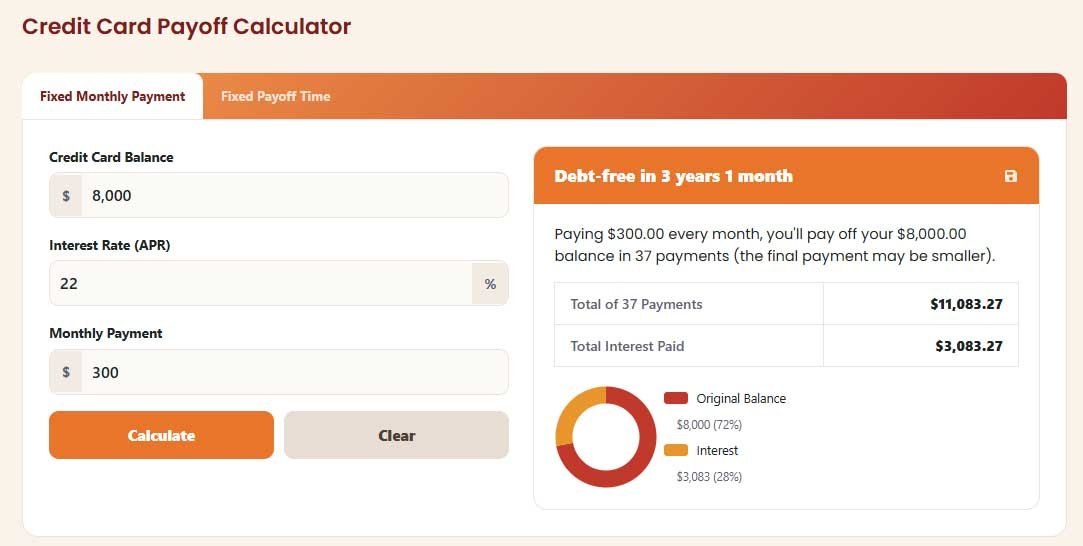
A Credit Card Payoff Calculator shows how long it will take to clear a credit card balance and how much interest you will pay along the way. It has two modes: enter a fixed monthly payment to see your payoff date, or enter a payoff time to see the monthly payment you need. It is built for one card at a time; if you have several debts, use the Debt Payoff Calculator.
How to use it
- Choose Fixed Monthly Payment or Fixed Payoff Time.
- Enter your card balance and its APR.
- Enter the monthly payment you can make, or the number of years and months in which you want to be debt-free.
- Click Calculate to see your payoff time or required payment, total interest and a schedule. Stop using the card while you pay it down, or the estimate will be too optimistic.
Credit card payoff formula
n = −ln(1 − r × B ÷ P) ÷ ln(1 + r)
where n is the number of monthly payments, B is the balance, r is the monthly interest rate (APR ÷ 12) and P is the monthly payment. Card issuers usually calculate interest on your average daily balance, so your statement may differ slightly.
Example: $5,000 at 22% APR
| Monthly payment | Time to pay off | Total interest |
|---|---|---|
| $150 | about 52 months | about $2,800 |
| $250 | about 26 months | about $1,286 |
| $400 | about 15 months | about $732 |
Going from $150 to $250 a month cuts the payoff time in half and saves about $1,500 in interest.
Tips to pay off a card faster
- Pay more than the minimum. Minimum payments are designed to keep you paying for years.
- Stop adding new charges to the card you are paying down.
- Ask your issuer for a lower APR; a good payment history helps.
- A balance transfer or consolidation loan can lower the rate, but check the fees and the rate after any promotional period.
- Pay on time every month to avoid late fees and penalty rates.
Factors That Affect Your Credit Card Payoff
Several factors can change how quickly you repay credit card debt. Understanding these factors can help you make better use of a payoff calculator.
- Outstanding balance: A larger balance generally requires more time or larger payments to eliminate.
- APR: A higher interest rate can increase the cost of carrying a balance.
- Monthly payment: Paying more than the minimum can generally shorten the repayment period.
- New purchases: Continuing to use a card while paying it down can slow your progress.
- Fees: Late fees and other charges can increase the amount you owe.
- Payment timing: The way interest and payments are calculated can affect the final payoff amount.
- Number of cards: Managing multiple balances can require a more organized repayment strategy.
Because these factors can change over time, it is helpful to update your calculations whenever your balance, interest rate, or payment amount changes.
How to Use a Credit Card Payoff Calculator
Using the calculator is straightforward. Start by entering your current credit card balance. Next, enter the card’s annual percentage rate and the amount you plan to pay each month.
The calculator can then estimate the number of payments required and the potential interest cost under the entered assumptions. Try several monthly payment amounts to see how they affect your payoff timeline.
If you have multiple cards, repeat the calculation for each account or use a calculator designed to handle multiple balances. This can give you a clearer picture of your overall debt repayment plan.
Frequently Asked Questions
It depends on your balance, APR and payment. For example, a $5,000 balance at 22% APR takes about 52 months at $150 a month, about 26 months at $250 and about 15 months at $400.
It uses standard monthly compounding and assumes no new charges or fees. Most issuers calculate interest on your average daily balance, so your real payoff may differ by a payment or two.
The snowball method, paying the smallest balance first, mainly helps with motivation when you have several cards. If you have only one card, simply pay as much as you can each month. With several cards, paying the highest-APR card first (the avalanche method) usually saves the most interest. The Debt Payoff Calculator compares both.
This calculator handles one card at a time. To plan several cards together, with snowball or avalanche ordering, use the Debt Payoff Calculator.
Generally, paying down the balance faster can reduce the amount of time interest accrues and may lower total interest costs. The exact savings depend on your card’s APR and interest calculation method.
Disclaimer: This calculator gives estimates for general information only. It is not financial, tax or legal advice. Results depend on the numbers you enter and on simplified assumptions, so your actual figures may differ. Check important decisions with a qualified professional or the official source.
Related Calculators
If you are working on more than one debt, these calculators can help you plan.
Written by Sharp Calculator Team — we build and test every calculator on this site, checking each formula against hand-worked examples and official sources. Last updated: October 2026.