
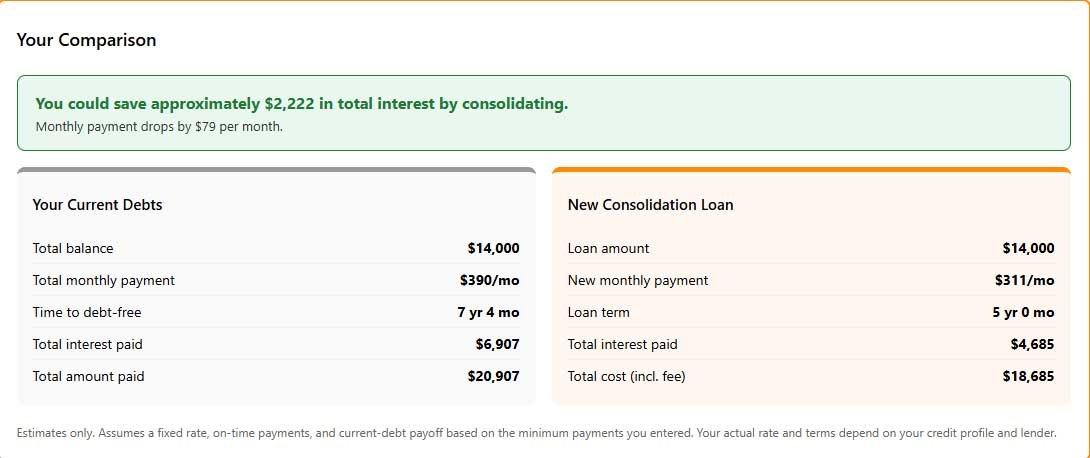
Your Comparison
Your Current Debts
New Consolidation Loan
Debt Consolidation Calculator
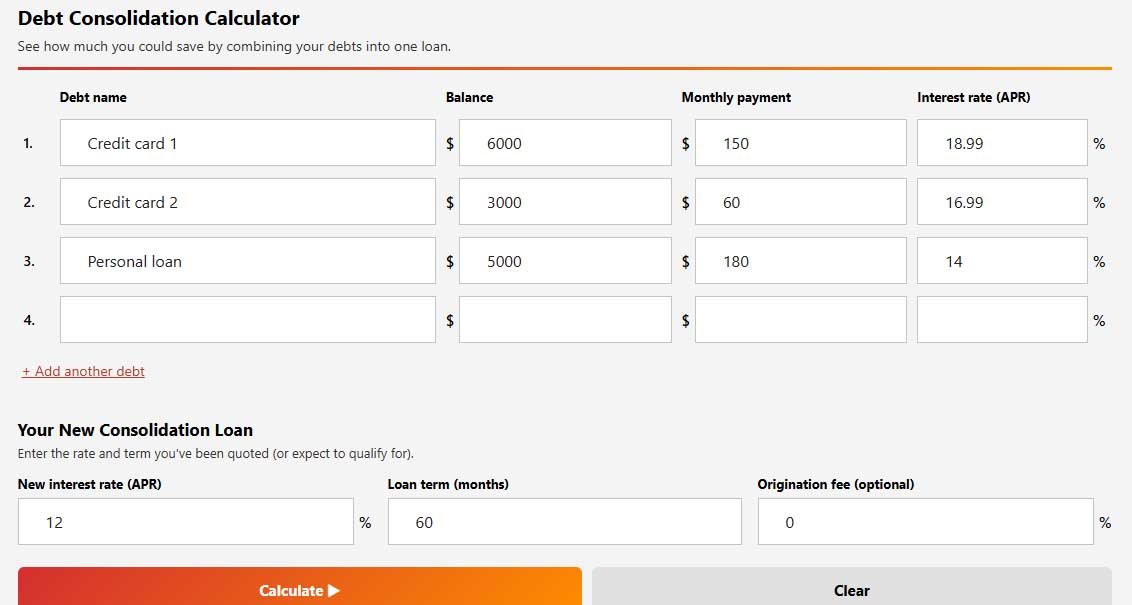
Managing several debts at the same time can make monthly finances difficult to organize. Different balances, interest rates, and payment due dates can make it hard to know exactly how much you are paying and when you will become debt-free. A Debt Consolidation Calculator helps you estimate what your payments could look like if multiple debts were combined into one loan.
By entering your total debt, estimated interest rate, and repayment term, you can compare your current payments with a potential consolidation loan. This can help you understand the possible monthly payment, total interest, and repayment period before considering a consolidation option.
How Does a Debt Consolidation Calculator Work?
A Debt Consolidation Calculator estimates the payment for a loan used to combine multiple existing debts. Instead of making separate payments on credit cards, personal loans, or other qualifying debts, consolidation may replace them with one monthly payment.
The calculator generally uses your total debt amount, estimated consolidation rate, and loan term. You can change these figures to compare different scenarios and see how the monthly payment and overall borrowing cost may change.
For example, if you have several credit cards with different interest rates, you can enter the combined balance and an estimated consolidation rate. The result can give you a starting point for deciding whether a consolidation loan is worth exploring.
Debt Consolidation Loan Formula
The monthly payment for an installment loan can be estimated using:
M = P × [r(1 + r)ⁿ] ÷ [(1 + r)ⁿ − 1]
Where:
M = monthly payment
P = loan principal
r = monthly interest rate
n = total number of monthly payments
The actual payment offered by a lender may differ because of fees, credit profile, loan terms, and other factors.
Debt Consolidation Monthly Payment Calculator
A Debt Consolidation Monthly Payment Calculator is useful when your main goal is to estimate how much you might pay each month after combining debts. Monthly payment is one of the most important factors to consider because a lower payment does not necessarily mean the loan will cost less overall.
A longer repayment term can reduce the required monthly payment, but you may pay interest for a longer period. A shorter term can increase the monthly payment while potentially reducing the total interest paid.
For this reason, it is helpful to compare several loan terms instead of focusing only on the smallest monthly payment. A calculator lets you test different amounts and repayment periods before making a decision.
Debt Consolidation Rates and Loan Costs
Debt consolidation rates have a major effect on the cost of borrowing. Your available rate may depend on factors such as credit history, income, debt-to-income ratio, loan amount, repayment term, and lender requirements.
If your existing credit card debt has relatively high interest rates, a consolidation loan with a lower rate could potentially reduce interest costs. However, this depends on the actual rate and terms you qualify for.
A low monthly payment can sometimes be misleading if the repayment period is extended significantly. Always compare the interest rate, loan term, fees, monthly payment, and total repayment amount together.
$30,000 Debt Consolidation Loan Calculator
A $30,000 debt consolidation loan calculator can help borrowers understand what different loan terms might look like for a $30,000 balance. Instead of assuming that one payment amount will work, you can compare several interest rates and repayment periods.
For example, a $30,000 consolidation loan could have very different monthly payments depending on whether it is repaid over three, five, or seven years. The interest rate also has a significant impact on the final cost.
If you are considering consolidating $30,000 of credit card or personal debt, use the calculator to test realistic rates and terms rather than using only the best advertised rate. This gives you a more useful estimate based on the circumstances you may actually qualify for.
How Much Is the Payment on a $50,000 Consolidation Loan?
The payment on a $50,000 consolidation loan depends on the interest rate and repayment term. There is no single monthly payment that applies to every borrower.
For example, a $50,000 loan repaid over a shorter period will generally require higher monthly payments than the same amount spread across a longer term. However, extending the term can result in more interest being paid over the life of the loan.
A Debt Consolidation Calculator allows you to enter the $50,000 balance and compare different rates and terms. This makes it easier to see which repayment scenario may fit your budget.
Free and Best Debt Consolidation Calculators
A Free Debt Consolidation Calculator can provide a convenient way to compare loan scenarios without manually performing complex calculations. You can change the balance, interest rate, and repayment term to see how each factor affects the estimated payment.
People often search for the best debt consolidation calculator or best free debt consolidation loan calculator when comparing online financial tools. The most useful calculator is one that clearly shows the monthly payment, total repayment, interest cost, and assumptions used in the calculation.
A calculator should be treated as a planning tool rather than a guarantee of loan approval or a specific rate. Actual loan offers depend on the lender and your individual financial circumstances.
Wells Fargo and Regions Debt Consolidation Calculators
Searches such as Wells Fargo debt consolidation calculator and Debt consolidation calculator Regions often come from people researching consolidation options from specific financial institutions.
A calculator can help you understand the mathematics behind a consolidation loan, regardless of which lender you eventually consider. However, lender-specific offers can include different rates, fees, eligibility requirements, and repayment terms.
When comparing lenders, look beyond the monthly payment. Check the annual percentage rate, origination or other fees, repayment period, and total amount you would repay. This provides a more complete comparison than choosing a loan based only on its advertised payment.
How to Pay $30,000 Debt in One Year?
Paying off $30,000 of debt in one year requires a significant repayment amount. Before considering interest, dividing $30,000 across 12 months equals $2,500 per month. With interest and possible fees included, the required payment could be higher.
Whether this goal is realistic depends on your income, essential expenses, interest rates, and other financial obligations. A calculator can help you estimate the payment needed for a one-year target and compare it with longer repayment periods.
If the required payment is too high, extending the repayment period may make the monthly obligation more manageable. However, a longer term can increase the total interest cost, so both affordability and total repayment should be considered.
Frequently Asked Questions
The monthly payment depends on the interest rate and repayment term. A calculator can show different payment scenarios by changing these two factors.
You would need to make substantial monthly payments. Before interest, $30,000 divided over 12 months is $2,500 per month, but the actual amount may be higher once interest and fees are considered.
The main concern is that consolidation may change the structure of the debt without addressing spending habits. If new debt is accumulated afterward, consolidation may not solve the underlying problem.
Start by listing your balances, interest rates, and minimum payments. You can then compare strategies such as aggressive repayment, debt consolidation, or other debt-management options based on your financial situation.
It can provide a useful estimate based on the information entered. Actual loan payments can differ because lenders may offer different rates, fees, and terms.
Related Calculator:
Explore more financial tools designed to simplify your calculations. Whether you’re planning a mortgage, estimating an auto loan, calculating taxes, or tracking investment growth, our free calculators provide fast and accurate results to help you make smarter financial decisions.