
See how much of your income goes toward debt each month, and what lenders will think of it.
What is a debt-to-income ratio calculator?
A Debt-to-Income Ratio Calculator works out what share of your gross (before-tax) income goes to debt payments each month. Lenders check this number, called your DTI, before approving a mortgage, car loan or personal loan, so knowing it in advance helps you see where you stand and what to improve.
How to use it
- Enter every source of income before tax: salary, pension and Social Security, investment income and any other regular income. Pick per year or per month for each.
- Enter your housing costs: rent or mortgage, property tax, HOA fees and home insurance.
- Enter your other debt payments: credit cards, student loans, auto loans and other loans or obligations such as alimony.
- Click Calculate to see your front-end (housing) and back-end (total) DTI.

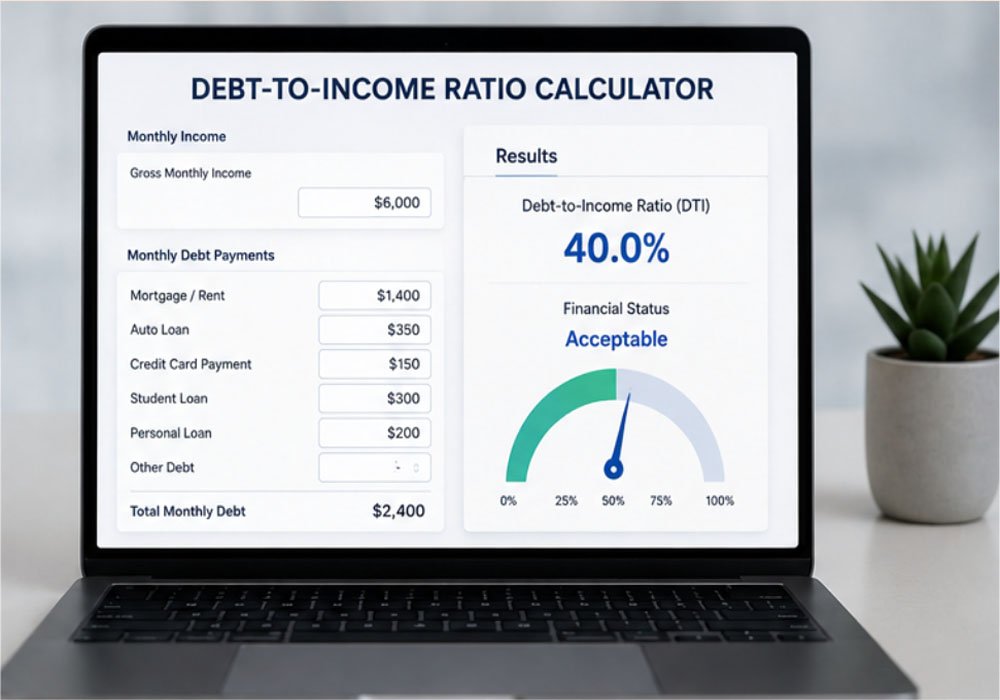
What is a debt-to-income ratio?
Your DTI is the percentage of your gross monthly income that goes toward monthly debt payments.
DTI = Total monthly debt payments ÷ Gross monthly income × 100
Example
You earn $5,000 a month before tax. Your mortgage payment with tax and insurance is $1,200, your car loan is $300 and your minimum card payments total $100.
- Front-end DTI: $1,200 ÷ $5,000 = 24%
- Back-end DTI: ($1,200 + $300 + $100) ÷ $5,000 = $1,600 ÷ $5,000 = 32%
Types of debt-to-income ratios
Lenders look at two versions of the ratio.
Front-end ratio
The front-end or housing ratio counts only housing costs: mortgage or rent, property tax, home insurance, HOA fees and mortgage insurance.
Back-end ratio
The back-end ratio adds every other recurring debt payment: credit cards, car loans, student loans, personal loans, child support and alimony. Most lenders focus on this one.
Common guideline: the 28/36 rule
| Ratio | Common guideline |
|---|---|
| Front-end (housing) | 28% or less |
| Back-end (all debts) | 36% or less |
This is a rule of thumb, not a law. As the Consumer Financial Protection Bureau notes, different loan products and lenders have different DTI limits, so check with your lender (source: consumerfinance.gov).


How to lower your DTI
- Pay down the debts with the highest monthly payments first, such as a card with a large minimum.
- Avoid new loans or credit card balances before applying for a mortgage.
- Increase your income if you can, for example with a raise or extra work you can document.
- Refinancing or consolidating may lower your monthly payments, but check the total cost.
Frequently Asked Questions
A common guideline is 36% or less for total debt and 28% or less for housing. Lenders set their own limits, which vary by loan type, so a higher DTI may still be accepted in some cases.
Yes. Credit card payments, car loans, student loans, personal loans, mortgage payments, and other recurring debts should all be included.
Mortgage lenders use DTI to determine whether borrowers can comfortably afford monthly mortgage payments alongside their existing financial obligations.
Yes. Paying off debt, increasing your income, avoiding new loans, and refinancing high-interest debt are common ways to lower your DTI.
Not directly. However, lowering debt can improve your overall financial profile, which may positively affect factors related to your credit health.
Disclaimer: This calculator gives estimates for general information only. It is not financial, tax or legal advice. Results depend on the numbers you enter and on simplified assumptions, so your actual figures may differ. Check important decisions with a qualified professional or the official source.
Related Calculators
To improve your ratio or see what you can afford, try these calculators.
Written by Sharp Calculator Team — we build and test every calculator on this site, checking each formula against hand-worked examples and official sources. Last updated: October 2026.