
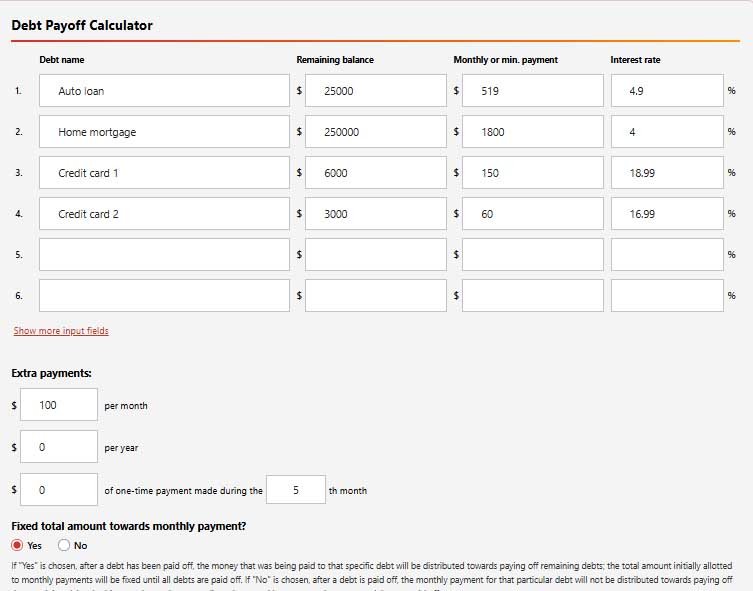
If "Yes" is chosen, after a debt has been paid off, the money that was being paid to that specific debt will be distributed towards paying off remaining debts; the total amount initially allotted to monthly payments will be fixed until all debts are paid off. If "No" is chosen, after a debt is paid off, the monthly payment for that particular debt will not be distributed towards paying off the remaining debts. In this case, the total amount allotted to monthly payments decreases as debts are paid off.
Your Debt Payoff Summary
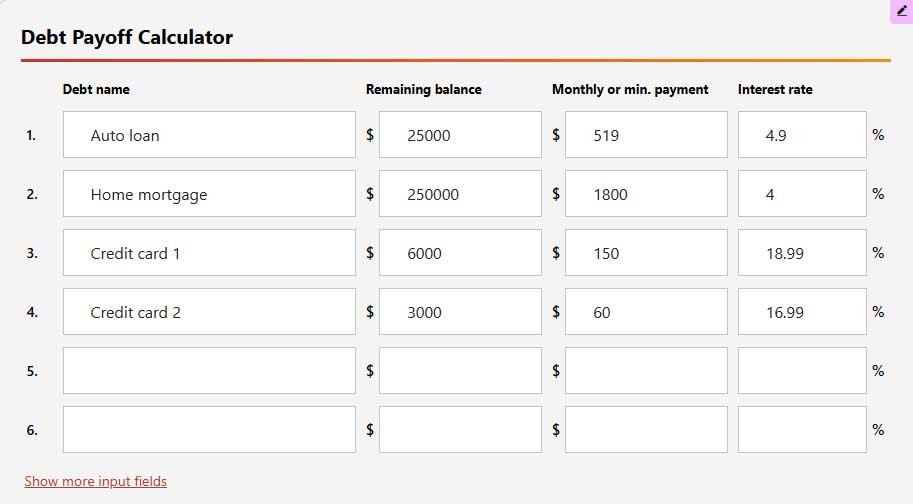
Debt Payoff Calculator
Paying off debt can feel overwhelming when you have multiple balances, different interest rates, and monthly payments to manage. A Debt Payoff Calculator helps you estimate how long it may take to become debt-free and how much you could pay in interest along the way.
By entering your current debt balance, interest rate, and planned monthly payment, you can compare different repayment scenarios. The calculator can also help you understand how extra payments or different debt repayment strategies may change your payoff timeline.
Why Use a Debt Payoff Calculator?
A debt payoff calculator provides a clearer picture of your repayment progress instead of relying on guesswork. It can be especially helpful when you want to set a specific debt-free target.
- Estimate your debt-free date based on your current payment.
- Calculate potential interest costs over the repayment period.
- Compare different monthly payment amounts.
- See the impact of extra payments.
- Evaluate snowball and other repayment strategies.
- Organize multiple debts with different balances and interest rates.
- Create a realistic repayment budget.
- Track how changes in payments could affect your timeline.
The calculator is most useful when you revisit it as your financial situation changes. If your balance decreases, interest rate changes, or you increase your monthly payment, updating the calculation can provide a more current estimate.
How Does a Debt Payoff Calculator Work?
A Debt Payoff Calculator estimates your repayment schedule based on the amount you owe, the interest rate, and how much you pay each month. As you make payments, part of the payment generally goes toward interest while the remaining amount reduces the principal balance.
The larger your monthly payment, the faster you can generally reduce the principal. Paying more than the required amount may also reduce the total interest paid because the debt is eliminated sooner.
A calculator is useful because you can test several scenarios before changing your repayment plan. For example, you can compare your current payment with a higher payment to see how much sooner you could potentially pay off the debt.
Debt Payoff Formula
The estimated number of payments can be calculated using:
n = −ln(1 − rB/P) ÷ ln(1 + r)
Where:
n = number of payments
B = current debt balance
r = periodic interest rate
P = payment amount
The actual repayment schedule can vary depending on the type of debt, interest calculation method, fees, payment dates, and lender terms.
Debt Payoff Strategies and Extra Payments
There are several ways to approach debt repayment, and a calculator can help you compare them. One common approach is the debt payoff calculator snowball method. With the debt snowball, you focus on paying the smallest debt first while continuing the required payments on your other debts. Once the smallest balance is paid off, you move that payment toward the next debt.
The snowball method can be attractive because it creates visible progress. Paying off a smaller account may provide motivation to continue working toward larger balances. However, it does not always minimize the amount of interest paid.
Another approach is to prioritize the debt with the highest interest rate. This can potentially reduce the total interest cost because expensive debt is addressed first. Your choice may depend on whether your main goal is reducing interest, gaining motivation from quick wins, or creating a repayment plan that is easier to follow.
A debt payoff calculator’s extra payments feature can also show how additional money may affect your payoff timeline. Even relatively small extra payments can make a difference over a long repayment period, particularly when interest is being charged on the outstanding balance.
For example, if your regular payment is $300 per month, you could test what happens if you pay $350 or $400 instead. Comparing these scenarios gives you a clearer idea of how additional payments may shorten the repayment period.
Debt Payoff Calculator for Different Types of Debt
Debt can come from many sources, and the repayment approach may differ depending on the account. A debt payoff calculator credit card scenario can help you estimate how long it may take to eliminate revolving credit card balances based on your APR and monthly payment.
Credit card debt can be particularly expensive when the interest rate is high. Continuing to make only minimum payments can keep the balance outstanding for a long period. Increasing your payment, avoiding additional purchases, and creating a structured repayment strategy can help you work toward becoming debt-free.
A debt payoff calculator for a student loan scenario can be useful for borrowers who want to understand how additional payments might affect their repayment timeline. Student loans can have different interest rates, repayment terms, and payment structures, so the calculator should be used with the terms that apply to your specific loan.
The same principle can be applied to personal loans, medical debt, and other forms of borrowing. Entering accurate information allows you to compare potential repayment scenarios and create a more realistic plan.
Debt Payoff Calculator by Ramit and Ramsey
People searching for a debt payoff calculator Ramit may be looking for tools associated with Ramit Sethi’s approach to personal finance and debt management. Similarly, searches for a debt payoff calculator – Ramsey are often connected with the debt repayment principles associated with Dave Ramsey.
These approaches can differ in their focus and recommended strategies. Rather than relying on a calculator simply because it is associated with a particular financial personality, it is more useful to understand how the repayment method works and whether it fits your financial situation.
A calculator can be used alongside a chosen strategy to estimate the impact of your payment amount, interest rate, and debt balances. The results can help turn a general repayment goal into a more measurable plan.
Using a Debt Payoff Calculator App
A debt payoff calculator app can make it easier to track balances and repayment progress from your phone. Apps may provide features such as payment reminders, debt tracking, payoff projections, and different repayment scenarios.
However, you do not necessarily need an app to calculate your payoff timeline. An online calculator can provide a quick estimate without requiring you to maintain another account or install additional software.
The most important thing is that the tool allows you to enter accurate balances, interest rates, and payment amounts. If you have several debts, a tool that supports multiple accounts can make planning easier.
How Much Monthly Payment Do You Need?
Your required monthly payment depends on your total balance, interest rate, and desired payoff period. A person who wants to eliminate debt quickly will generally need to make larger payments than someone working with a longer repayment timeline.
For example, someone with a $20,000 balance may compare several monthly payment amounts to determine which one fits their budget while still providing a reasonable payoff timeline.
The calculator does not decide what you should pay. Instead, it shows how different payment amounts could affect the estimated repayment period and interest cost. This allows you to make a more informed decision based on your available income and expenses.
How to Pay Off $30,000 in Debt in 1 Year?
Paying off $30,000 in debt in one year requires a substantial monthly commitment. Before considering interest, dividing $30,000 across 12 months results in $2,500 per month. Because interest and possible fees can increase the total amount required, the actual monthly payment would generally need to be higher.
A debt payoff calculator can help you determine the payment needed based on your specific interest rates and balances. If the required payment is too high for your current budget, you can test a longer repayment period and compare the results.
Reducing expenses, increasing income, directing bonuses or other extra money toward debt, and avoiding new borrowing can potentially make an aggressive repayment plan easier to maintain. The key is to choose a target that is challenging but realistic for your financial circumstances.
Frequently Asked Questions
The exact time depends on your interest rates and monthly payments. A Debt Payoff Calculator can estimate the repayment period by using your balance, APR, and planned payment.
It depends on how much you can consistently pay each month and the interest charged on the debt. Entering different payment amounts into a calculator can show how quickly each option may eliminate the balance.
Yes. A free Debt Payoff Calculator can estimate your payoff timeline, interest costs, and the effect of different monthly payments without requiring complicated manual calculations.
Extra payments can reduce the outstanding principal sooner. A lower principal balance can mean less interest accumulates over time, potentially shortening the overall repayment period.
The snowball method focuses on paying the smallest debt first while maintaining required payments on other debts. It can provide motivation through quick account payoffs, although another strategy may reduce interest costs more effectively.
Related Calculator:
Explore more financial tools designed to simplify your calculations. Whether you’re planning a mortgage, estimating an auto loan, calculating taxes, or tracking investment growth, our free calculators provide fast and accurate results to help you make smarter financial decisions.