
Amortization Schedule
| Year | Interest | Principal | Ending Balance |
|---|
Estimates only, based on the values you enter. Actual home equity loan terms, closing costs, and rates vary by lender. Not financial advice.
What is a home equity loan calculator?
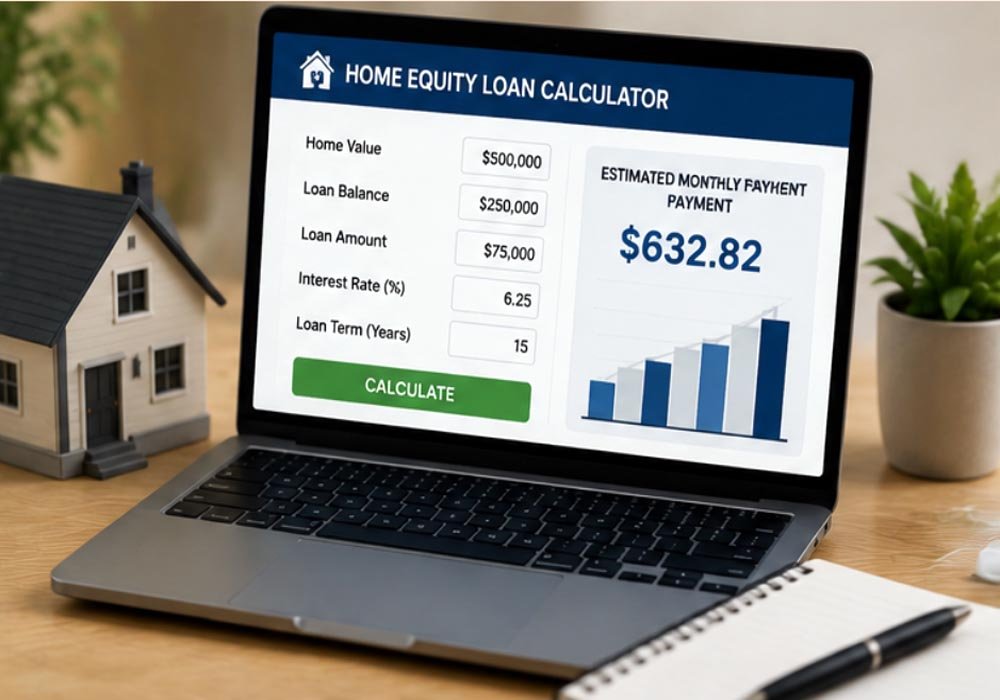
A Home Equity Loan Calculator estimates the monthly payment, total interest and payoff date for a home equity loan. Enter the amount you plan to borrow, the interest rate, the term in years and, if you like, the closing costs. It helps homeowners see what a loan would cost before they apply and compare different rates and terms.
How to use it
- Enter the loan amount you want to borrow.
- Enter the interest rate quoted by the lender.
- Enter the loan term in years (often 5 to 30).
- Tick Include closing costs and enter them if you want to see their effect on the total cost.
- Click Calculate to see the monthly payment, total cost, payoff date and the amortization schedule.
The calculator does not ask for your home value or mortgage balance. To estimate how much you might be able to borrow, use the simple formula below first.

What is a home equity loan?
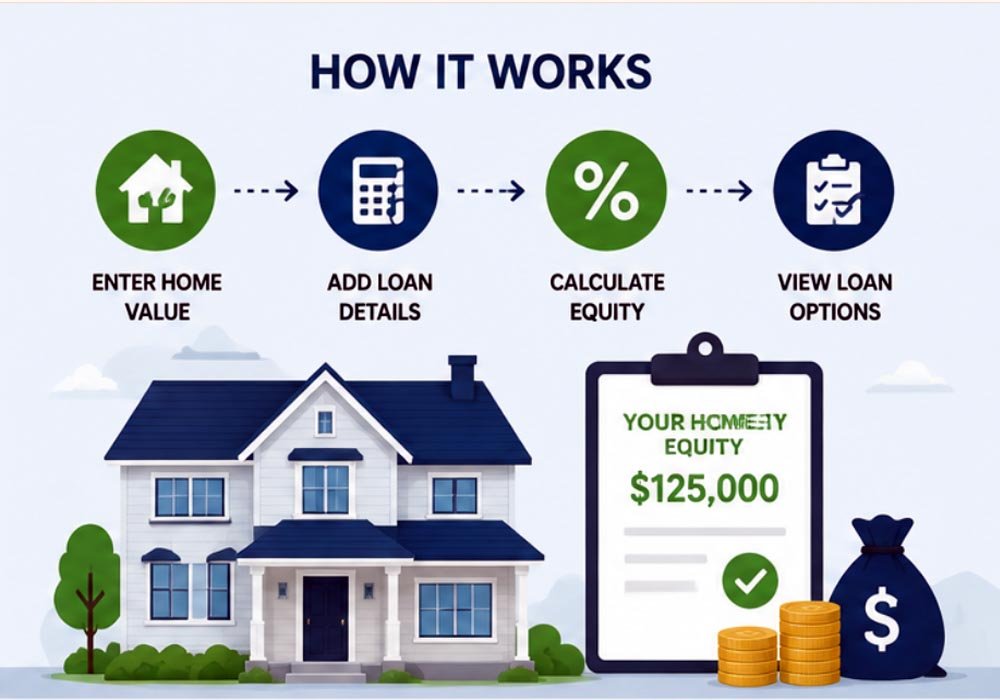
A home equity loan, sometimes called a second mortgage, lets you borrow a lump sum against the equity in your home. Equity is the part of the home you own outright: its market value minus what you still owe on the mortgage. Most home equity loans have a fixed rate and a fixed monthly payment.
How much can you borrow?
Lenders usually cap total borrowing at a percentage of the home’s value, called the maximum combined loan-to-value (CLTV), often around 80% to 85%. A quick estimate:
Maximum loan ≈ Home value × Maximum CLTV − Current mortgage balance
Payment formula
M = P × r(1 + r)^n ÷ ((1 + r)^n − 1)
where M is the monthly payment, P is the loan amount, r is the monthly rate (annual rate ÷ 12) and n is the number of monthly payments.
Example
Your home is worth $400,000, your lender allows up to 80% CLTV, and you owe $250,000 on your mortgage:
- $400,000 × 80% = $320,000
- $320,000 − $250,000 = up to $70,000 available to borrow
If you borrow the full $70,000 at 8% for 15 years, the payment is about $668.96 a month, and you would pay about $50,412 in interest over the life of the loan (before closing costs).
Home Equity Loan Costs and Common Uses
A home equity loan can involve both upfront and ongoing costs. Understanding these expenses is important because they affect the actual cost of borrowing.
- Closing costs: May include appraisal, origination, document, and title-related fees.
- Interest charges: Monthly payments generally include both principal and interest, with the interest portion typically higher during the early stages of repayment.
- APR: The annual percentage rate can provide a broader view of borrowing costs by accounting for interest and certain fees.
- Home improvements: Funds may be used for major renovations, repairs, or upgrades that improve the property.
- Debt consolidation: Some homeowners use home equity to pay off higher-interest debts, such as credit card balances.
- Large expenses: Depending on the borrower’s circumstances, funds may be used for education, major purchases, or other planned financial needs.
Because your home secures the loan, borrowing should be carefully considered and based on an affordable repayment plan.

Tips before you borrow against your home
- Your home secures the loan, so missing payments can put it at risk. Borrow only what you can repay comfortably.
- Compare the APR, not just the rate, because it includes many of the fees.
- Try a shorter term in the calculator: the payment rises, but total interest falls sharply.
- If you need money in stages rather than all at once, compare a home equity line of credit with the HELOC Calculator.
Frequently Asked Questions
Most lenders let your total mortgage debt reach about 80% to 85% of your home’s value. Multiply your home value by that percentage and subtract your mortgage balance. For a $400,000 home at 80% with $250,000 owed, that is up to $70,000. Your credit score, income and debt-to-income ratio also affect the final amount.
A home equity loan pays you one lump sum, usually at a fixed rate with equal monthly payments. A HELOC is a credit line you draw from as needed, usually at a variable rate, with interest-only payments possible during the draw period. A loan suits a single known cost; a HELOC suits expenses spread over time.
Most home equity loans have a fixed rate, so the payment stays the same for the whole term. Always confirm with the lender, because some products have variable rates.
Common costs include an appraisal, origination or application fee, title search and recording fees. They often add up to a few percent of the loan amount, and some lenders waive part of them. Enter them in the calculator to see the full cost.
Because the loan is secured by your home, falling behind can lead to late fees, damage to your credit and, in the worst case, foreclosure. If you expect trouble, contact the lender early to ask about options.
Disclaimer: This calculator gives estimates for general information only. It is not financial, tax or legal advice. Results depend on the numbers you enter and on simplified assumptions, so your actual figures may differ. Check important decisions with a qualified professional or the official source.
Related Calculators
If you are weighing ways to use your home equity, these calculators help you compare the options.
Written by Sharp Calculator Team — we build and test every calculator on this site, checking each formula against hand-worked examples and official sources. Last updated: October 2026.