
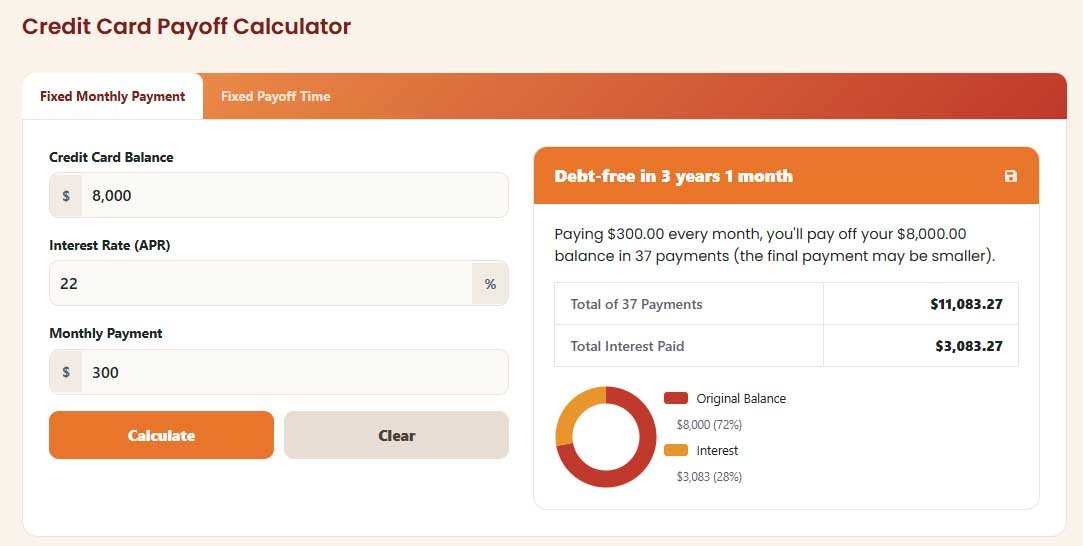
Credit Card Payoff Calculator
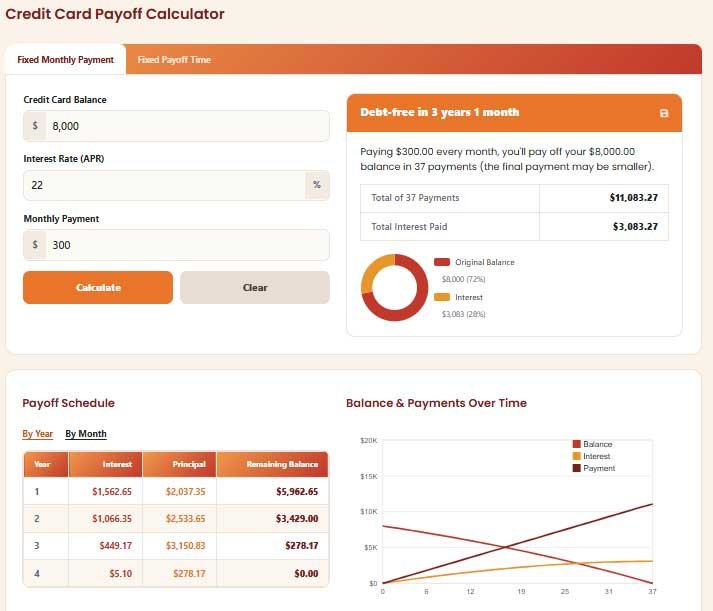
Payoff Schedule
| Year | Interest | Principal | Remaining Balance |
|---|
Balance & Payments Over Time
Credit Card Payoff Calculator
Credit card debt can become difficult to manage when balances, interest charges, and minimum payments continue to accumulate. A Credit Card Payoff Calculator helps you estimate how long it may take to pay off your balance and how much interest you could pay over time.
By entering your current balance, interest rate, and monthly payment, you can see how different payment amounts may affect your payoff timeline. This makes it easier to create a realistic repayment plan and understand the cost of carrying credit card debt.
How Does a Credit Card Payoff Calculator Work?
A Credit Card Payoff Calculator estimates your repayment period based on the balance you owe, annual percentage rate (APR), and payment amount. Each monthly payment generally goes toward interest, and the remaining amount reduces your principal balance.
If you only make the minimum payment, repayment can take considerably longer because interest continues to accumulate. Increasing your monthly payment can reduce the repayment period and potentially lower the total interest paid.
The calculator can also help you compare different repayment scenarios. For example, you can enter a higher monthly payment to see how much sooner you could become debt-free.
Credit Card Payoff Formula
The estimated number of payments can be calculated using:
n = −ln(1 − rB/P) ÷ ln(1 + r)
Where:
n = number of monthly payments
B = current credit card balance
r = monthly interest rate
P = monthly payment
The actual calculation may vary depending on how the credit card issuer calculates interest, fees, payment timing, and other account terms.
Free Credit Card Payoff Calculator for Debt Planning
A Free Credit Card Payoff Calculator can be useful when you want to understand your debt without doing complicated calculations yourself. You can experiment with different balances, APRs, and monthly payments to see how your repayment strategy changes.
For example, someone with a $5,000 balance may want to compare paying $150, $250, or $400 per month. The results can show how increasing the monthly payment could shorten the payoff period and reduce interest costs.
This type of calculation is particularly useful before creating a debt repayment budget. Instead of choosing a payment amount randomly, you can evaluate several options and select an amount that fits your finances.
Monthly Payment Credit Card Calculator
A monthly payment credit card calculator can help you determine how much you may need to pay each month to reach a particular payoff goal. You can use it to explore scenarios such as paying off a balance within one year, two years, or another target period.
A higher monthly payment generally means a shorter repayment period. However, your payment should always be realistic for your budget. Choosing an amount that you cannot consistently afford may make your repayment plan difficult to maintain.
Multiple Credit Card Payoff Calculator
Managing several credit cards can make debt repayment more complicated because each card may have a different balance, APR, and minimum payment. A multiple credit card payoff calculator can help you compare your accounts and understand how different repayment strategies may affect your overall debt.
For example, you might have one card with a $2,000 balance at a high interest rate and another with a $4,000 balance at a lower rate. Paying attention only to the largest balance may not always be the most efficient strategy.
A calculator can help you organize your balances and evaluate how much you could save by directing additional money toward specific cards while continuing to make required payments on the others.
Credit Card Payoff Calculator Snowball Method
The credit card payoff calculator snowball approach focuses on paying off your smallest balance first while continuing minimum payments on your other accounts. Once the smallest balance is eliminated, the payment you were making toward it can be redirected to the next-smallest balance.
The snowball method can provide a sense of progress because smaller accounts may be eliminated relatively quickly. Seeing individual balances disappear can help some people stay motivated throughout the repayment process.
Snowball vs. Interest-Focused Repayment
With the snowball approach, debts are generally prioritized by balance size. Another common approach is to prioritize the card with the highest interest rate first.
The best approach depends on your financial circumstances, motivation, and ability to remain consistent. A payoff calculator lets you compare different payment scenarios rather than relying on a single repayment strategy.
Using Credit Card Payoff Calculators from Popular Websites
You may come across searches such as Credit Card Payoff Calculator Credit Karma, Credit Card Payoff Calculator Discover, or Credit Card Payoff Calculator NerdWallet. These searches generally reflect interest in debt payoff tools and repayment planning resources offered by well-known financial websites or card issuers.
The important thing is to understand the information used by the calculator. A useful payoff estimate should consider your balance, interest rate, payment amount, and repayment assumptions.
If you compare results from different calculators, small differences can occur because each tool may use different assumptions about interest calculations, payment timing, fees, or minimum-payment rules. Therefore, calculator results should be treated as estimates rather than an exact prediction of your credit card statement.
Factors That Affect Your Credit Card Payoff
Several factors can change how quickly you repay credit card debt. Understanding these factors can help you make better use of a payoff calculator.
- Outstanding balance: A larger balance generally requires more time or larger payments to eliminate.
- APR: A higher interest rate can increase the cost of carrying a balance.
- Monthly payment: Paying more than the minimum can generally shorten the repayment period.
- New purchases: Continuing to use a card while paying it down can slow your progress.
- Fees: Late fees and other charges can increase the amount you owe.
- Payment timing: The way interest and payments are calculated can affect the final payoff amount.
- Number of cards: Managing multiple balances can require a more organized repayment strategy.
Because these factors can change over time, it is helpful to update your calculations whenever your balance, interest rate, or payment amount changes.
How to Use a Credit Card Payoff Calculator
Using the calculator is straightforward. Start by entering your current credit card balance. Next, enter the card’s annual percentage rate and the amount you plan to pay each month.
The calculator can then estimate the number of payments required and the potential interest cost under the entered assumptions. Try several monthly payment amounts to see how they affect your payoff timeline.
If you have multiple cards, repeat the calculation for each account or use a calculator designed to handle multiple balances. This can give you a clearer picture of your overall debt repayment plan.
Frequently Asked Questions
The payoff time depends mainly on your balance, APR, and monthly payment. Entering these details into a payoff calculator can provide an estimated repayment timeline.
A free calculator can provide a useful estimate based on the information entered. Actual results may differ because credit card issuers can use different interest calculations, fees, payment dates, and account terms.
Yes. A Roth IRA calculator by age can estimate potential growth based on your current age, planned retirement age, contributions, and expected investment return.
Yes. A multiple credit card payoff calculator can help you evaluate several balances, interest rates, and payment amounts. This can make it easier to organize your overall debt repayment strategy.
Generally, paying down the balance faster can reduce the amount of time interest accrues and may lower total interest costs. The exact savings depend on your card’s APR and interest calculation method.
Related Calculator:
Explore more financial tools designed to simplify your calculations. Whether you’re planning a mortgage, estimating an auto loan, calculating taxes, or tracking investment growth, our free calculators provide fast and accurate results to help you make smarter financial decisions.