
Result
Percentage Discount Calculator
A percentage discount calculator helps you quickly find how much money you save and how much you need to pay after a discount. Whether you are shopping online, comparing sale prices, checking a coupon, or calculating a business invoice, this tool makes discount calculations simple and accurate.
Enter the original price and discount percentage to calculate the discount amount, final price, and total savings. You can also use a simple discount calculator to work with fixed-amount discounts, calculate the discount percentage from two prices, or check the effect of tax and multiple discounts.
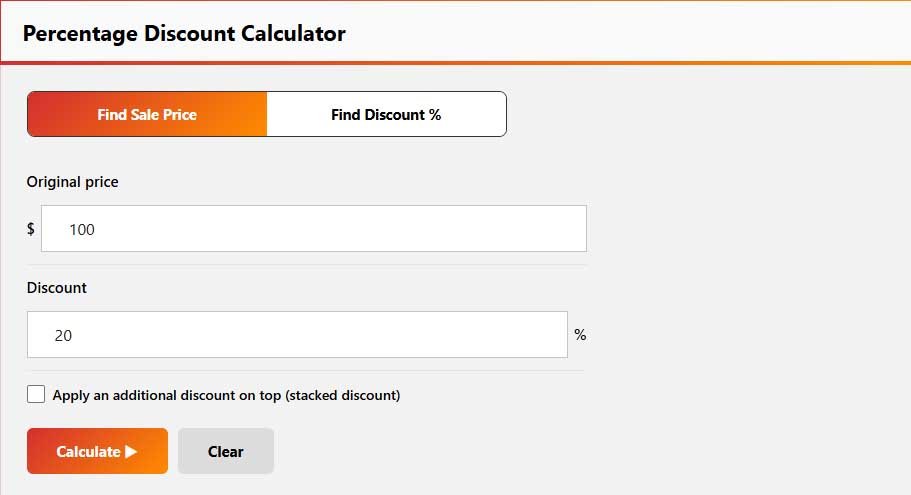
How Does a Discount Calculator Work?
A discount calculator uses the original price and discount rate to determine the amount taken off the price. It then subtracts the discount from the original price to show the final amount you pay.
For example, if an item costs $100 and has a 20% discount:
Discount Amount = $100 × 20 ÷ 100 = $20
Final Price = $100 − $20 = $80
You save $20 and pay $80.
This basic calculation is also useful when checking sale prices, promotional offers, coupons, and special deals.
Percentage Discount Calculator Formula
The standard percentage discount calculator formula is:
Discount Amount = Original Price × Discount Percentage ÷ 100
To find the final price:
Final Price = Original Price − Discount Amount
You can also calculate the final price directly:
Final Price = Original Price × (1 − Discount Percentage ÷ 100)
For example, suppose a jacket costs $250 and is advertised at 30% off.
Discount Amount = $250 × 30 ÷ 100 = $75
Final Price = $250 − $75 = $175
Therefore, the customer saves $75 and pays $175.
How to Calculate a Discount Percentage
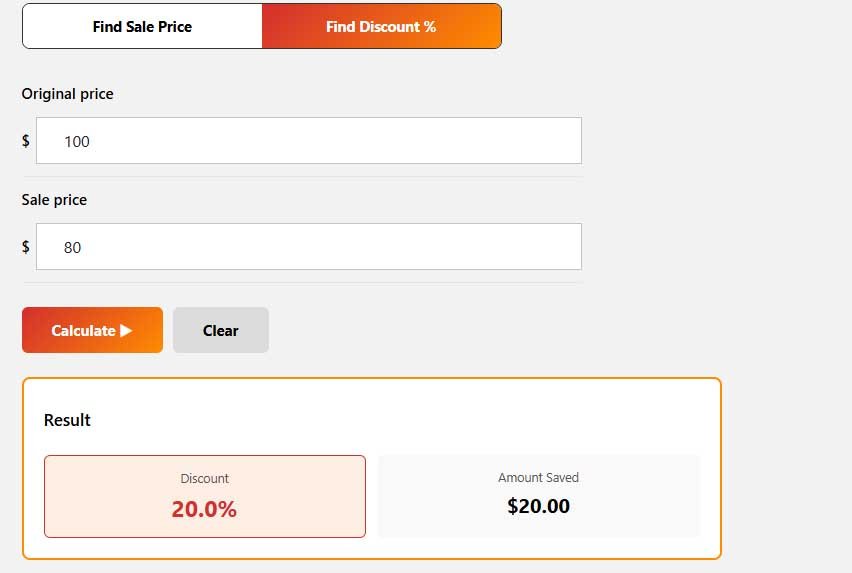
Sometimes you know the original price and sale price but do not know the discount rate. In this situation, you can calculate the percentage discount with this formula:
Discount Percentage = (Original Price − Sale Price) ÷ Original Price × 100
For example, if a product was originally $120 and is now $90:
Discount = ($120 − $90) ÷ $120 × 100
Discount = 25%
The product has a 25% discount, and the customer saves $30.
How to Use a Simple Discount Calculator
A simple discount calculator can be used for both percentage and fixed discounts.
Enter the original price first. Then select the discount type and enter the discount value. The calculator can show the discount amount, savings, and final price.
For example, if a product costs $150 and you receive a fixed $20 discount:
$150 − $20 = $130
The final price is $130, and you save $20.
A percentage discount works differently because the amount saved changes according to the original price. A 20% discount on a $50 product saves $10, while the same 20% discount on a $500 product saves $100.
How to Calculate a 10% Discount
A 10% discount calculator is useful when you want to quickly calculate common sales offers.
To calculate a 10% discount manually, divide the original price by 10.
For a $200 product:
10% of $200 = $20
Then subtract the discount:
$200 − $20 = $180
So, a 10% discount on $200 gives you $20 in savings, making the final price $180.
The same method works for 5%, 15%, 20%, 25%, 50%, or any other percentage.
Double Discount Calculator
Two discounts applied one after another should not normally be added together.
For example, suppose an item costs $100 and receives a 20% discount followed by another 10% discount.
First discount:
$100 − 20% = $80
Second discount:
$80 − 10% = $72
The final price is $72.
The total savings is $28, which means the effective discount is 28%, not 30%.
A double discount calculator is useful for retail sales, coupon combinations, clearance offers, and promotions where multiple discounts are applied sequentially.
Discount Calculator With Tax
Some purchases include sales tax or VAT, so it is important to know whether tax is calculated before or after the discount. Many checkout and invoicing situations apply the discount first and then calculate tax on the reduced amount, although tax rules can vary by location and transaction type.
For example, assume:
Original price = $100
Discount = 20%
Tax = 10%
First calculate the discount:
$100 − $20 = $80
Then calculate 10% tax:
$80 × 10% = $8
Final price:
$80 + $8 = $88
A discount calculator with tax can therefore help you estimate the final amount when both a discount and tax are involved.
Discount Calculator Euro
A discount calculation does not change when the currency changes. You can use a discount calculator euro for prices displayed in euros (€), just as you would for dollars, pounds, or other currencies.
For example, if a €200 product has a 15% discount:
€200 × 15% = €30 savings
€200 − €30 = €170
The final price is €170.
The currency symbol changes, but the percentage discount formula remains the same.
How to Find the Original Price After a Discount
Sometimes you know the final price and discount percentage but want to find the original price.
Use this formula:
Original Price = Final Price ÷ (1 − Discount Percentage ÷ 100)
For example, an item costs $80 after a 20% discount.
Original Price = $80 ÷ (1 − 20 ÷ 100)
Original Price = $80 ÷ 0.80
Original Price = $100
Therefore, the original price was $100.
This reverse calculation is useful when a retailer shows only the sale price and discount percentage.
What Is the Difference Between Discount Amount and Discount Percentage?
The discount amount is the actual money you save.
The discount percentage represents how large that saving is compared with the original price.
For example, if a $200 product is reduced by $50:
Discount Amount = $50
Discount Percentage = $50 ÷ $200 × 100 = 25%
Therefore, the customer receives a 25% discount and saves $50.
Frequently Asked Questions
Calculating a discount manually is easy for simple numbers, but an online calculator can save time when dealing with taxes, multiple discounts, different currencies, or reverse calculations.
A good discount calculator can help you:
- Calculate percentage savings
- Find the final sale price
- Calculate the original price
- Find the discount percentage
- Compare sale prices
- Calculate fixed discounts
- Calculate double or multiple discounts
- Estimate tax after a discount
- Work with different currencies
It can be especially useful during online shopping, seasonal sales, Black Friday promotions, coupon offers, and business invoicing.
Multiply the original price by 20 and divide by 100. For example, 20% of $100 is $20. Subtract $20 from $100 to get a final price of $80.
The basic formula is:
Discount Amount = Original Price × Discount Percentage ÷ 100
The final price is the original price minus the discount amount.
Subtract the sale price from the original price, divide the result by the original price, and multiply by 100.
Discount Percentage = (Original Price − Sale Price) ÷ Original Price × 100
Apply the first discount to the original price. Then apply the second discount to the reduced price. Do not simply add the two percentages together.
For example, 20% followed by 10% on $100 results in a final price of $72.
Related Calculator:
Explore more financial tools designed to simplify your calculations. Whether you’re planning a mortgage, estimating an auto loan, calculating taxes, or tracking investment growth, our free calculators provide fast and accurate results to help you make smarter financial decisions.