
Dog BMI Calculator
Check whether your dog is underweight, ideal or overweight.
Your Results
Enter your values and press Calculate to see your results.
What Is a Dog BMI Calculator?
A dog BMI calculator helps you judge whether your dog’s weight suits its size. Human BMI uses height squared, but dogs come in very different shapes, so this tool compares your dog’s weight-to-height ratio with the official standard for its breed. A ratio inside the breed range suggests a healthy weight; a ratio well above or below it is a reason to look more closely.
Because breed averages cannot account for every individual, the calculator also includes a body condition score (BCS) tab. Vets use the 9-point BCS scale to assess body fat by feel and sight, and it can be used to estimate your dog’s ideal weight.
How to Use the Dog BMI Calculator
- Pick BMI by Breed and select your dog’s breed.
- Weigh your dog and enter the weight in lb or kg.
- Measure the height at the withers – from the floor to the top of the shoulder blades – while your dog stands straight.
- Press Calculate to compare the ratio with the breed range.
- For mixed breeds, use the Body Condition Score tab to estimate ideal weight.
Dog BMI Formula
The dog BMI calculator uses a simple ratio, then compares it with the ratio calculated from breed standard weights and the average breed height.
Dog BMI = Weight (lb) ÷ Height at withers (in)- Weight – current body weight in pounds
- Height – shoulder height in inches
- Healthy range – breed minimum and maximum weight ÷ average breed height
- BCS method – ideal weight = current weight ÷ (1 + 0.1 × (BCS − 5))
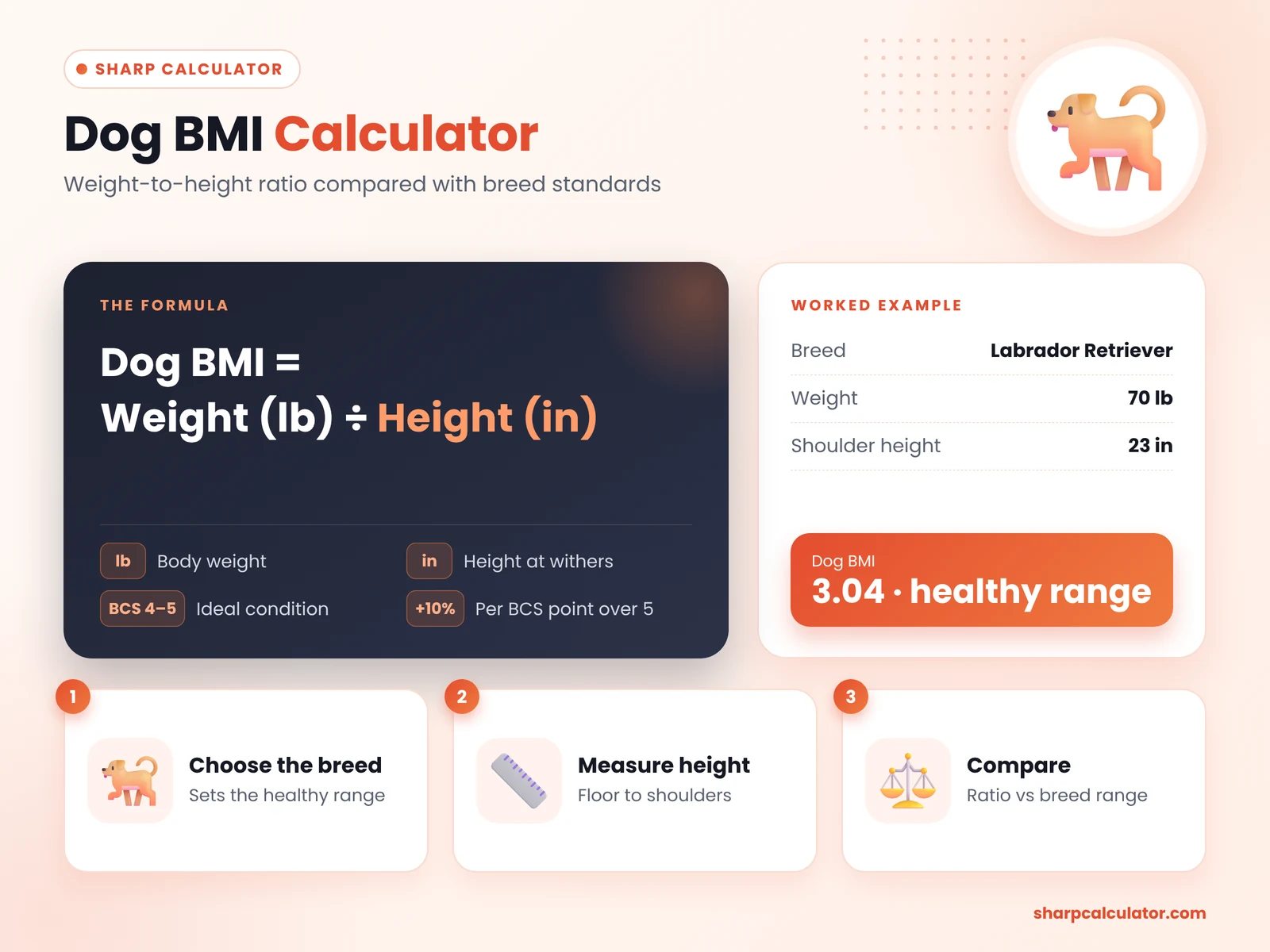
The BCS formula is based on the widely used guideline that each point above 5 on the 9-point scale represents roughly 10 % excess body weight.
Worked example
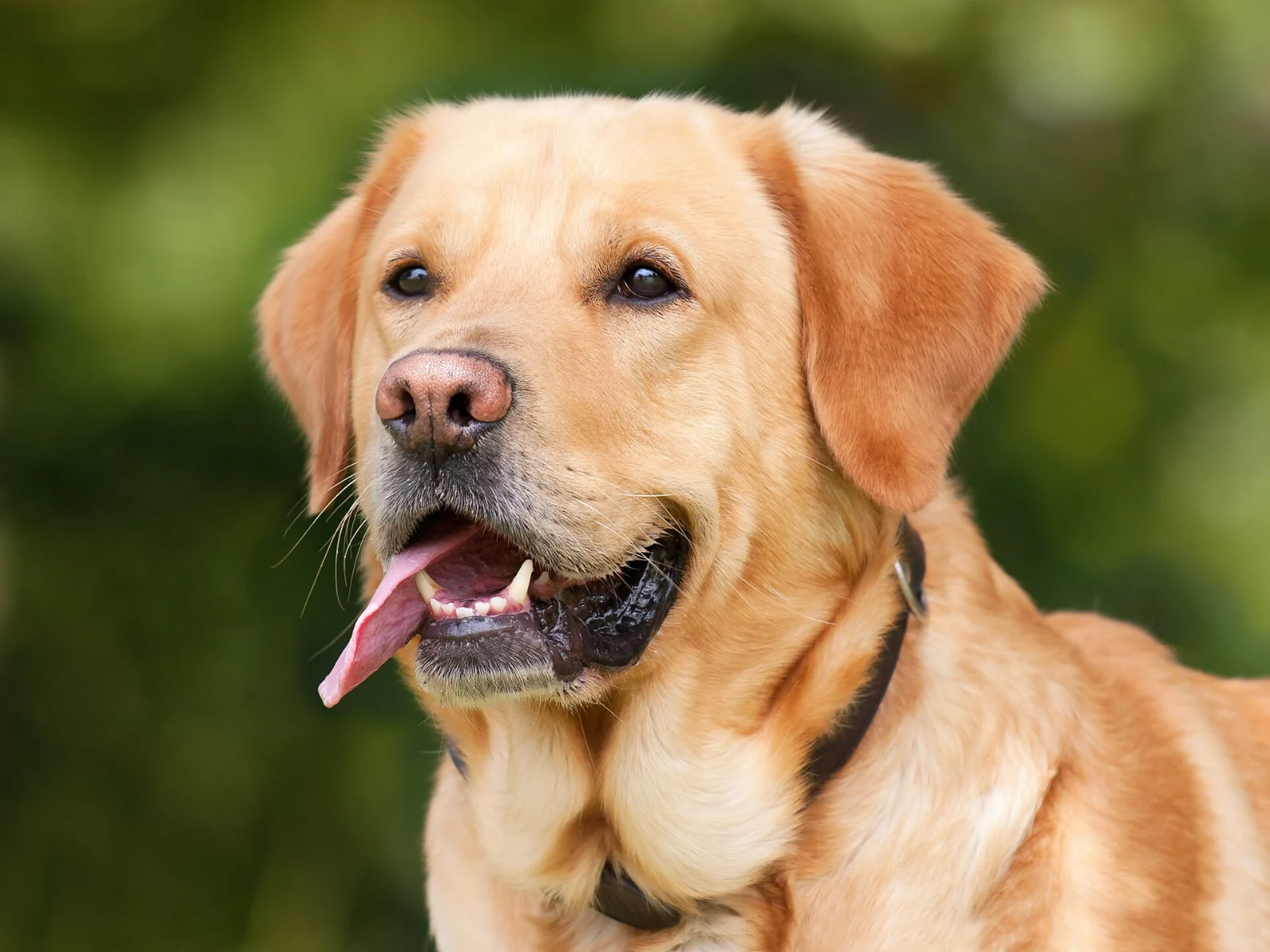
A Labrador Retriever weighs 70 lb and stands 23 inches at the shoulder.
BMI = 70 ÷ 23 = 3.04. The healthy range for Labradors, based on 55–80 lb and an average height of 23 inches, is about 2.39 to 3.48, so this dog is in the healthy range.
Understanding Body Condition Score
The body condition score is the most practical way to judge whether a dog is carrying the right amount of fat. On the 9-point scale, a score of 4 or 5 is ideal: you can feel the ribs easily under a thin layer of fat, see a waist from above and a tuck in the belly from the side. Scores of 6–7 mean overweight and 8–9 obese, while 1–3 indicate a thin or underweight dog.
A quick hands-on check each month is one of the simplest ways to keep your dog healthy. Run your hands along the ribs, look down from above for a waist and check the side view for a belly tuck. Small changes are much easier to correct than big ones.
If your dog scores 6 or more, small changes such as measuring meals, cutting back treats and adding a daily walk usually make a clear difference within a few months. Ask your vet to record weight and body condition at every visit so trends are easy to follow.
| Score | Description | What you notice |
|---|---|---|
| 1–3 | Too thin | Ribs, spine and hip bones easily visible |
| 4–5 | Ideal | Ribs easy to feel, clear waist and belly tuck |
| 6–7 | Overweight | Ribs hard to feel, waist barely visible |
| 8–9 | Obese | Ribs not felt, no waist, fat deposits on back and tail |
Health Risks of Excess Weight in Dogs
Obesity is one of the most common health problems in dogs. Extra weight puts stress on joints and is linked to osteoarthritis, diabetes, breathing difficulties, heat intolerance and some cancers. A long-term study of Labrador Retrievers found that dogs kept lean lived about two years longer than their overweight littermates. Checking your dog’s weight regularly with a dog BMI calculator and a body condition score helps you spot gradual weight gain early.
How to Weigh Your Dog at Home
Small dogs can be weighed on a kitchen or baby scale. For larger dogs, weigh yourself on a bathroom scale, then pick up your dog and weigh again; the difference is your dog’s weight. Very large dogs are best weighed on the walk-on scale at your vet clinic or a pet store. Weigh at the same time of day, before meals, for consistent results.
Tips for Keeping Your Dog at a Healthy Weight
- Weigh regularly.Check weight every month on the same scale.
- Measure correctly.Stand your dog square on a level floor and measure to the top of the shoulder blades.
- Use your hands.Feel the ribs: they should be easy to find under a thin fat layer.
- Measure food.Use a kitchen scale or measuring cup, not guesswork.
- Count treats.Treats should make up no more than about 10 % of daily calories.
- Change slowly.Aim for weight loss of 1–2 % per week with your vet’s guidance.
Why Monitoring Your Dog’s Weight Matters
Weight changes happen slowly, and it is easy to miss a dog gradually becoming overweight. A dog BMI calculator gives you an objective number to track, while the body condition score adds a hands-on check. Together they help you adjust food and exercise early and protect your dog’s mobility and lifespan.
Who Can Use This Tool?
This tool is useful for dog owners, breeders, dog walkers, groomers and veterinary staff. It works on phones and computers and needs no sign-up.
Note: This dog BMI calculator gives a general estimate based on breed standards. Individual dogs vary – your veterinarian can give the most accurate assessment.
Frequently Asked Questions
How do you calculate BMI for a dog?
Divide your dog’s weight in pounds by its height at the shoulder in inches, then compare the result with the range for its breed.
What is a healthy BMI for a dog?
It depends on the breed. For a Labrador it is about 2.4–3.5 lb per inch; small breeds have much lower values.
Is body condition score better than BMI for dogs?
Body condition score is often more reliable because it directly assesses body fat. Using both gives the best picture.
How can I tell if my dog is overweight?
If you cannot easily feel the ribs, there is no visible waist from above, or there is fat over the base of the tail, your dog is probably overweight.
Can I use this for mixed-breed dogs?
Yes. Use the Body Condition Score tab, which works for any dog.
How fast should my dog lose weight?
A safe target is about 1–2 % of body weight per week, under veterinary supervision.