
Benadryl Dosage Calculator for Dogs
Estimate the usual diphenhydramine dose for your dog’s weight.
Your Results
Enter your values and press Calculate to see your results.
What Is a Benadryl Dosage Calculator for Dogs?
A Benadryl dosage calculator for dogs estimates how much diphenhydramine – the active ingredient in Benadryl – is commonly used for a dog of a given weight. Veterinarians sometimes recommend diphenhydramine for mild allergic reactions, insect stings, itching, motion sickness or mild anxiety during travel. The usual guideline is 1 mg per pound of body weight (about 2.2 mg/kg), given two to three times a day.
Enter your dog’s weight and choose the product you have. The calculator shows the estimated dose in milligrams and converts it into tablets, chewables or millilitres of children’s liquid. It is a planning aid only: diphenhydramine is not right for every dog, so please confirm the dose with your veterinarian first.
How to Use the Benadryl Dosage Calculator for Dogs
- Weigh your dog, or use the weight from a recent vet visit.
- Enter the weight and choose lb or kg.
- Select the Benadryl product: 25 mg tablets, 12.5 mg chewables or children’s liquid.
- Press Calculate to see the dose in mg and tablets or mL.
- Check the result with your vet before giving any medication.
Benadryl Dose Formula for Dogs
The Benadryl dosage calculator for dogs uses the dose most often quoted in veterinary references.
Dose (mg) = Body weight (lb) × 1 mgDose (mg) = Body weight (kg) × 2.2 mg- Frequency – every 8 to 12 hours, up to three times daily
- 25 mg tablet – roughly one tablet per 25 lb
- Children’s liquid – 12.5 mg per 5 mL, so mL = mg ÷ 2.5
- Rounding – tablets are rounded to the nearest quarter
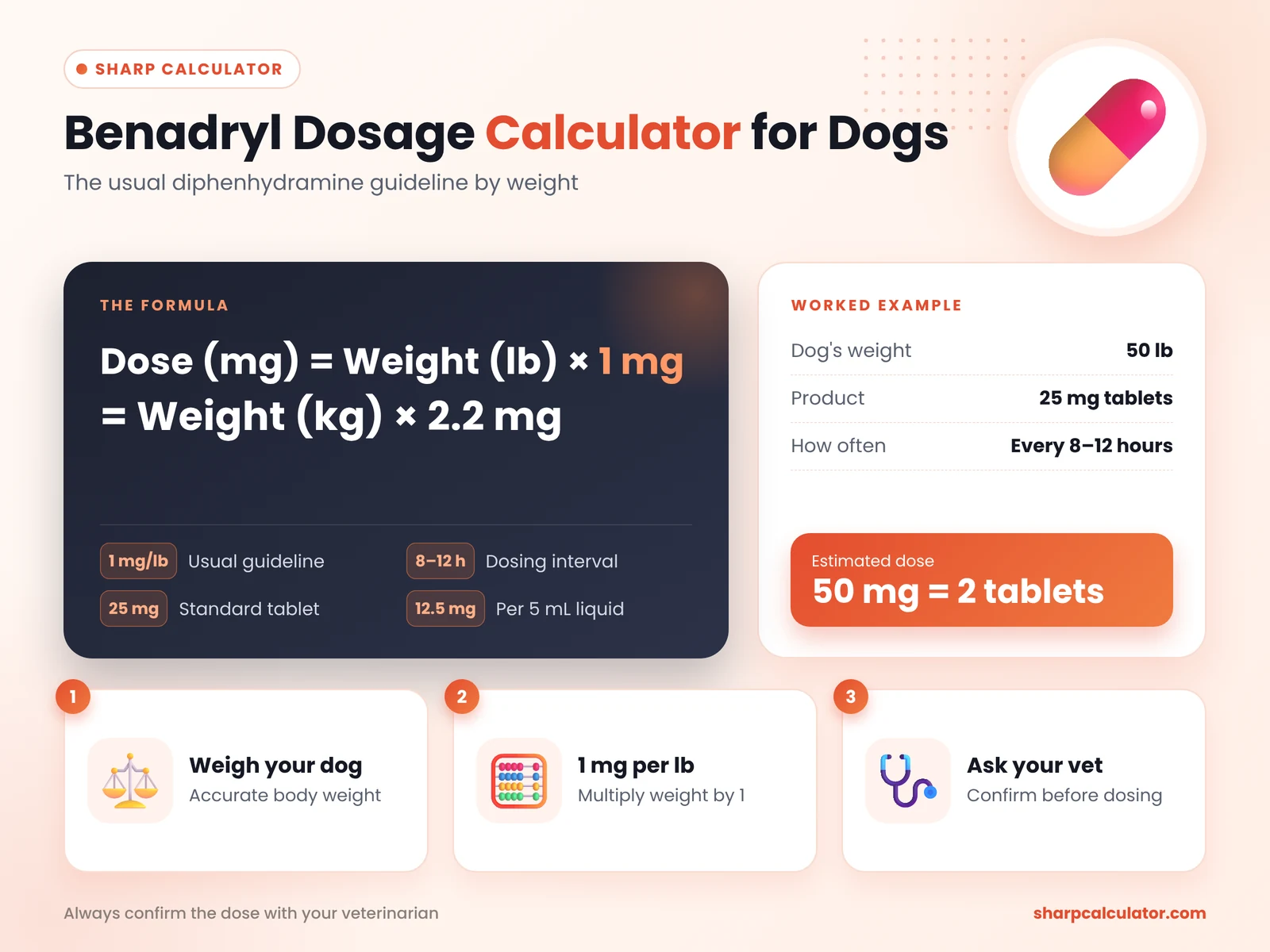
Your vet may choose a different dose or frequency depending on your dog’s age, health conditions and other medications.
Worked example
A 50 lb Labrador is stung by a bee and your vet advises diphenhydramine.
At 1 mg per lb, the dose is 50 mg – two 25 mg tablets – repeated every 8–12 hours if needed. Using the children’s liquid, it would be 20 mL.
Which Benadryl Products Are Safe for Dogs?
Only products whose sole active ingredient is diphenhydramine should be considered. Many “Benadryl” branded items in pharmacies contain extra ingredients that are dangerous for dogs, especially decongestants and pain relievers. Some liquid products contain xylitol, a sweetener that is highly toxic to dogs, and alcohol.
Always check the active ingredients panel rather than the brand name, because packaging can look almost identical between plain and combination products. Avoid time-release capsules, which are not suitable for splitting, and never give products containing pseudoephedrine, phenylephrine, acetaminophen or ibuprofen. Liquids should be alcohol-free and xylitol-free. If you are unsure which product you have, take a photo of the label and show it to your vet or pharmacist before giving any dose, and keep all medicines out of reach of curious pets. Topical creams and sprays are not a substitute for oral dosing and can be harmful if your dog licks them off, so use them only on your vet’s advice.
| Product | Diphenhydramine | Suitable? |
|---|---|---|
| Benadryl Allergy 25 mg tablets | 25 mg | Yes, if plain diphenhydramine |
| Children’s chewables | 12.5 mg | Check for xylitol |
| Children’s liquid | 12.5 mg / 5 mL | Only alcohol- and xylitol-free |
| Benadryl-D / Allergy Plus Congestion | + phenylephrine | No |
| Benadryl Itch cream | Topical | Not for licking dogs |
Possible Side Effects
- Drowsiness and sedation – the most common effect
- Dry mouth and increased thirst
- Urinary retention
- Rapid heart rate or rapid breathing
- Paradoxical excitement or hyperactivity in some dogs
- Vomiting or diarrhoea
Seek emergency veterinary care if your dog has facial swelling, hives spreading quickly, trouble breathing, collapse or pale gums – these can be signs of a severe allergic reaction that needs more than an antihistamine.
When Not to Use Benadryl
Avoid diphenhydramine without veterinary advice if your dog has glaucoma, heart disease, high blood pressure, seizures, prostate enlargement or is pregnant or nursing. It can also interact with sedatives, some antidepressants and other antihistamines. For long-term allergies, your vet may recommend more effective treatments such as specific allergy medications or dietary changes.
Using the Calculator Safely
Think of the Benadryl dosage calculator for dogs as a way to prepare for a conversation with your vet, not to replace it. Write down the result, the product you have at home and your dog’s symptoms, then call your clinic. Many vets are happy to confirm a dose over the phone for a known patient. Keep the original packaging so you can read the exact ingredients aloud, and never combine diphenhydramine with other antihistamines or sedatives unless your vet tells you to.
Safety Tips
- Read the label.Make sure diphenhydramine is the only active ingredient.
- Avoid xylitol.Check liquid and chewable products for xylitol or alcohol.
- Use an accurate weight.Dosing by guesswork can lead to too much or too little.
- Measure liquids precisely.Use an oral syringe, not a kitchen spoon.
- Watch your dog.Monitor for side effects for a few hours after the first dose.
- Ask your vet first.Especially for puppies, seniors and dogs on other medicines.
Why Weight-Based Dosing Matters
Dogs range from tiny Chihuahuas to giant breeds, so a “one tablet” approach can be badly wrong. Weight-based dosing helps keep the amount within the range your vet would expect. This Benadryl dosage calculator for dogs makes the conversion quick and clear, so you can have an informed conversation with your veterinarian.
Who Can Use This Tool?
This tool is for dog owners, pet sitters and anyone who has been advised by a vet to use diphenhydramine. It is free and works on mobile and desktop.
Note: This calculator is for general information and does not replace professional veterinary advice. Always consult your veterinarian before giving your dog any medication.
Frequently Asked Questions
How much Benadryl can I give my dog?
The commonly quoted veterinary guideline is 1 mg per pound of body weight, two to three times a day. Confirm the dose with your vet.
How much Benadryl for a 50 lb dog?
About 50 mg, which is two 25 mg tablets, given every 8–12 hours if your vet agrees.
Can I give my dog children’s liquid Benadryl?
Only if it contains plain diphenhydramine and no xylitol or alcohol. At 12.5 mg per 5 mL, give 2 mL for every 5 lb of body weight.
How long does Benadryl take to work in dogs?
It usually starts working within about 30 minutes to an hour.
Can Benadryl help my dog’s anxiety?
It may cause mild drowsiness, but it is not a reliable anxiety treatment. Talk to your vet about safer, more effective options.
What are signs of a Benadryl overdose in dogs?
Agitation, very fast heart rate, dilated pupils, tremors or seizures. Contact a vet or animal poison control immediately.