
Dry Matter Calculator
Compare wet and dry foods fairly on a dry matter basis.
Your Results
Enter your values and press Calculate to see your results.
What Is a Dry Matter Calculator?
A dry matter calculator converts the nutrient values printed on a pet food or livestock feed label into a dry matter basis – the values the food would have if all the water were removed. Labels list nutrients “as fed”, including moisture, which makes wet foods look much lower in protein and fat than dry foods. Converting to dry matter is the only fair way to compare them.
Enter the moisture percentage and the guaranteed analysis values for protein, fat, fibre and ash. The calculator shows the dry matter content and each nutrient on a dry matter basis, plus an estimate of carbohydrate. A second tab converts an amount of feed into its dry matter weight, useful for hay, silage and ration planning.
How to Use the Dry Matter Calculator
- Find the guaranteed analysis on the food or feed label.
- Enter the moisture percentage.
- Enter protein, fat, fibre and, if listed, ash.
- Press Calculate to see dry matter values.
- Repeat for another food and compare the results side by side.
Dry Matter Formula
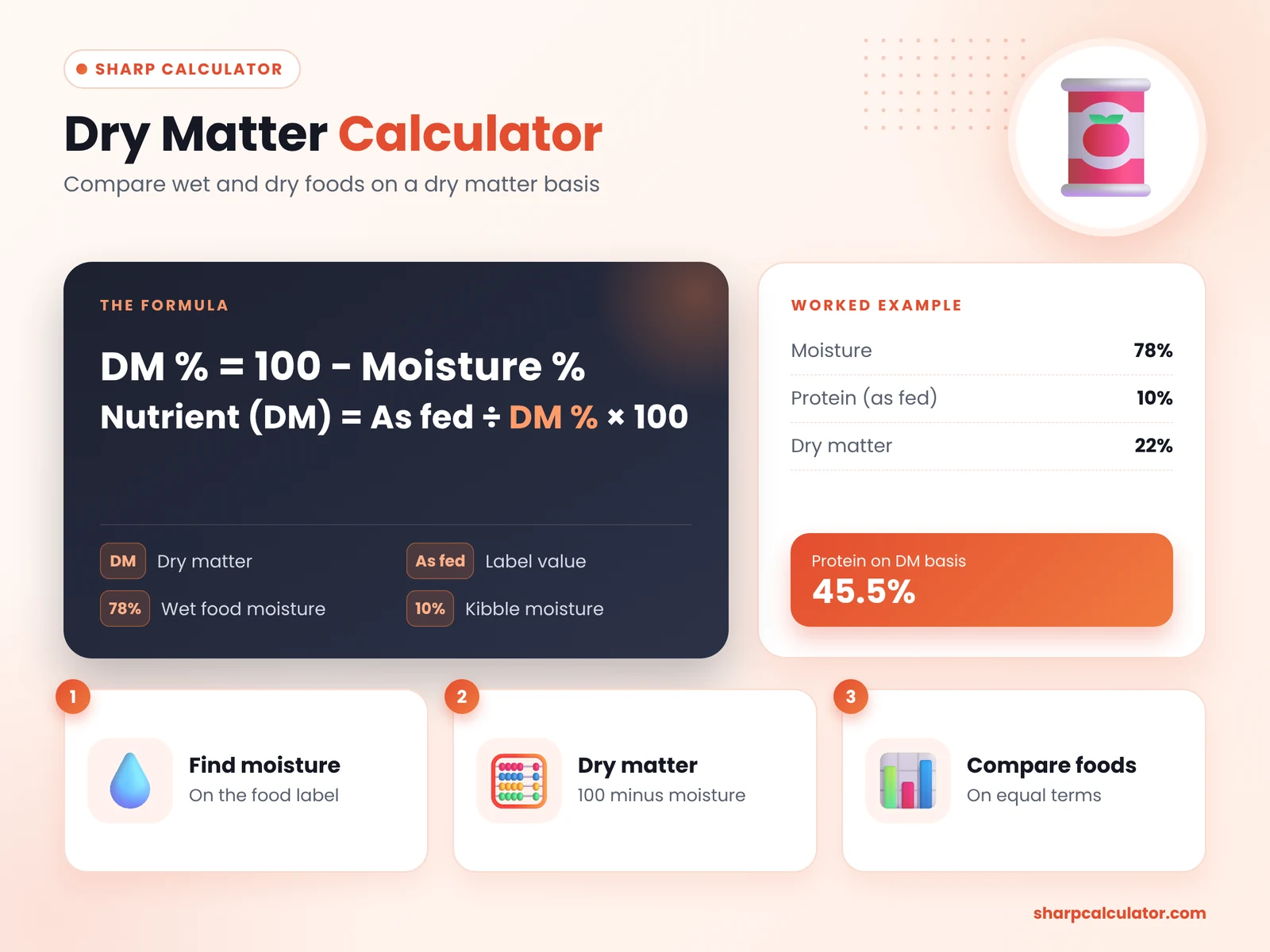
The dry matter calculator first finds how much of the food is not water, then rescales each nutrient to that amount.
Dry matter (%) = 100 − Moisture (%)Nutrient (DM %) = As-fed % ÷ Dry matter % × 100- As fed – values exactly as printed on the label
- Dry matter (DM) – everything except water
- NFE – nitrogen-free extract, an estimate of carbohydrate
- Feed weight – DM weight = amount × (100 − moisture) ÷ 100
Guaranteed analysis values are minimums (protein, fat) or maximums (fibre, moisture), so the dry matter results are close estimates rather than exact laboratory values.
Worked example
A canned cat food lists 78 % moisture, 10 % protein, 5 % fat and 1 % fibre.
Dry matter = 100 − 78 = 22 %. Protein on a dry matter basis = 10 ÷ 22 × 100 = 45.5 % – far higher than a kibble with 30 % protein and 10 % moisture, which works out to about 33 % on a dry matter basis.
Typical Moisture Levels in Foods and Feeds
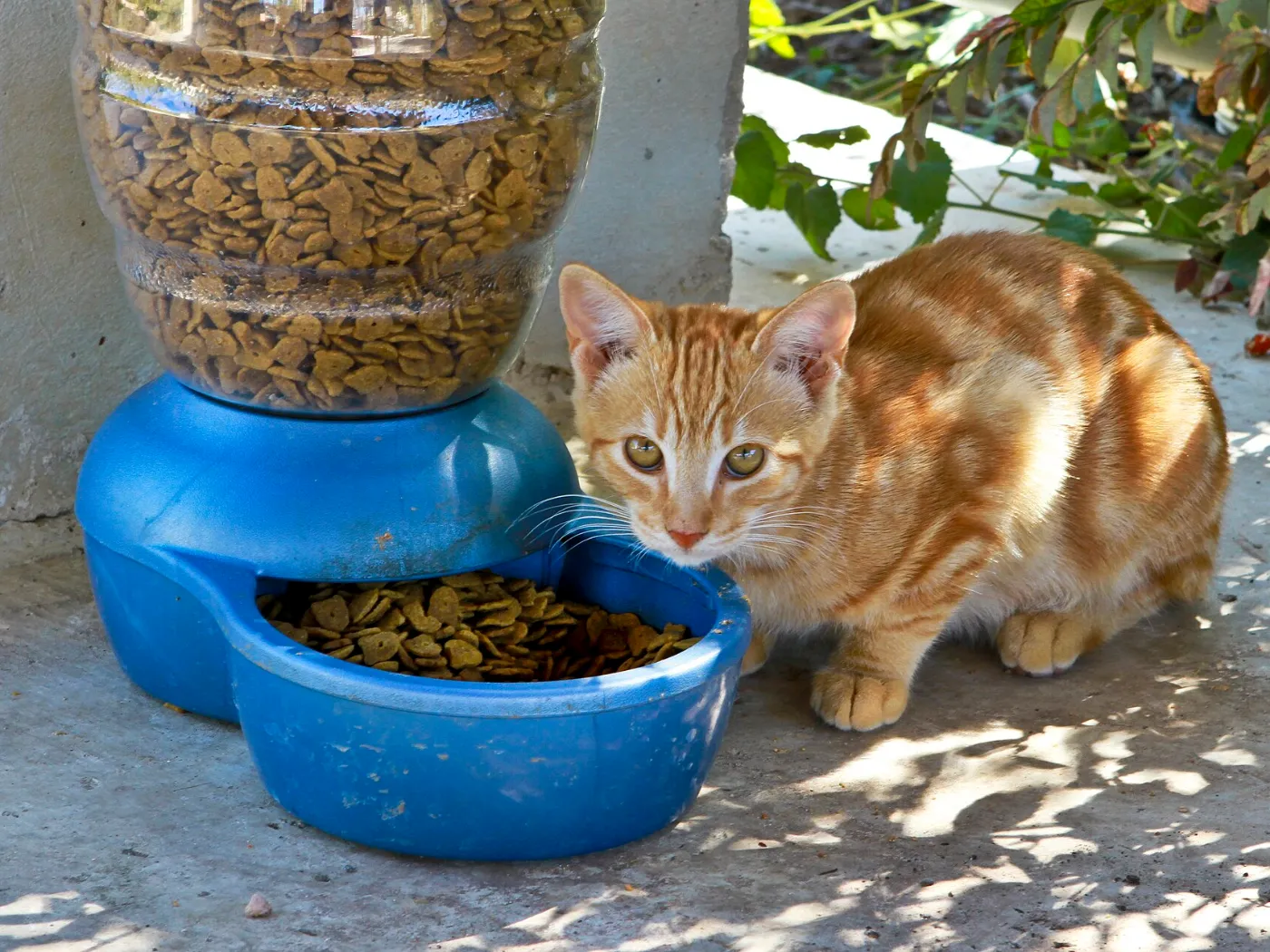
Moisture varies widely between products. That is why two labels showing the same protein percentage can deliver very different amounts of nutrition per bite. For livestock, dry matter intake (DMI) is the basis of almost all ration formulation.
Because moisture can vary from batch to batch, especially in silage, haylage and raw pet food, it is worth testing feeds regularly or asking the supplier for a recent analysis. A change of just ten percentage points in moisture can shift dry matter intake noticeably, which affects weight gain, milk yield and body condition over time.
For pet owners, dry matter values make it easier to choose foods for special needs, such as low-fat diets for pancreatitis-prone dogs or high-protein foods for active cats, by comparing labels on the same basis. Livestock farmers use the same principle every day: rations are formulated on a dry matter basis so animals receive consistent nutrients even when silage or pasture moisture changes after rain.
| Food or feed | Typical moisture | Typical dry matter |
|---|---|---|
| Dry kibble | 8–12% | 88–92% |
| Semi-moist pet food | 25–35% | 65–75% |
| Canned / wet pet food | 72–82% | 18–28% |
| Raw pet food | 60–75% | 25–40% |
| Hay | 10–15% | 85–90% |
| Corn silage | 60–70% | 30–40% |
| Fresh pasture | 75–85% | 15–25% |
Why Dry Matter Matters for Livestock
Farm animals eat to meet their dry matter needs. A dairy cow, for example, may eat about 3–4 % of her body weight in dry matter each day. If a ration includes wet feeds such as silage or fresh grass, the as-fed weight is much larger than the dry matter weight. Using a dry matter calculator ensures the ration delivers the intended nutrients and avoids under- or over-feeding when feed moisture changes, such as after rain or a new batch of silage.
Comparing Two Foods Step by Step
To compare a wet food with a dry food, run the dry matter calculator for each one and write down the results. Compare protein, fat and estimated carbohydrate on the dry matter basis rather than the label values. Then consider cost per day: divide the price of each food by the number of days it will feed your pet. This gives a complete picture of nutrition and value, and often shows that wet food delivers more protein per gram of dry matter than its label suggests.
Tips for Reading Labels
- Use the guaranteed analysis.It lists moisture, protein, fat and fibre.
- Compare like with like.Always convert both foods before comparing.
- Remember minimums.Label protein and fat are minimum values.
- Check feed moisture.Silage and pasture moisture can change from week to week.
- Consider calories too.Dry matter protein is useful, but energy content also matters.
- Ask a nutritionist.For special diets, a vet nutritionist can interpret the numbers.
Why Dry Matter Comparisons Matter
Pet owners often choose foods by the protein number on the label, not realising that water hides the true values. Farmers need dry matter values to balance rations accurately. A dry matter calculator removes the water from the equation, so you can make informed, like-for-like comparisons in seconds.
Who Can Use This Tool?
This tool is for pet owners comparing foods, animal nutrition students, livestock farmers, ration formulators and vets. It works on mobile and desktop.
Note: This dry matter calculator uses label values, which are minimums or maximums. Laboratory analysis gives exact results.
Frequently Asked Questions
What is dry matter basis?
It is the nutrient content of a food after all moisture has been removed, allowing fair comparison between wet and dry products.
How do you calculate dry matter?
Subtract the moisture percentage from 100. Then divide each nutrient percentage by that number and multiply by 100.
Why does wet food look low in protein?
Because wet food is about 75–80 % water. On a dry matter basis, its protein is often higher than kibble.
How do I estimate carbohydrates in pet food?
Subtract moisture, protein, fat, fibre and ash from 100. The calculator does this when ash is entered.
What is dry matter intake?
The amount of feed an animal eats with the water removed – the basis of livestock ration planning.
What if the label doesn’t list ash?
Many dry foods contain about 6–8 % ash and wet foods about 2–3 %; you can leave it blank if unknown.