
Horse Weight Calculator
Estimate your horse’s weight with just a tape measure.
Your Results
Enter your values and press Calculate to see your results.
What Is a Horse Weight Calculator?
A horse weight calculator estimates your horse’s body weight from two simple tape measurements: heart girth and body length. Most owners do not have access to a livestock scale, yet knowing your horse’s weight is essential for dosing dewormers and medicines, planning feed rations and monitoring condition over time. The heart girth formula is widely used by vets and equine nutritionists and is usually accurate to within a few percent.
Enter the heart girth and body length in inches or centimetres and choose the horse type. The calculator gives the estimated weight in pounds and kilograms, and a rounded-up weight to use when dosing paste dewormers.
How to Use the Horse Weight Calculator
- Stand your horse squarely on level ground.
- Measure the heart girth: around the barrel just behind the elbows and over the withers, after the horse breathes out.
- Measure the body length: from the point of the shoulder to the point of the buttock.
- Choose the horse type – adult, pony, yearling or weanling.
- Press Calculate to see the estimated weight.
Horse Weight Formula
The horse weight calculator uses the well-known heart girth and body length equation. The divisor changes for young horses and ponies, whose body proportions are different.
Weight (lb) = Heart girth² (in) × Body length (in) ÷ 330- Adult horses – divide by 330
- Ponies – divide by 299
- Yearlings – divide by 301
- Weanlings – divide by 280
- Metric – kg = girth² (cm) × length (cm) ÷ 11,877
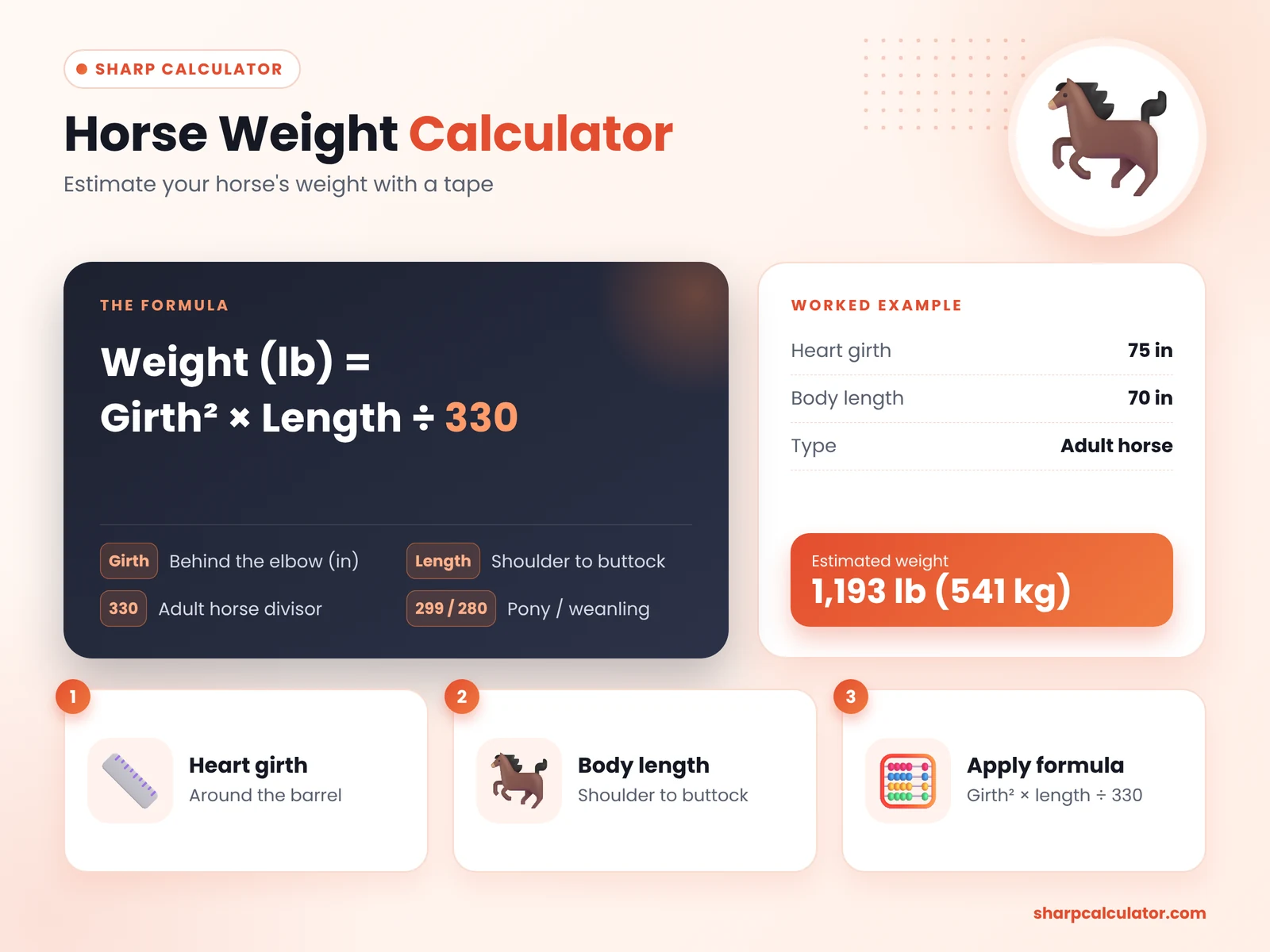
The formula is less accurate for very heavily muscled horses, draft breeds, heavily pregnant mares and horses at the extremes of body condition. For these horses, use the result as a guide and track changes over time.
Worked example
A riding horse has a heart girth of 75 inches and a body length of 70 inches.
Weight = 75² × 70 ÷ 330 = 1,193 lb (about 541 kg). For a paste dewormer you would dose for 1,200 lb.
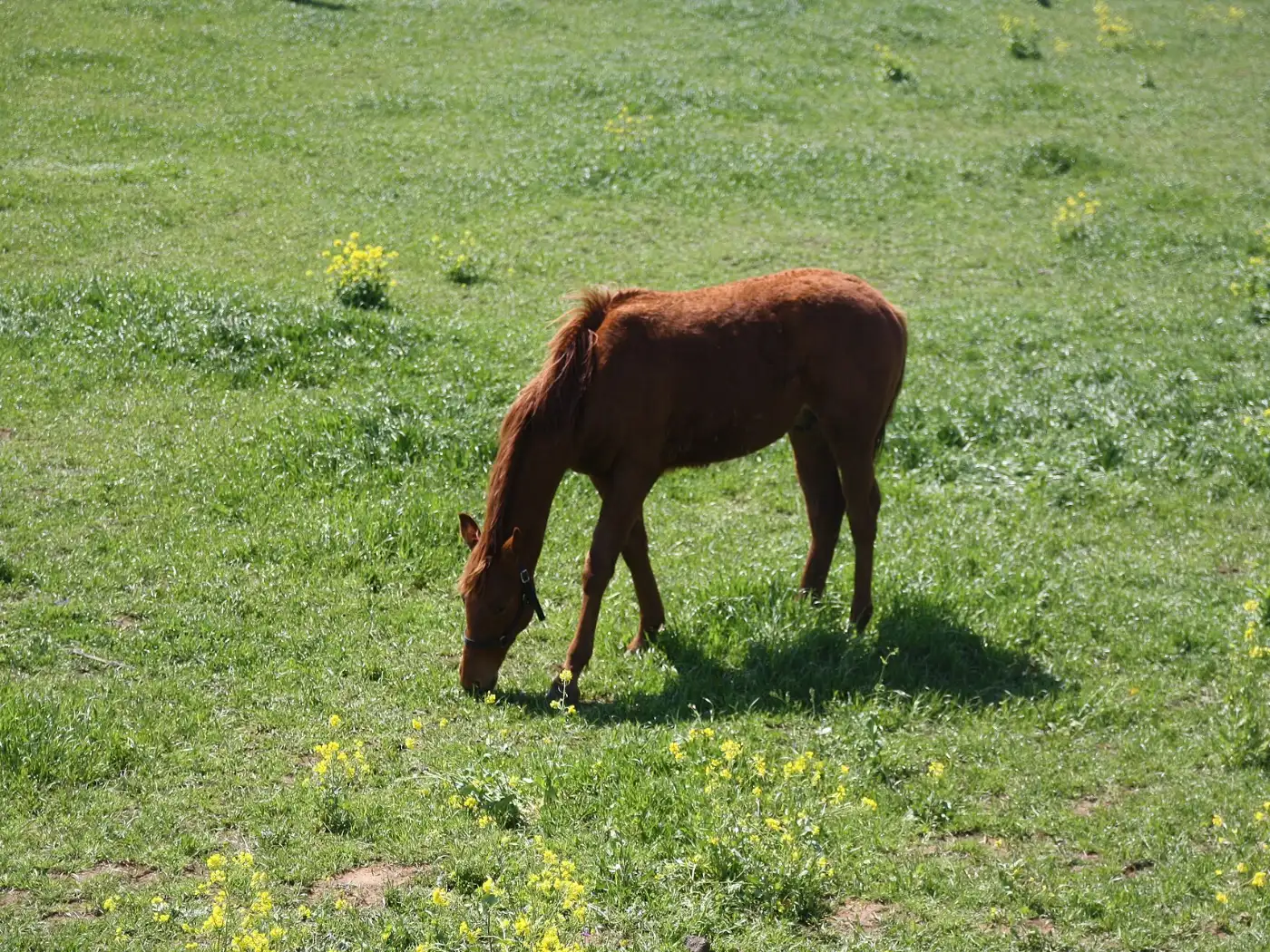
Average Weight of Horses by Breed
Weight varies widely with breed, height and condition. Comparing your horse with typical ranges helps you spot whether it may be underweight or carrying extra condition, but body condition scoring is the best way to judge fat cover.
Individual horses within a breed can vary by 200 lb or more depending on height, build, age and fitness. Use breed averages as a rough guide and rely on your own regular tape measurements to track changes over time.
Weight can change with the seasons. Many horses gain on spring grass and lose condition in winter, while older horses may struggle to hold weight as their teeth wear. Measuring every two to four weeks and recording the results in a simple log makes these changes easy to spot. Combine the numbers with a hands-on body condition check so you can adjust feed, exercise or dental care early. Ponies and draft breeds can fall outside these ranges, so treat the figures as a starting point rather than a target.
| Breed / type | Typical height | Typical weight |
|---|---|---|
| Shetland pony | 9–11 hh | 400–450 lb |
| Welsh pony | 12–14 hh | 500–800 lb |
| Arabian | 14.1–15.1 hh | 800–1,000 lb |
| Thoroughbred | 15.2–17 hh | 1,000–1,200 lb |
| Quarter Horse | 14.3–16 hh | 1,000–1,300 lb |
| Clydesdale | 16–18 hh | 1,600–2,000 lb |
How Much Should a Horse Eat?
Most adult horses eat 1.5–2.5 % of their body weight in dry matter each day, mainly as forage. A 1,200 lb horse therefore needs roughly 18–30 lb of hay or equivalent pasture daily, with at least 1 % of body weight as forage for digestive health. Weight estimates from a horse weight calculator are the starting point for feed planning; adjust based on work level, age, season and body condition.
Tracking Weight Over Time
Measure your horse every two to four weeks at the same time of day and in the same way, and record the results. A steady trend is more meaningful than a single number. Sudden weight loss can be an early sign of dental problems, parasites or illness, while gradual gain may mean feed or exercise needs adjusting.
Body Condition Scoring for Horses
Weight alone does not tell you whether a horse is too fat or too thin. The Henneke body condition score rates fat cover from 1 (poor) to 9 (extremely fat) by feeling the neck, withers, ribs, loin, tailhead and behind the shoulder. Most horses do best at a score of 5, where ribs can be felt but not easily seen. Combine regular tape measurements from this horse weight calculator with condition scoring to manage feed and exercise effectively.
Measuring Tips
- Use a soft tape.A cloth or weight tape follows the body’s curves.
- Measure on exhale.Take heart girth after the horse breathes out.
- Stand square.Uneven stance changes both measurements.
- Measure twice.Use the average of two readings.
- Round up for dewormers.Under-dosing contributes to parasite resistance.
- Record results.A weight log helps you notice changes early.
Why Knowing Your Horse’s Weight Matters
Medicines and dewormers are dosed by weight, and visual guesses are often wrong by 100 lb or more. Accurate weight also guides feed rations and helps you notice health problems early. A horse weight calculator gives you a reliable estimate with nothing more than a tape measure.
Who Can Use This Tool?
This tool helps horse owners, riders, barn managers, equine nutritionists, vets and students. It works on a phone at the barn.
Note: This horse weight calculator provides an estimate. For precise dosing of critical medicines, ask your vet or use a livestock scale.
Frequently Asked Questions
How do I calculate my horse’s weight?
Multiply the heart girth squared by the body length (in inches), then divide by 330 for adult horses.
How accurate is the heart girth formula?
It is usually within about 3–10 % of scale weight for average riding horses.
Where do I measure heart girth?
Around the barrel just behind the elbows and over the withers, where a girth would sit.
Is a weight tape accurate?
Weight tapes give a rough estimate; adding body length, as in this calculator, usually improves accuracy.
How much does an average horse weigh?
Many riding horses weigh between 900 and 1,300 lb (400–590 kg).
Can I use this for ponies and foals?
Yes. Choose pony, yearling or weanling to apply the appropriate divisor.