
DNA Copy Number Calculator
Convert DNA mass into the number of molecules – and back again.
Your Results
Enter your values and press Calculate to see your results.
What Is a DNA Copy Number Calculator?
A DNA copy number calculator converts the mass of a DNA sample into the actual number of molecules it contains. This is essential when you prepare absolute standard curves for qPCR or digital PCR, spike-in controls, transfection mixes or sequencing libraries, because experiments care about how many template copies are present, not just how many nanograms.
Enter the DNA amount, the template length and the type of nucleic acid. The calculator returns the copy number, the molar amount and, if you add a volume, the copies per microlitre. A second tab works in reverse and tells you how much DNA to use for a target copy number.
How to Use the DNA Copy Number Calculator
- Pick Mass → Copies to convert a measured amount of DNA into copies.
- Enter the DNA amount and choose ng, pg or µg.
- Enter the template length in base pairs (or nucleotides for single strands).
- Select dsDNA, ssDNA or RNA.
- Optionally add a volume to get copies/µL, then press Calculate.
- Use Copies → Mass to find how many ng you need for a chosen number of copies.
DNA Copy Number Formula
The DNA copy number calculator divides the mass of DNA by the mass of a single molecule. The mass of one molecule comes from its length, the average molecular weight per base pair and Avogadro’s number.
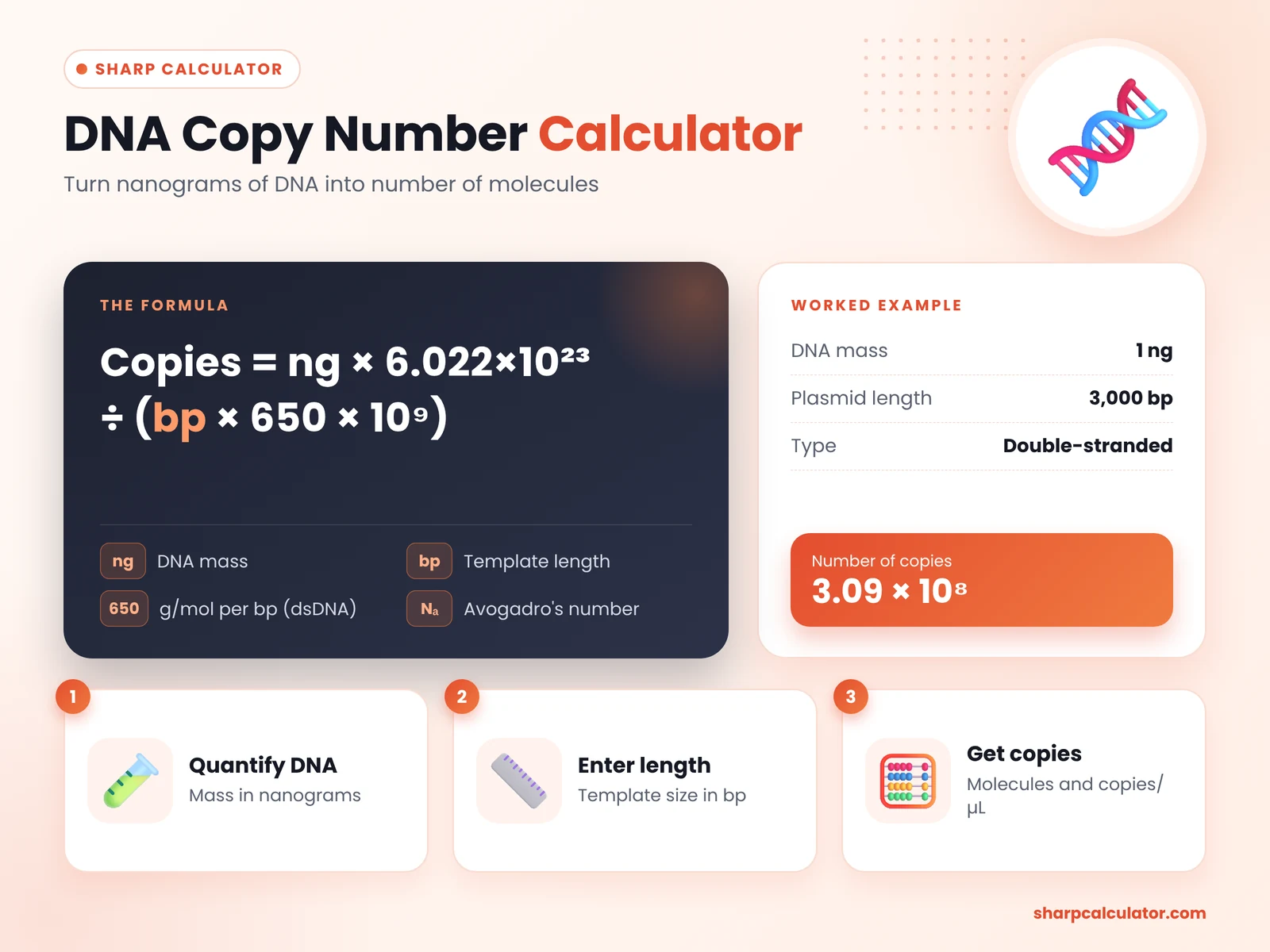
Copies = (ng × 6.022 × 10²³) ÷ (length × MW per bp × 10⁹)- ng – amount of DNA in nanograms
- 6.022 × 10²³ – Avogadro’s number (molecules per mole)
- length – template size in bp or nt
- MW per bp – 650 g/mol (dsDNA), 330 (ssDNA) or 340 (RNA)
- 10⁹ – converts grams to nanograms
Some protocols use 660 g/mol per base pair instead of 650. The difference is about 1.5 %, which is well within normal quantification error.
Worked example
You have 1 ng of a 3,000 bp plasmid.
Copies = (1 × 6.022 × 10²³) ÷ (3,000 × 650 × 10⁹) = 3.09 × 10⁸ copies. If that nanogram is in 10 µL, the stock contains about 3.1 × 10⁷ copies/µL – a good top standard for a ten-fold qPCR dilution series.

Building a qPCR Standard Curve
For absolute quantification, prepare a high-concentration stock, calculate its copy number, then make a ten-fold serial dilution covering at least five orders of magnitude. Each standard should be run in triplicate. Linearise plasmid standards when possible, because supercoiled DNA can amplify less efficiently than linear templates.
Store standard dilutions in low-binding tubes, avoid repeated freeze–thaw cycles and include a no-template control in every run to check for contamination.
Each ten-fold step should shift the Ct value by about 3.3 cycles when the assay is efficient. If the spacing between points is uneven, check pipetting accuracy, mix every dilution thoroughly and prepare fresh standards. Many labs make a large batch of the top standard, divide it into single-use aliquots and freeze them, so every run starts from exactly the same material. Recording the calculated copies per microlitre on each tube avoids confusion later and makes results comparable between experiments, operators and instruments. Writing the calculation in your lab notebook alongside the quantification method also helps when results need to be checked or repeated months later.
| Standard | Copies per reaction | Dilution |
|---|---|---|
| S1 | 10⁷ | Stock |
| S2 | 10⁶ | 1 : 10 |
| S3 | 10⁵ | 1 : 100 |
| S4 | 10⁴ | 1 : 1,000 |
| S5 | 10³ | 1 : 10,000 |
| S6 | 10² | 1 : 100,000 |
Copy Number for Genomic DNA
You can use the same formula for genomic DNA by entering the genome size. A haploid human genome is about 3.1 × 10⁹ bp, so one copy weighs roughly 3.3 pg. That means 10 ng of human genomic DNA contains around 3,000 haploid genome copies – a useful number when you estimate how many target copies are present in a PCR reaction from a tissue or blood sample.
Copy Number vs Concentration
Two samples with the same ng/µL can contain very different numbers of molecules. A 300 bp PCR product has ten times more copies per nanogram than a 3,000 bp plasmid, because each molecule is ten times lighter. That is why qPCR standards, CRISPR donor templates and spike-in controls should always be planned in copies or moles rather than mass. Converting with a DNA copy number calculator before every experiment keeps template input consistent across runs and between different constructs.
Tips for Accurate Results
- Quantify accurately.Use fluorometric dyes for low-concentration standards; A260 can over-estimate DNA in dilute samples.
- Use the full template length.For plasmids, enter the total plasmid size including the insert, not just the amplicon.
- Dilute in carrier.Low-copy standards stick to plastic; adding carrier tRNA or using low-bind tubes improves accuracy.
- Make fresh dilutions.Very dilute standards degrade quickly; prepare them on the day of the run.
- Pick the right molecule type.Single-stranded oligos and RNA transcripts use roughly half the molecular weight per base.
- Use wide-bore pipetting for genomic DNA.High-molecular-weight DNA is viscous; mix gently but thoroughly before sampling.
Why Copy Number Matters
Absolute quantification in qPCR, digital PCR and NGS library preparation depends on knowing exactly how many template molecules go into each reaction. A DNA copy number calculator links the mass you measure on a spectrophotometer to the molecules your assay detects, making standard curves reliable and results comparable between labs.
Who Can Use This Tool?
This tool supports molecular biologists, qPCR and dPCR users, diagnostics developers, students learning molecular units and anyone preparing nucleic acid standards. It runs on any phone or computer.
Note: This DNA copy number calculator uses average molecular weights. Actual values vary slightly with base composition and modifications.
Frequently Asked Questions
How do I calculate DNA copy number from ng?
Multiply the mass in ng by 6.022 × 10²³, then divide by the template length × 650 × 10⁹ for double-stranded DNA.
Should I use 650 or 660 g/mol per base pair?
Both are common averages. 650 g/mol is used here; switching to 660 changes the answer by only about 1.5 %.
How many copies are in 1 ng of a 3 kb plasmid?
About 3.1 × 10⁸ copies.
How do I calculate copies per µL?
Divide the total number of copies by the volume of the sample in microlitres. The calculator does this if you enter the volume.
Can I use this for RNA?
Yes. Choose single-stranded RNA, which uses an average of 340 g/mol per nucleotide.
How much DNA do I need for 10⁶ copies?
For a 3,000 bp dsDNA template, about 3.2 pg (0.0032 ng). Use the Copies → Mass tab for any length.