
Dihybrid Cross Calculator
Cross two genes at once and get the full 4 × 4 Punnett square.
Your Results
Enter your values and press Calculate to see your results.
What Is a Dihybrid Cross Calculator?
A dihybrid cross calculator predicts the offspring of two parents when you follow two different genes at the same time. Each parent can pass on four combinations of alleles, so the cross fills a 4 × 4 Punnett square with 16 boxes. Doing this by hand is slow and easy to get wrong; the calculator builds the square for you, lists every genotype and reduces the phenotypes to a simple ratio.
The best-known result is Gregor Mendel’s 9 : 3 : 3 : 1 ratio from crossing two double heterozygotes (AaBb × AaBb), but the tool works for any combination of homozygous and heterozygous parents.
How to Use the Dihybrid Cross Calculator
- Choose the gene A genotype for parent 1 (AA, Aa or aa).
- Choose the gene B genotype for parent 1.
- Repeat for parent 2.
- Press Calculate.
- Read the 16-box Punnett square, the phenotype ratio and the list of genotypes with their probabilities.
How the Dihybrid Cross Is Calculated
The dihybrid cross calculator follows Mendel’s law of independent assortment: alleles of gene A separate independently of alleles of gene B when gametes form.
Gametes from AaBb: AB, Ab, aB, abProbability = P(gene A outcome) × P(gene B outcome)- Uppercase letters – dominant alleles
- Lowercase letters – recessive alleles
- A_ – AA or Aa, showing the dominant trait
- Each box – a 1/16 chance for one offspring
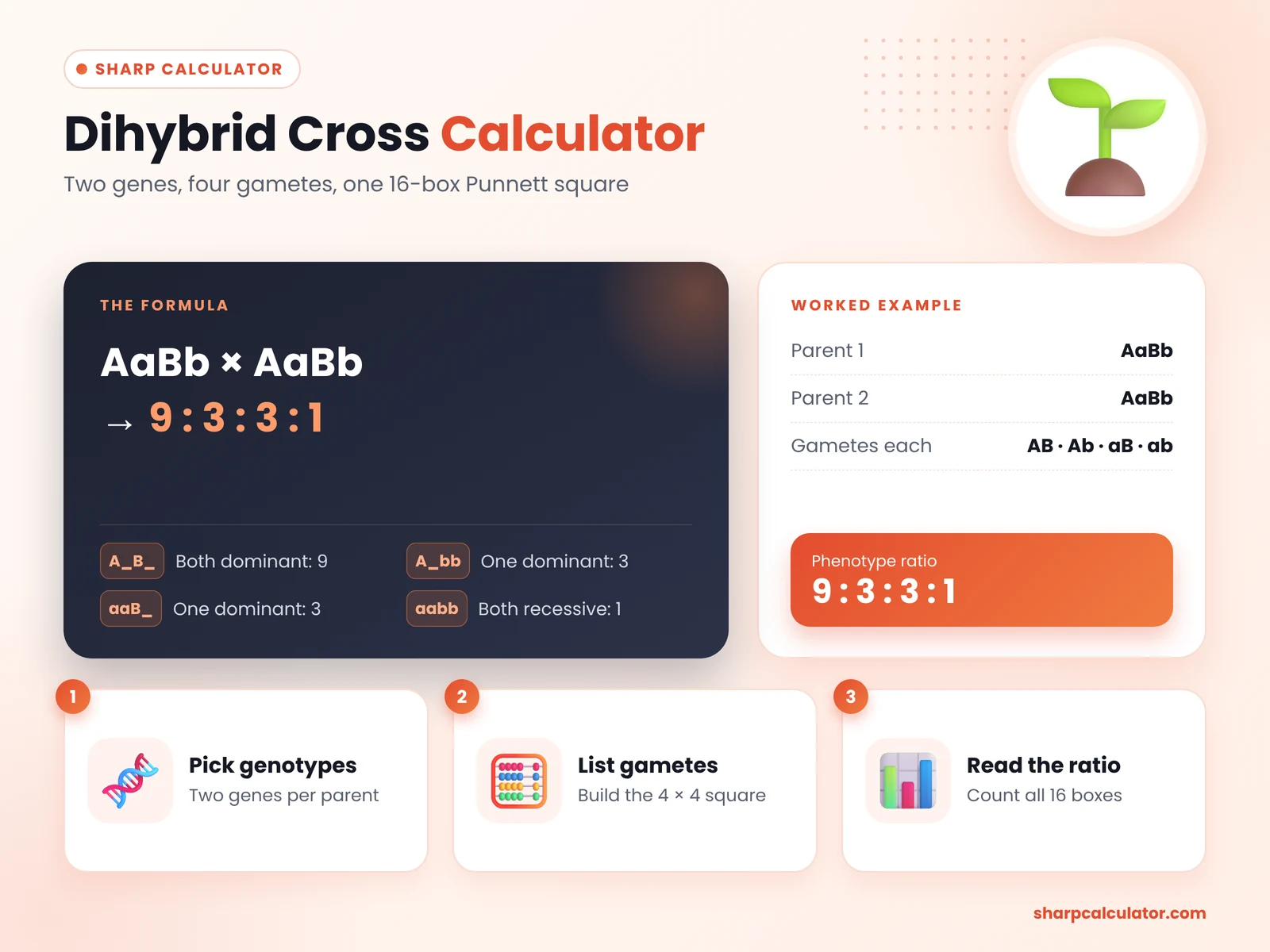
Because the genes act independently, you can also multiply two single-gene ratios: (3 : 1) × (3 : 1) gives 9 : 3 : 3 : 1. The calculator does the full square so you can see every combination.
Worked example: Mendel’s peas
Round-yellow peas (RrYy) are crossed with each other. Round (R) is dominant to wrinkled (r) and yellow (Y) is dominant to green (y).
The offspring appear in a 9 : 3 : 3 : 1 ratio: 9 round-yellow, 3 round-green, 3 wrinkled-yellow and 1 wrinkled-green out of every 16.

Common Dihybrid Cross Ratios
Not every two-gene cross gives 9 : 3 : 3 : 1. The ratio depends on whether each parent is homozygous or heterozygous for each gene. A test cross with a double recessive parent is especially useful because it reveals the gametes of the unknown parent directly.
These ratios assume the two genes sit on different chromosomes and assort independently. When genes are close together on the same chromosome, they tend to be inherited together and the offspring show more of the parental combinations. Comparing real results with the expected ratio is therefore a classic way for geneticists to detect gene linkage.
Breeders use the same logic when combining two desirable traits, such as disease resistance and fruit colour, in one variety. Knowing the expected ratio tells them how many offspring to grow to find the rare double-recessive or double-dominant plants they need. For example, a double-recessive plant appears in only 1 of every 16 offspring from two double heterozygotes, so at least 16–32 seedlings are usually grown to be confident of finding it.
| Cross | Phenotype ratio | Name |
|---|---|---|
| AaBb × AaBb | 9 : 3 : 3 : 1 | Classic dihybrid |
| AaBb × aabb | 1 : 1 : 1 : 1 | Test cross |
| AaBb × AAbb | 1 : 1 | Only gene B segregates |
| AABB × aabb | All A_B_ | Uniform F1 |
| AaBB × Aabb | 3 : 1 | One gene segregating |
Dihybrid vs Monohybrid Cross
A monohybrid cross follows one gene and produces a 2 × 2 Punnett square with four boxes, giving ratios such as 3 : 1 for phenotype and 1 : 2 : 1 for genotype. A dihybrid cross follows two genes, so the square grows to 16 boxes and nine different genotypes become possible. The extra complexity is exactly why a dihybrid cross calculator is helpful: one missed gamete can change the whole answer.
You can also solve a dihybrid problem with the product rule. Work out the probability for each gene separately, then multiply. For AaBb × AaBb, the chance of an aabb offspring is ¼ × ¼ = 1/16, which matches the single box in the corner of the full Punnett square.
Tips for Accurate Results
- Use standard notation.Write the dominant allele first (Aa, not aA) to keep genotypes easy to read.
- Check gene linkage.Genes close together on the same chromosome do not assort independently, so real ratios may differ.
- Remember dominance.The tool assumes complete dominance; incomplete dominance or epistasis change the phenotype ratio.
- Use probabilities for small families.A 9 : 3 : 3 : 1 ratio describes probabilities, not exact counts in a litter.
- Try a test cross.Crossing with aabb reveals an unknown genotype in the next generation.
- Compare with real data.Use a chi-square test to see whether observed offspring fit the expected ratio.
Why Dihybrid Crosses Are Important
Dihybrid crosses show how independent assortment produces new combinations of traits, one of the key reasons sexual reproduction creates variation. Breeders use the same logic to plan crosses for two desirable traits, and students use it to master probability in genetics. A dihybrid cross calculator lets you check homework, explore different parent combinations and visualise the full Punnett square instantly.
Who Can Use This Tool?
This tool helps biology students, teachers preparing worksheets, plant and animal breeders, and anyone curious about Mendelian inheritance. It is free, mobile friendly and needs no sign-up.
Note: This dihybrid cross calculator assumes two unlinked genes with complete dominance. Real inheritance can be affected by linkage, epistasis and other factors.
Frequently Asked Questions
What is a dihybrid cross?
A dihybrid cross follows two different genes at once, such as seed shape and seed colour, between two parents.
Why does AaBb × AaBb give a 9:3:3:1 ratio?
Each gene alone gives a 3 : 1 ratio. Because the genes assort independently, multiplying (3 : 1) × (3 : 1) gives 9 : 3 : 3 : 1.
How many boxes are in a dihybrid Punnett square?
Sixteen. Each parent produces up to four gamete types, giving a 4 × 4 grid.
What is a dihybrid test cross?
It is a cross between an individual with the dominant phenotype and a double recessive (aabb) partner. AaBb × aabb gives a 1 : 1 : 1 : 1 ratio.
Does the calculator handle linked genes?
No. It assumes independent assortment. Linked genes produce more parental combinations and fewer recombinants.
Can I use any letters for the genes?
The calculator uses A and B, but you can map them to any traits, such as R for round and Y for yellow.