
This Estate Tax Calculator provides a simplified estimate for general planning purposes only and is not legal or tax advice. It uses approximate 2025 and 2026 federal exemption amounts and a simplified federal estate tax rate schedule. State estate tax estimates use simplified exemption and rate assumptions and may not reflect actual state rules, deductions, credits, graduated brackets, or filing requirements. Estate tax laws can change, so consult a qualified tax professional or estate planning attorney for advice about your specific situation.
What is an estate tax calculator?
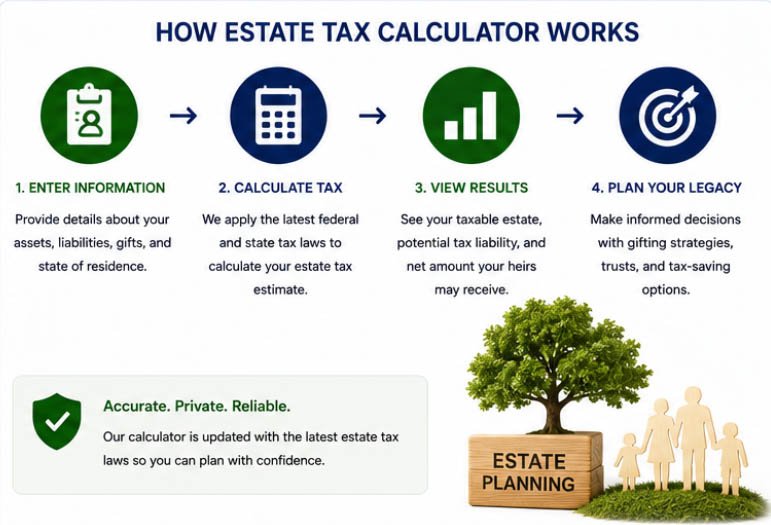
An Estate Tax Calculator estimates the federal estate tax, and for some states the state estate tax, that may be due on a person’s estate at death. It adds up the estate’s assets, subtracts debts, expenses and charitable bequests, adds back taxable lifetime gifts and applies the exemption for the chosen year. It is a planning tool for people with larger estates and their families.
How to use it
- Choose the tax year and, if relevant, the state.
- Enter the value of each type of asset: real estate, investments, retirement accounts, life insurance, business interests, personal property and other assets.
- Enter debts and mortgages, funeral and administrative expenses, and charitable bequests.
- Enter any taxable gifts already made during life (gifts above the yearly exclusion).
- Click Calculate.
What is an estate?
An estate is everything a person owns or controls at death, valued at fair market value: bank accounts, investments, homes, retirement accounts, life insurance they owned, business interests and personal property.

How is estate tax calculated?
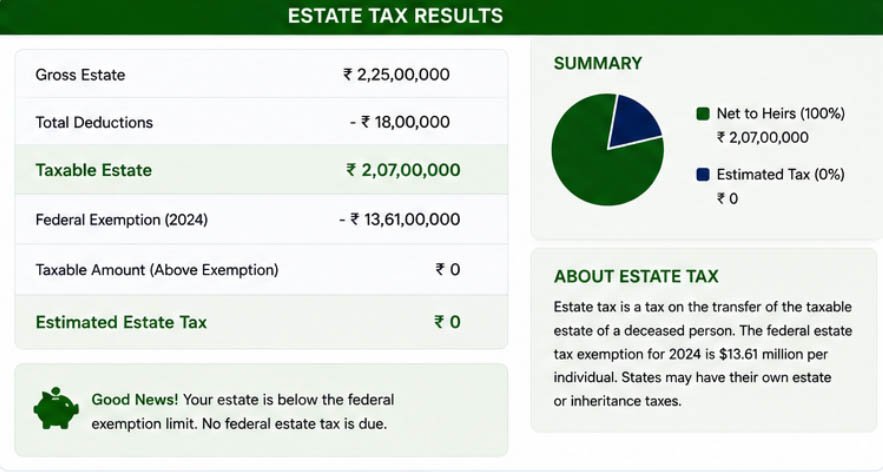
Taxable estate = Gross estate − Debts − Expenses − Charitable bequests
Estate tax = Tax on (taxable estate + taxable lifetime gifts) − Tax on the basic exclusion amount
Because the exclusion is so large, any estate that owes tax pays the top rate of 40% on the amount above the exclusion.
Key facts for 2026
- Federal basic exclusion amount: $15,000,000 per person (2026, source: IRS Rev. Proc. 2025-32).
- Top federal estate tax rate: 40% (source: irs.gov).
- Assets left to a US-citizen spouse are generally deductible (the marital deduction). This calculator does not have a separate marital deduction field, so enter only the assets that will not pass to a surviving spouse.
Example
An estate of $20,000,000 with no deductions or prior taxable gifts, for a death in 2026: the amount above the exclusion is $5,000,000, so the federal estate tax is about 40% × $5,000,000 = $2,000,000, leaving about $18,000,000 to heirs.
Estate Tax and Inheritance Tax
Estate tax and inheritance tax are not the same. Estate tax is generally determined from the value of the deceased person’s taxable estate before assets are distributed. Inheritance tax, on the other hand, is generally imposed on the person receiving the inheritance. The federal government does not impose a federal inheritance tax, although some states have their own inheritance tax rules.
The amount of inheritance tax, where applicable, can depend on the value received and the relationship between the beneficiary and the deceased person. Spouses are generally treated more favorably under state inheritance tax rules, while more distant beneficiaries may face different requirements.

Tips
- Most estates owe no federal estate tax because of the large exclusion, but several states have much lower thresholds.
- Married couples can often combine their exclusions; ask an estate attorney about portability.
- Lifetime gifts above the yearly gift tax exclusion use up part of the estate exclusion.
- Review beneficiary designations on retirement accounts and life insurance; they pass outside the will.
Frequently Asked Questions
An Estate Tax Calculator estimates the potential federal estate tax based on the value of an estate, applicable deductions, taxable gifts, and the relevant exemption. It can help with preliminary estate planning and financial estimates.
The gross estate can include cash, securities, real estate, insurance, trusts, annuities, business interests, and other assets owned or controlled by the individual. These assets are generally valued using their fair market value.
Certain liabilities and expenses can reduce the value of the taxable estate. Examples can include mortgages, unpaid debts, and qualifying estate administration expenses.
Qualifying charitable gifts can receive favorable estate tax treatment and may reduce the taxable value of an estate. The specific requirements depend on the type of gift and applicable tax rules.
Estate planning can be useful at any age because it can establish guardianship arrangements for children, specify how assets should be managed, and identify someone responsible for handling the estate.
Disclaimer: This calculator gives estimates for general information only. It is not financial, tax or legal advice. Results depend on the numbers you enter and on simplified assumptions, so your actual figures may differ. Check important decisions with a qualified professional or the official source.
Related Calculators
For other tax and retirement planning, try these calculators.
Written by Sharp Calculator Team — we build and test every calculator on this site, checking each formula against hand-worked examples and official sources. Last updated: October 2026.