
Mortgage Interest
Charitable Donations
Student Loan Interest, $2,500 Max
Child Care Expenses, $3,000 Max
Education Tuition, $4,000 Max
This is a simplified estimate for general planning only — not tax advice. It uses approximate 2025 federal brackets, a simplified stacking method for capital gains, a flat-rate state/local tax estimate, and does not model phase-outs, AMT, or NIIT. Consult a tax professional for your actual liability.
What Is a Marriage Tax Calculator?
A Marriage Tax Calculator helps married couples estimate how their tax situation may change after marriage. Filing as a married couple can sometimes reduce the overall tax burden, especially when one spouse earns significantly more than the other. However, couples with similar or higher incomes may experience a marriage penalty, where their combined tax liability is greater than it would have been if they had remained single.

Benefits of Filing Jointly
Married couples commonly choose the married filing jointly status because it may provide access to tax benefits that are unavailable or limited for some single filers. Depending on eligibility, these can include earned income benefits, education-related tax credits, student loan interest deductions, and certain retirement contribution opportunities. Joint filing can also be particularly beneficial when there is a significant difference between the spouses’ incomes.
Another potential advantage is that filing jointly may place combined income into a more favorable tax structure than filing as two single individuals. A non-working spouse may also qualify for certain retirement-saving opportunities through a spousal IRA when the couple meets the applicable requirements.
Married Filing Separately
Although married couples generally file jointly, married filing separately is another filing status that may be available. In some specific situations, separate filing can make financial sense, but it can also limit access to certain deductions and credits. The appropriate choice depends on the couple’s income, deductions, credits, and overall financial circumstances.
A Marriage Tax Calculator can help provide an estimate of the potential difference between being taxed as married compared with being taxed as single. The results should be viewed as an estimate rather than a substitute for professional tax advice.


What Is the Marriage Penalty?
The marriage penalty occurs when two married individuals pay more combined taxes than they would have paid as two otherwise equivalent single taxpayers. This can happen when both spouses have substantial incomes, and their combined earnings move them into less favorable tax brackets or cause certain credits and deductions to become limited.
The opposite can also occur. When there is a large difference between spouses’ incomes, combining income through joint filing may produce a lower overall tax liability. For this reason, the financial effect of marriage varies considerably from one household to another.
How a Marriage Tax Calculator Can Help
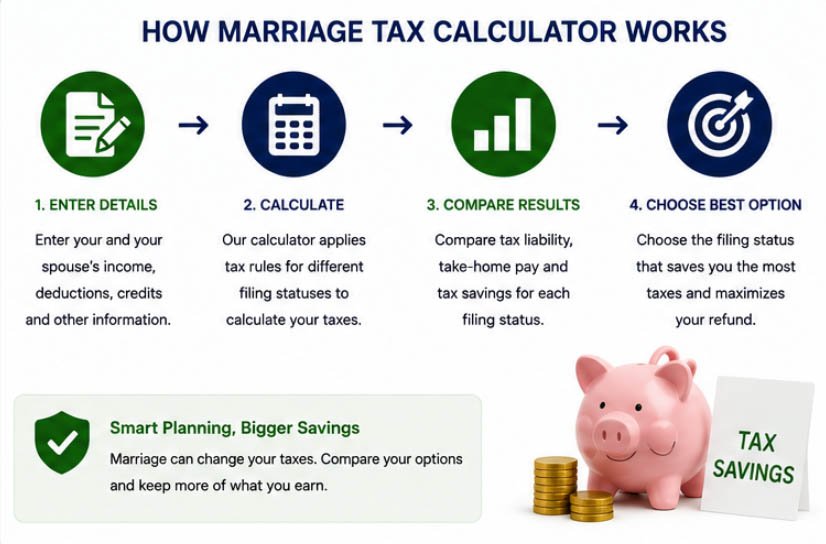
A Marriage Tax Calculator provides a convenient way to estimate how marriage may affect your tax position. By entering relevant income and tax information for both spouses, you can compare potential outcomes and better understand whether filing jointly may result in a tax benefit or a higher liability.
Because tax rules, deductions, credits, and income thresholds can change, calculator results should be used for planning and comparison rather than treated as a final tax return calculation.
Frequently Asked Questions
Yes. Marriage can change your filing status and may affect your tax brackets, deductions, and credits. The impact depends on the income of both spouses and their individual financial circumstances.
In many cases, filing jointly can provide tax advantages, particularly when one spouse earns significantly more than the other. However, couples with similar or higher incomes may experience a marriage penalty.
The marriage tax penalty occurs when a married couple pays more in combined taxes than they would have paid as two otherwise equivalent single taxpayers. It can occur when combined income reaches less favorable tax brackets or certain benefits become limited.
Yes. A non-working spouse can still affect the household’s tax situation when the couple files jointly. Depending on eligibility, joint filing may also provide access to certain retirement contribution opportunities.
Yes, married couples may generally choose married filing separately instead of filing jointly. However, separate filing can limit certain deductions and tax credits, so the best option depends on the couple’s circumstances.
Related Calculator:
Explore more financial tools designed to simplify your calculations. Whether you’re planning a mortgage, estimating an auto loan, calculating taxes, or tracking investment growth, our free calculators provide fast and accurate results to help you make smarter financial decisions.