
IRA Calculator
| Traditional, SIMPLE, or SEP IRA | Roth IRA | Regular Taxable Savings | |
|---|---|---|---|
| Balance at age 65 | $0 | $0 | $0 |
| Balance at age 65 (after tax) | $0 | $0 | $0 |
—
Annual Schedule
| Age | Traditional/SIMPLE/SEP IRA (Before Tax) |
Traditional/SIMPLE/SEP IRA (After Tax) |
Roth IRA (After Tax) |
Regular Taxable Savings (After Tax) |
||||
|---|---|---|---|---|---|---|---|---|
| Start | End | Start | End | Start | End | Start | End | |
Estimates only. Assumes a simplified model: the taxable account pays tax on its gains every year at your current marginal rate, and the Traditional/SIMPLE/SEP IRA's after-tax value simply applies your expected retirement tax rate to its before-tax balance. Actual accounts, contribution limits, and tax rules are more complex and may change. Not tax or financial advice.
IRA Calculator
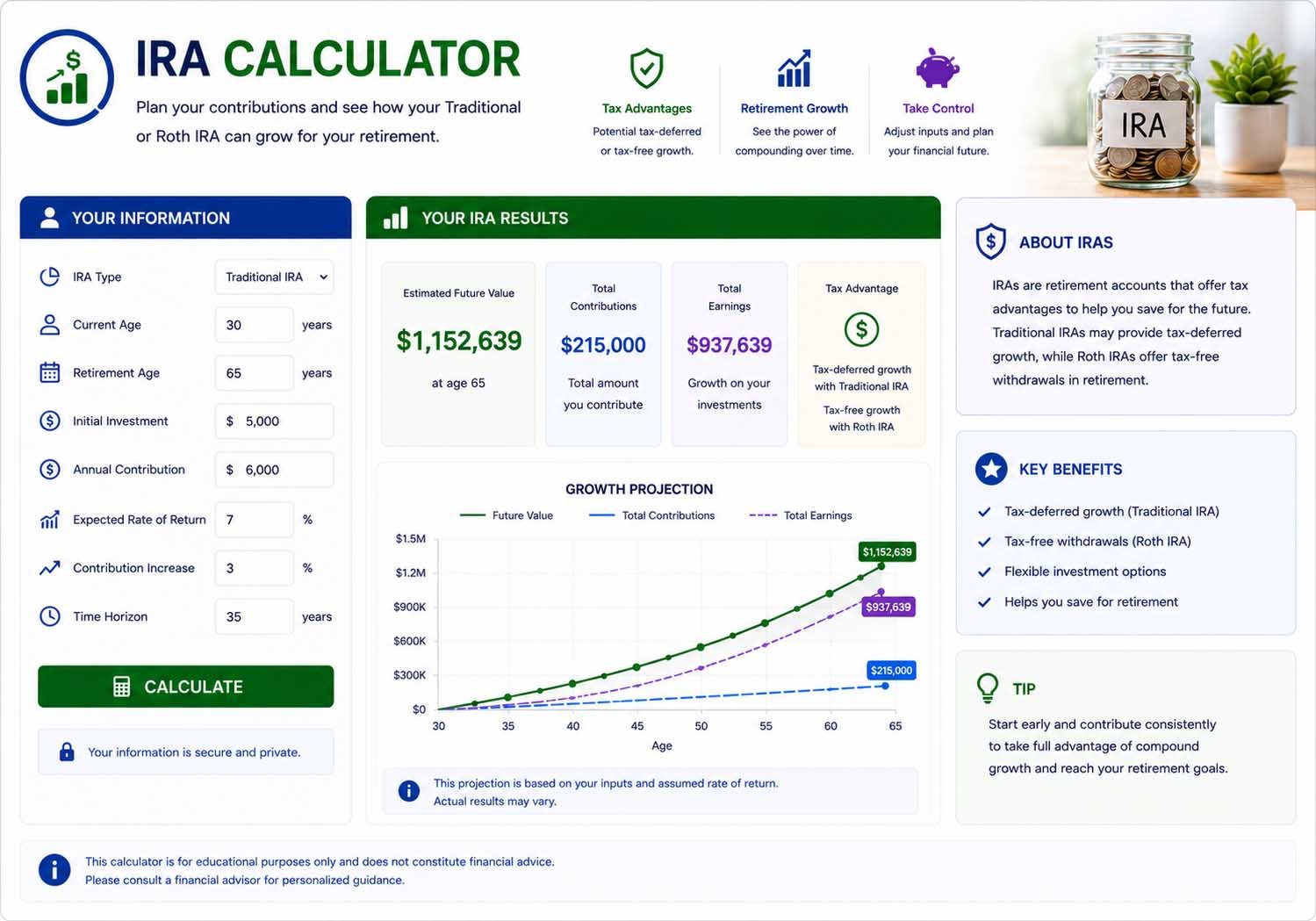
An IRA Calculator helps estimate how your retirement savings could grow over time. By entering your current balance, regular contributions, expected return, and investment period, you can see a potential future value for your IRA.
Whether you are starting with a small amount or already have substantial retirement savings, an IRA calculator makes it easier to compare different savings and retirement scenarios.
IRA Calculator Formula
For a simplified compound-growth estimate, the future value can be calculated using:
Future Value = Current Balance × (1 + r)ⁿ + Contributions
Where r represents the expected rate of return and n represents the investment period.
How Does an IRA Calculator Work?
An IRA calculator uses your current IRA balance, contribution amount, expected annual return, and number of years to estimate how much your account could potentially grow. The longer your money remains invested, the more opportunity compound growth has to increase your balance.
An IRA calculator compound interest estimate can be especially useful when comparing different contribution levels. You can adjust the assumptions to see how increasing your monthly or annual contributions may affect your projected retirement savings.
The calculation is based on assumptions, so the final result is not guaranteed. Actual investment returns can change from year to year depending on market performance.
IRA Calculator by Retirement Age
Your age and expected retirement date can have a major impact on your projected IRA balance. Someone who starts saving at 30 may have several more decades for contributions and investment growth than someone who starts at 50.
An IRA calculator allows you to compare different retirement ages and contribution amounts. This can help you understand how delaying retirement or increasing savings could potentially affect your available funds.
A 401k IRA calculator can also be useful when comparing IRA savings with money invested through an employer-sponsored 401(k). These accounts have different rules and features, so they should be evaluated separately as part of an overall retirement plan.
SIMPLE IRA Calculator
A SIMPLE IRA calculator is designed for estimating retirement savings in a SIMPLE IRA, which is an employer-sponsored retirement plan for eligible small businesses and their employees.
Because contribution rules and employer contributions can differ from a traditional IRA, using the appropriate calculator can provide a more relevant estimate.
If you are comparing multiple retirement accounts, consider your contributions, employer contributions, investment returns, fees, and expected retirement income rather than focusing only on the final account balance.
How Do I Calculate My IRA?
To calculate your IRA’s potential future value, you generally need your current account balance, regular contribution amount, expected annual return, and the number of years you plan to remain invested.
Enter these values into the calculator and review the estimated future balance. You can then change one factor at a time to see how different savings strategies affect the result.
People also search for tools such as an IRA calculator Bankrate, IRA calculator NerdWallet, and IRA calculator Schwab. These calculators may use different layouts or assumptions, but the goal is generally to help users estimate retirement savings.
IRA Calculator 2026
An IRA Calculator 2026 can help you estimate retirement growth using your current savings and planned contributions for the 2026 tax year.
IRA contribution limits, income restrictions, and tax rules can change, so make sure the assumptions you enter match the applicable tax year. A calculator can estimate potential growth, but it does not determine your personal eligibility or tax liability.
You can use the calculator to test different scenarios, such as contributing more each year, starting at a younger age, or changing your expected investment return.
What Can You Use an IRA Calculator For?
A Free IRA Calculator can help you explore several common retirement-planning questions without manually performing calculations.
- Estimate potential IRA growth over 10, 20, or 30 years.
- Compare different monthly or annual contribution amounts.
- See how compound growth may affect long-term savings.
- Compare different expected rates of return.
- Estimate how much you may have accumulated by retirement.
- Test different retirement ages and savings strategies.
The results should be treated as estimates rather than guarantees because investment performance and future financial conditions can change.
Can You Retire With $500,000 in an IRA?
It is possible for someone to retire with $500,000 in an IRA, but whether that amount is enough depends on several factors. Your retirement age, annual expenses, Social Security income, other savings, taxes, and expected investment returns all affect how long the money may last.
For example, someone with low annual expenses and additional retirement income may need less from their IRA than someone who relies heavily on IRA withdrawals.
Instead of asking whether a specific balance is automatically enough, use an IRA calculator to estimate potential growth and withdrawals based on your own retirement assumptions.
How Much Will an IRA Grow in 20 Years?
The growth of an IRA over 20 years depends mainly on the starting balance, contributions, and investment return. Regular contributions can make a significant difference because each contribution has the potential to grow over time.
For example, an account with a $20,000 starting balance will have a different projected value from an account starting with $100,000, even if both earn the same return.
An IRA calculator can show multiple scenarios so you can compare conservative, moderate, and higher return assumptions.
Frequently Asked Questions
Investing $100 each month for 30 years means making 360 monthly contributions. The final balance depends on the average investment return, but compound growth can make a substantial difference over a long period.
An IRA calculator provides an estimate based on the information and expected return you enter. It cannot predict actual investment performance, so your real account balance may be higher or lower than the calculated amount.
The appropriate contribution depends on your income, expenses, retirement goals, and other savings. Contributing consistently and increasing contributions when possible can help build retirement savings over time.
Yes. An IRA calculator can help estimate how much your account could potentially grow and compare different savings scenarios. For a complete retirement plan, you should also consider Social Security, pensions, other investments, taxes, and expected expenses.
Neither account is automatically better for everyone. IRAs and 401(k)s have different contribution rules, tax treatment, investment choices, and employer benefits. Comparing both based on your circumstances can help determine how they fit into your retirement strategy.
Related Calculator:
Explore more financial tools designed to simplify your calculations. Whether you’re planning a mortgage, estimating an auto loan, calculating taxes, or tracking investment growth, our free calculators provide fast and accurate results to help you make smarter financial decisions.