
Your RMD for 2026 is $0.
The distribution period for your case is: 0.
If you only withdraw the RMD at the end of each year and your return rate is 5% per year, your future account balance and RMDs will look like the following.
RMD Schedule
| Year | Your Age | Distribution Period | RMD | End of Year Balance |
|---|
What is an RMD calculator?
A required minimum distribution (RMD) is the smallest amount the IRS requires you to withdraw each year from a traditional IRA, 401(k) or similar tax-deferred account once you reach a certain age. This RMD Calculator estimates this year’s RMD from your birth year and last year’s closing balance, and projects future RMDs if you take only the minimum. It is for account owners approaching or already taking RMDs. It does not calculate RMDs for inherited accounts.
How to use it
- Enter your year of birth and the year you want the RMD for.
- Enter the account balance on December 31 of the previous year.
- Say whether your spouse is the sole primary beneficiary and, if so, enter their birth year (a spouse more than 10 years younger changes the table used).
- Optionally enter a rate of return to project future balances, then click Calculate.
Key facts for 2026
- RMDs start at age 73 if you were born between 1951 and 1959, and at age 75 if you were born in 1960 or later.
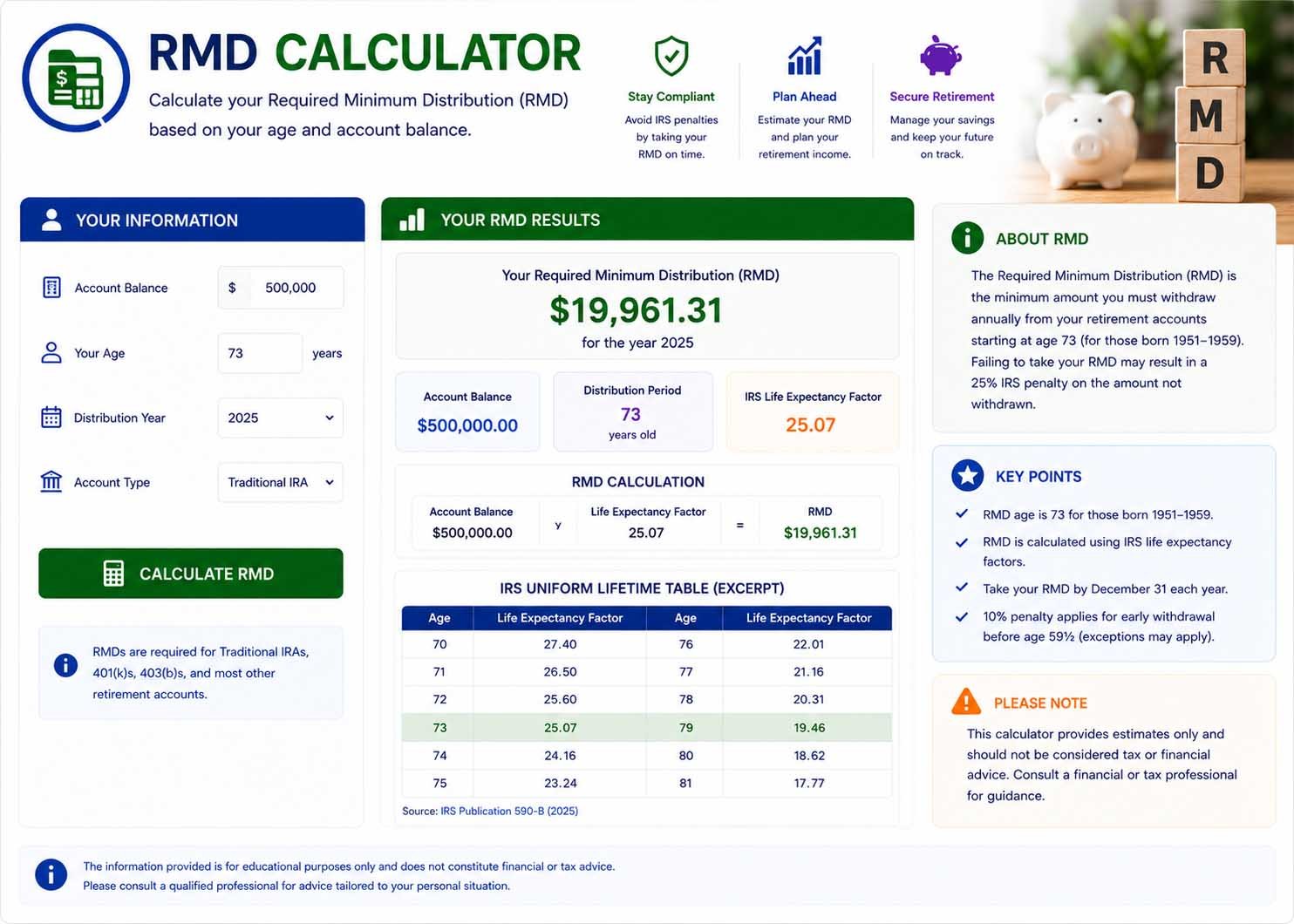
- Most owners use the IRS Uniform Lifetime Table. Its distribution period at age 73 is 26.5.
- If your spouse is your sole beneficiary and more than 10 years younger, the Joint Life and Last Survivor Expectancy Table is used instead, which gives a smaller RMD.
- Roth IRAs have no RMDs for the original owner.
(2026, source: irs.gov and IRS Publication 590-B)
RMD formula
RMD = Account balance on December 31 of last year ÷ Distribution period
The distribution period is the factor for your age in the IRS table that applies to you.
Example
You turn 73 this year and your IRA held $500,000 on December 31 last year. Using the Uniform Lifetime Table factor of 26.5: $500,000 ÷ 26.5 = $18,868. That is the minimum you must withdraw this year. The factor gets smaller each year, so the percentage you must take out rises with age.
RMDs and the 4% rule
The 4% rule is a spending guideline; an RMD is a legal minimum. At 73 the RMD works out to about 3.8% of the balance (1 ÷ 26.5), and it rises each year after that. You can always withdraw more than the RMD, but every dollar from a traditional account is taxable income.
Tips
- Missing an RMD can trigger an excise tax on the amount you should have withdrawn, so set a reminder before year-end.
- If you have several IRAs, you can add up their RMDs and take the total from any one of them; 401(k) RMDs are worked out and taken plan by plan.
- Your first RMD can be delayed until April 1 of the following year, but then you take two RMDs in one tax year.
Frequently Asked Questions
Under current law, RMDs start at 73 for people born from 1951 to 1959 and at 75 for people born in 1960 or later. Older rules used 70½ and then 72.
Yes. An RMD calculator by age can estimate your required distribution using your age, account balance, and the applicable life-expectancy factor.
Divide last year’s December 31 balance by 26.5. For a $500,000 balance that is about $18,868; for $200,000 it is about $7,547.
RMDs from traditional tax-deferred retirement accounts are generally included in taxable income, although the tax treatment can vary depending on the account and your circumstances.
Generally, you can withdraw more than the required minimum from an applicable retirement account. However, taking more than the RMD can increase your taxable income, so consider the tax consequences before making additional withdrawals.
Disclaimer: This calculator gives estimates for general information only. It is not financial, tax or legal advice. Results depend on the numbers you enter and on simplified assumptions, so your actual figures may differ. Check important decisions with a qualified professional or the official source.
Related Calculators
To plan withdrawals alongside your other retirement income, try these calculators.
Written by Sharp Calculator Team — we build and test every calculator on this site, checking each formula against hand-worked examples and official sources. Last updated: October 2026.