
Determine the ideal application age
Use the following calculation to determine the ideal age to apply for Social Security retirement benefits based on age, life expectancy, and average investment performance.
| Claim Age | % of Full Benefit | Monthly Benefit† | Accumulated by Life Expectancy |
|---|
Compare two application ages
Use the following calculation to compare the financial difference between two Social Security retirement benefit application ages. The U.S. Social Security website provides estimated benefit payment amounts of different claim ages.
| Age | Option 1, Saved | Option 2, Saved |
|---|
* Cost-of-living adjustment increases the monthly payment each year to help keep pace with inflation. † Assumes a baseline of $1,000/month at full retirement age, purely to compare claiming ages against each other — your actual benefit amount depends on your earnings history. Estimates only; not financial or Social Security advice. Consult the Social Security Administration for your actual benefit estimates.
Social Security Calculator
A Social Security Calculator helps estimate your potential retirement benefits based on factors such as your earnings history, age, and planned retirement date. It can be useful for comparing different claiming ages and understanding how your expected Social Security retirement benefits may change over time. A Social Security benefits calculator can also help with basic retirement income planning.
How Social Security Benefits Are Calculated
Your Social Security benefit is generally based on your lifetime earnings covered by Social Security. The Social Security benefits calculation uses your earnings record to determine an average indexed monthly earnings amount, which is then used to calculate your estimated benefit. Your claiming age is also important because starting benefits at different ages can change the amount you receive.
Understanding how Social Security benefits are calculated can make retirement planning easier. A Social Security retirement calculator allows you to enter relevant information and estimate potential benefits without working through the calculation manually.
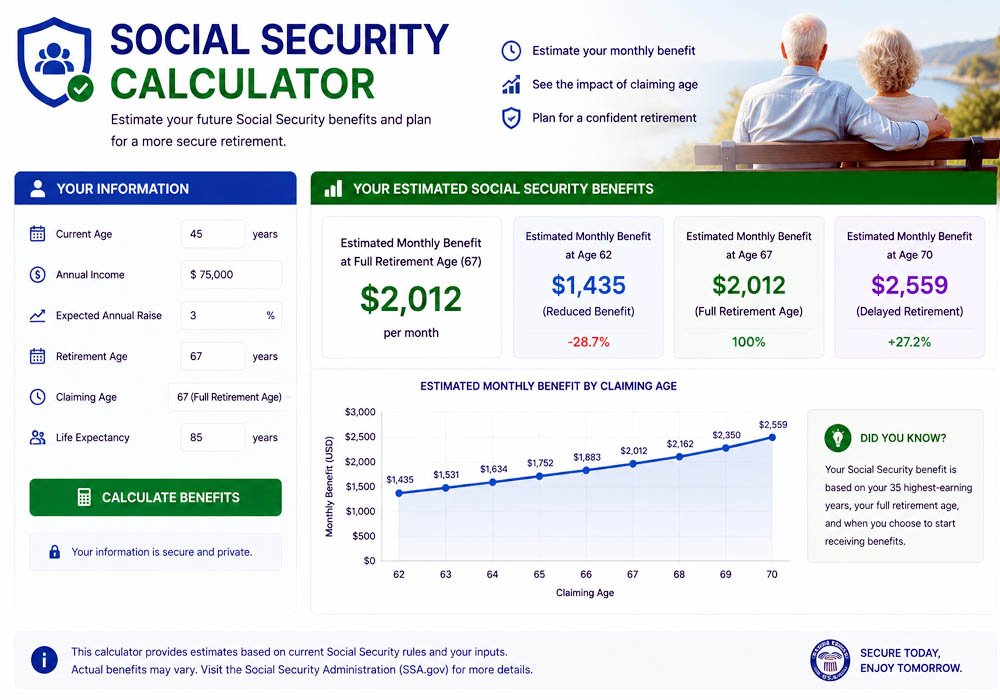
SSDI Calculator and Benefit Estimates
Social Security also provides disability-related benefits for eligible workers. An SSDI calculator can provide an estimate based on earnings and other information, while an SSDI estimate can help users understand the potential benefit amount.
These online estimates are useful for general planning, but actual benefits depend on your official earnings record and eligibility. For the most accurate personal information, review your Social Security records and official benefit estimate.
Social Security Wages and Earnings
Your earnings history is an important part of determining your future Social Security benefit. A Social Security wages calculator can help users explore how different annual income levels may affect estimated benefits.
For example, people commonly ask, “How much Social Security will I get if I make $25,000 a year?” or “How much Social Security will I get if I make $60,000 a year?” The answer depends on more than one year’s income because Social Security benefits are based on your covered earnings history and other calculation factors.
Social Security Benefits Pay Chart
A Social Security benefits pay chart by age can provide a general way to compare potential payments at different claiming ages. However, a personalized calculator is generally more useful because benefit amounts depend on your individual earnings record.
Instead of relying only on a Social Security benefits pay chart calculator, users can enter their own information to get an estimate that better reflects their situation.
How Do I Find My Estimated Social Security Benefit?
You can use a Social Security benefits calculator to estimate your potential benefit by entering information such as earnings and age. For the most reliable personal estimate, your official Social Security earnings record is important.
A Social Security calculator by SSN number should not be expected to provide official benefits simply by entering a Social Security number. Avoid entering sensitive personal information into unknown websites. A calculator should generally work with non-sensitive information such as estimated earnings, age, and retirement plans.
Social Security Calculator by Age
Your age can have a significant effect on your estimated retirement benefit. Someone who claims benefits earlier may receive a lower monthly amount, while delaying benefits can increase the monthly payment up to the applicable maximum claiming age. This is why a Social Security calculator by age can be useful when comparing different retirement strategies.
For example, people often compare Social Security age 66 vs 70 to see how delaying benefits could affect lifetime income. A Social Security break-even calculator can help estimate how long you would need to receive the higher benefit for delaying to become financially advantageous compared with claiming earlier.
Social Security Income and Retirement Planning
Social Security can be an important source of retirement income, but it may not be enough to cover every retirement expense. Using a Social Security income calculator alongside retirement savings estimates can give you a broader picture of your expected income.
The average Social Security benefits received by retirees can vary depending on earnings history, claiming age, and other factors. Your personal estimate may therefore be very different from an average benefit amount.
How to Get the Most Useful Social Security Estimate
Before using a Social Security retirement calculator, gather the information that can make your estimate more meaningful. Your approximate or actual earnings history, current age, expected retirement age, and work history can all help you understand the result.
It is also useful to calculate more than one scenario. For example, compare an estimate at age 62 with one at full retirement age and another at age 70. This can help you understand the trade-off between receiving benefits sooner and receiving a potentially larger monthly payment later.
How Much Social Security Could You Receive?
The amount you may receive depends on your earnings history, eligibility, and the age at which you claim benefits. Someone with a higher lifetime earnings record may qualify for a larger benefit, while claiming earlier can reduce the monthly amount compared with waiting longer.
People may also ask, “How much do you have to make to get $3,000 a month in Social Security?” There is no single salary that guarantees that amount because benefits depend on your complete earnings record and claiming age.
Frequently Asked Questions
There is no single income level that guarantees a $3,000 monthly Social Security benefit. Your benefit depends on your lifetime covered earnings and the age when you begin claiming. Use a Social Security Calculator to estimate your potential benefit based on your own situation.
Yes. A Social Security Calculator can provide an estimate using information such as your earnings history and planned claiming age. For the most accurate personal estimate, compare the calculator’s result with your official Social Security benefit information.
Making $100,000 in one year does not determine your Social Security benefit by itself. Benefits are based on your covered earnings history and other factors, including when you claim. A calculator can help estimate the potential benefit using your broader earnings information.
Your benefit cannot be determined from a single $60,000 salary alone. Social Security generally considers your earnings history and claiming age when determining benefits. Entering your information into a Social Security benefits calculator can provide a more useful estimate.
How is Social Security calculated?
Social Security benefits are calculated using your covered earnings record and a formula that determines your primary insurance amount. The age when you claim benefits can then affect the amount you receive each month.
Related Calculator:
Explore more financial tools designed to simplify your calculations. Whether you’re planning a mortgage, estimating an auto loan, calculating taxes, or tracking investment growth, our free calculators provide fast and accurate results to help you make smarter financial decisions.