
How much income can your savings pay?
Annuity Balances
| Year | Beginning balance | Interest/return | Ending balance |
|---|
Estimates only, based on a constant rate of return over the full payout period. Actual investment returns vary and are not guaranteed. Not financial advice.
What is an annuity payout calculator?
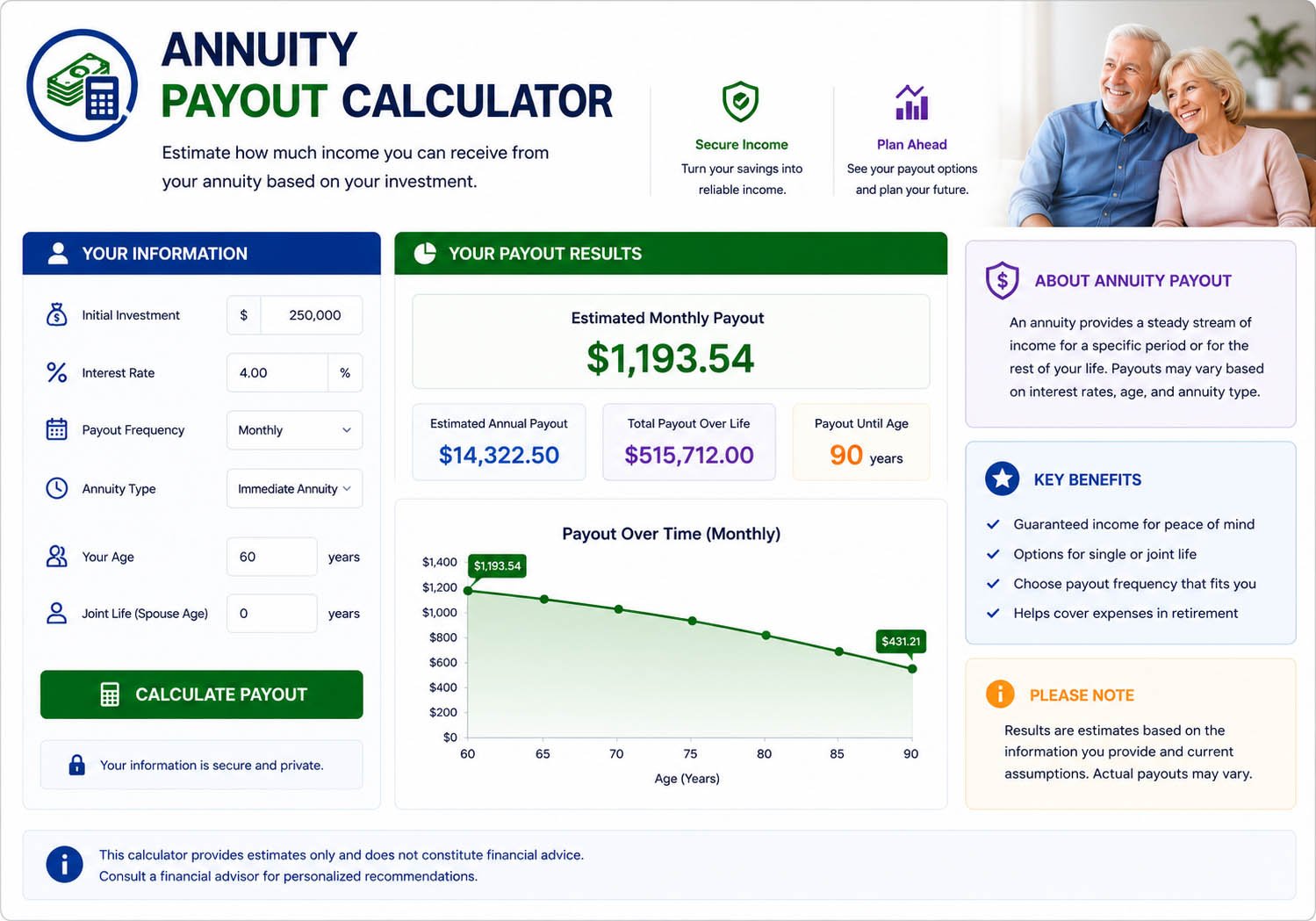
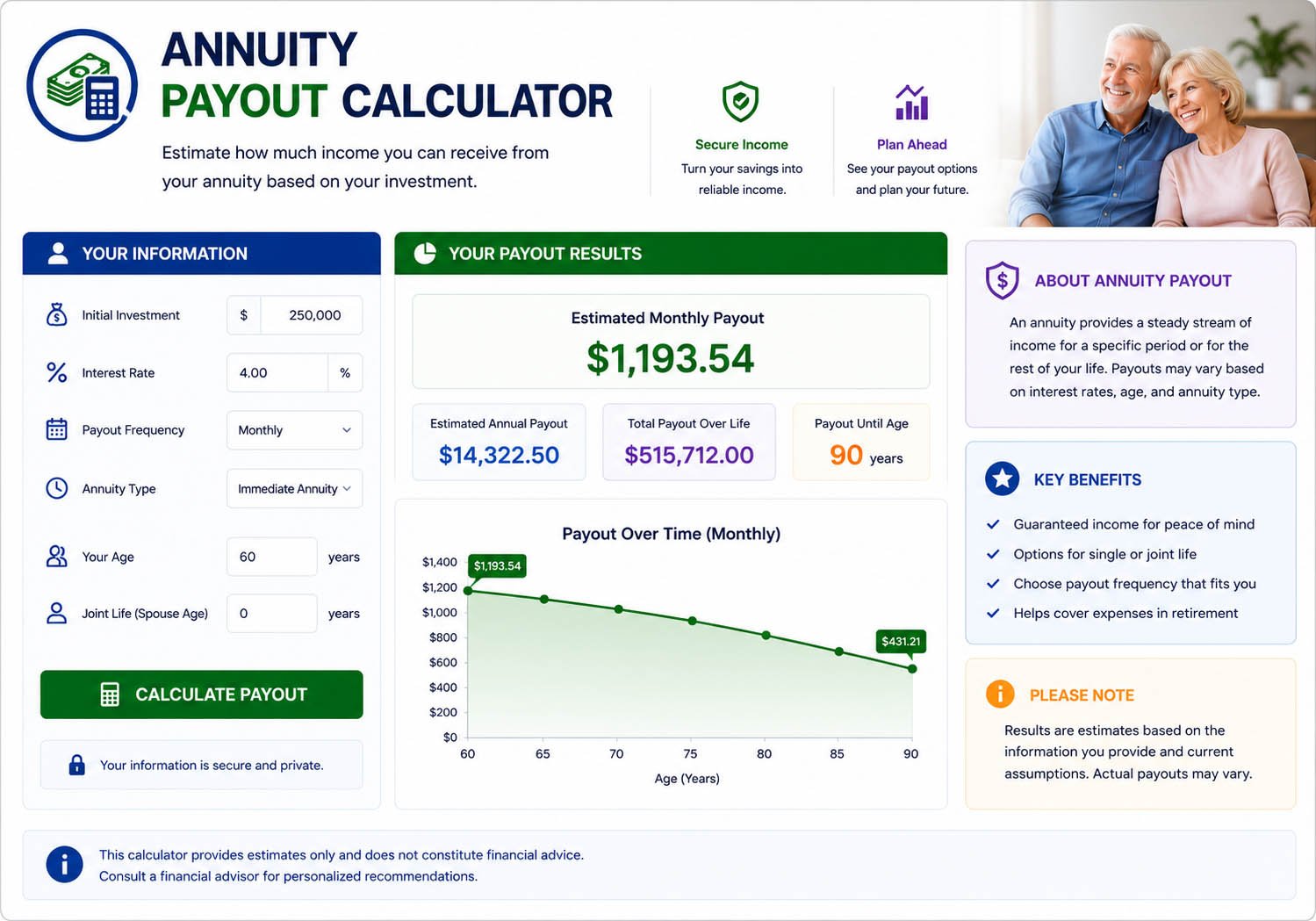
An Annuity Payout Calculator shows how much regular income a lump sum can pay over a fixed number of years while the remaining balance keeps earning a return, or how long the money will last if you take a fixed amount. It is useful for planning withdrawals from retirement savings or estimating a fixed-period annuity. It does not price lifetime annuities, whose payments depend on age and the insurer’s terms.
How to use it
- Choose Fixed length to find the payment, or Fixed payment to find how long the money lasts.
- Enter the starting principal and the interest or return rate.
- Enter the years to payout, or the payment amount you want.
- Choose monthly, quarterly or annual payments and click Calculate.
Annuity payout formula
PMT = PV × r ÷ (1 − (1 + r)^−n)
where PMT is each payment, PV is the starting balance, r is the return per payment period and n is the number of payments. The balance earns a return while it is being paid out, so the payments add up to more than the starting amount.
Examples (5% return, monthly payments)
- $100,000 paid out over 20 years: about $659.96 a month.
- $300,000 over 20 years: about $1979.87 a month.
- $2,000,000 over 30 years: about $10736.43 a month.
Types of annuity payouts
Annuities can pay out in several ways:
- Fixed period: equal payments for a set number of years. This is what the calculator models.
- Fixed amount: a set payment until the money runs out. The calculator’s Fixed payment mode covers this.
- Life annuity: payments for as long as you live, priced by an insurer using your age and life expectancy.
- Joint and survivor: payments that continue for a spouse after the first death.
- Period certain: lifetime payments with a guaranteed minimum number of years.
The calculator covers fixed-period and fixed-amount payouts only. For lifetime options, ask insurers for quotes.
What affects an annuity payout?
- Starting balance: more money supports bigger payments.
- Return rate: a higher rate raises each payment.
- Payout period: spreading the money over more years lowers each payment.
- Payment frequency: monthly, quarterly or yearly.
- Fees: contract charges reduce the money available for income.
- Taxes: payments from pre-tax money are fully taxable; for annuities bought with after-tax money, part of each payment is a tax-free return of principal.
Tips
- Use a conservative return; if returns fall short, the money runs out sooner.
- Fixed payments lose buying power to inflation. Consider planning for rising expenses.
- Compare insurer quotes for life annuities with the fixed-period results here.
- Keep some savings outside the annuity for emergencies.
Frequently Asked Questions
At a 5% return paid monthly over 20 years, $100,000 supports about $660 a month; over 30 years, about $537. A lifetime annuity from an insurer will pay a different amount based on your age.
There is no universal best age to purchase an annuity. Your retirement needs, financial resources, age, health, and desired income period all matter. For lifetime annuities, waiting longer may result in a higher payment, but the best choice depends on your circumstances.
At a 5% return over 20 years, about $1980 a month; over 30 years, about $1610.
At a 5% return, $2,000,000 paid out monthly over 30 years gives about $10736 a month, or about $3.87 million in total payments.
An annuity can be useful for people who value predictable income, especially during retirement. However, annuities can have fees, restrictions, and different guarantees, so it is important to compare the contract with other retirement-income options before deciding.
Disclaimer: This calculator gives estimates for general information only. It is not financial, tax or legal advice. Results depend on the numbers you enter and on simplified assumptions, so your actual figures may differ. Check important decisions with a qualified professional or the official source.
Related Calculators
For the growth stage and other retirement income planning, try these calculators.
Written by Sharp Calculator Team — we build and test every calculator on this site, checking each formula against hand-worked examples and official sources. Last updated: October 2026.