
Present Value of Future Money
Present Value of Periodical Deposits
Estimates only, based on the values you enter. Not financial advice.
What Is Present Value?
Present Value (PV) is the current worth of a future amount of money after accounting for a specific discount or interest rate. Because money available today can potentially earn a return, a future payment is generally worth less in today’s terms. A Present Value Calculator helps determine how much a future amount is worth today based on the future value, discount rate, and number of periods.

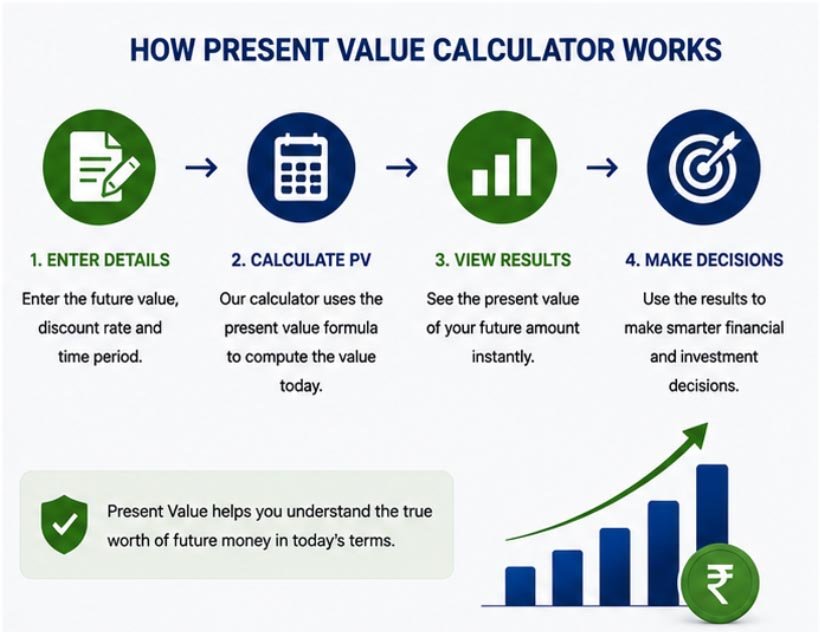
Present value formula
PV = FV ÷ (1 + r)^n
For a series of equal deposits made at the end of each period:
PV = PMT × [1 − (1 + r)^−n] ÷ r
Where PV is the present value, FV is the future value, r is the discount rate per period, and n is the number of periods. A higher discount rate or a longer time period generally results in a lower present value.
Why is present value important?
Money you have today can be invested, so a dollar received in the future is worth less than a dollar now. Present value turns future amounts into today’s dollars so you can compare them fairly, for example a lump-sum settlement against a series of payments, or the price of a bond against the cash it will pay you.
How to use the present value calculator
- Present value of future money: enter the future value (FV), the number of periods (N) and the interest or discount rate per period (I/Y), then click Calculate.
- Present value of periodic deposits: enter N, I/Y and the deposit per period (PMT), and choose whether deposits are made at the beginning or end of each period.
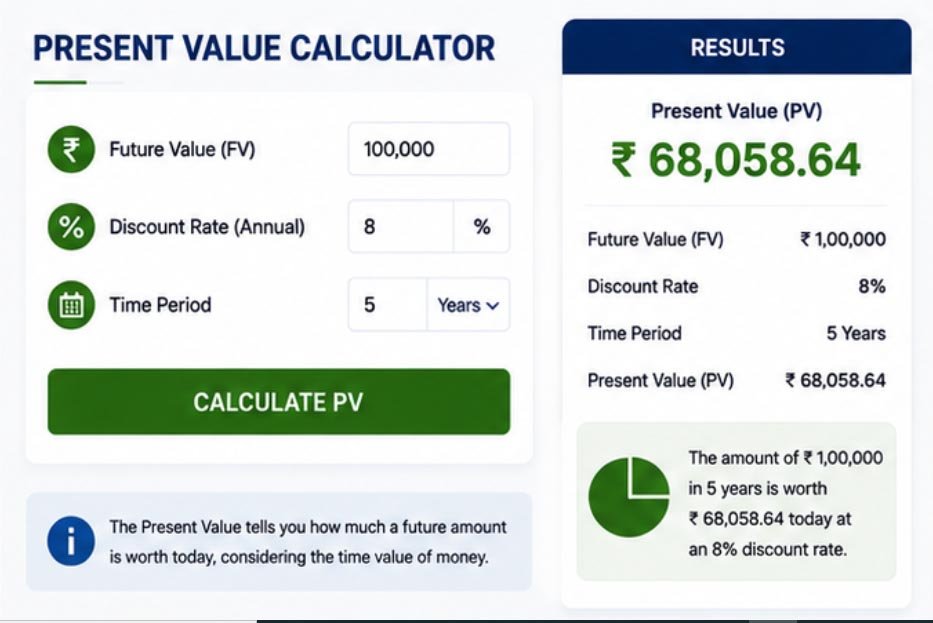

Present value example
You will receive $10,000 in 5 years and use a 6% yearly discount rate:
PV = $10,000 ÷ (1.06)^5 = $10,000 ÷ 1.33823 ≈ $7,472.58
In other words, $7,472.58 invested today at 6% would grow to $10,000 in five years. If someone offers you $7,000 today instead of $10,000 in five years, and 6% is a fair return for you, the future payment is worth more.
Present value in investment decisions
Businesses discount a project’s future cash flows to decide whether it is worth the investment today; investors do the same to value bonds and annuities. The higher the discount rate or the longer the wait, the lower the present value.
Tips
- Match the rate to the period: use a monthly rate with monthly periods.
- Choose a discount rate that reflects what you could realistically earn elsewhere at similar risk.
Frequently Asked Questions
Present value is the current value of money that will be received or paid in the future after applying a discount rate. It helps show what a future amount is worth in today’s terms.
Divide the future amount by (1 + r)^n. For example, $10,000 due in 5 years at 6% is worth $10,000 ÷ 1.06^5 ≈ $7,472.58 today.
When the discount or interest rate increases, the present value of a future amount generally decreases because the future money is discounted more heavily.
Present value helps investors and businesses compare current costs with future benefits. It is commonly used in investment analysis, valuation, bonds, and financial planning.
The Present Value formula is PV = FV ÷ (1 + r)ⁿ. It calculates what a future amount of money is worth today based on the discount rate and number of periods.
Disclaimer: This calculator gives estimates for general information only. It is not financial, tax or legal advice. Results depend on the numbers you enter and on simplified assumptions, so your actual figures may differ. Check important decisions with a qualified professional or the official source.
Related Calculators
For related time value of money calculations, try these calculators.
Written by Sharp Calculator Team — we build and test every calculator on this site, checking each formula against hand-worked examples and official sources. Last updated: October 2026.