
Solve for price, yield, term or coupon
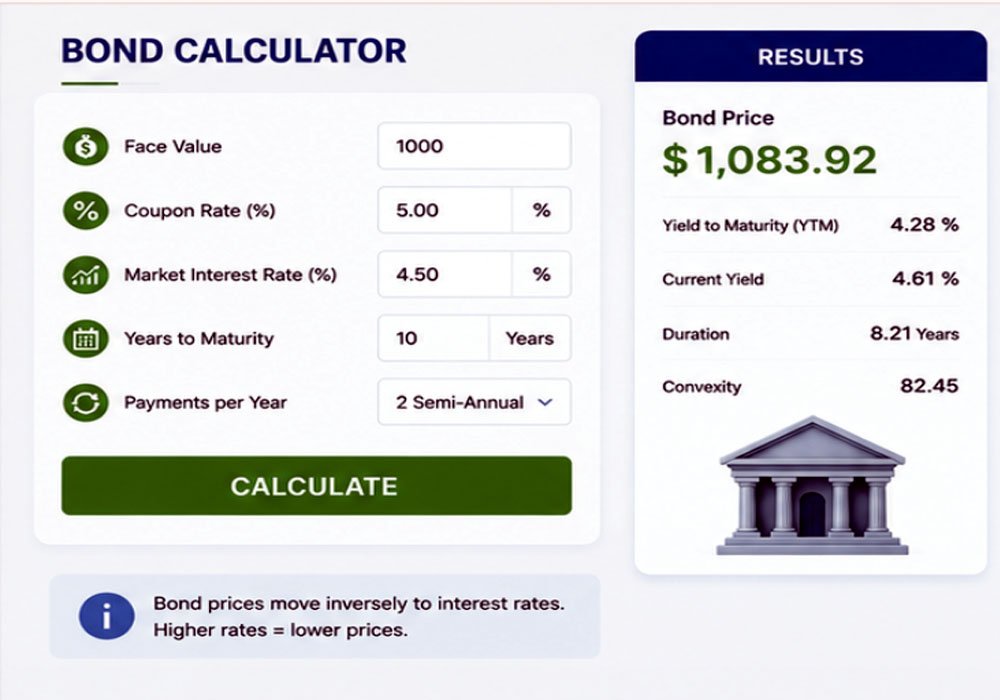
Fill in four of the five boxes and leave the one you want to find empty. This part assumes the bond is bought or sold on a coupon payment date.
—
Price a bond between coupon dates
Buying or selling between coupon dates? Enter the settlement and maturity dates to see the full (dirty) price, the quoted (clean) price and the interest that has built up since the last coupon.
Estimates only. Bond pricing assumes a flat yield curve and standard coupon-period conventions. Not financial or investment advice.
What is a bond calculator?
A Bond Calculator works out the fair price of a bond from its face value, coupon rate, yield and time to maturity, or solves for any one of those values when you know the other four. Investors use it to compare a bond’s price with its yield, to see how a change in market rates affects value, and to check quotes before buying.
How to use it
- Top box: enter any four of price, face value, yield, years to maturity and annual coupon, leave the fifth blank, choose the coupon frequency and click Calculate.
- Second box: for trades between coupon dates, enter face value, yield, coupon, frequency, maturity date, settlement date and day-count convention to get the dirty price, clean price and accrued interest.
Bond price formula
Price = Σ (t = 1 to n) C ÷ (1 + r)^t + F ÷ (1 + r)^n
where C is the coupon paid each period, F is the face value, r is the yield per period and n is the number of periods to maturity. Each payment is discounted back to today, and the bond’s price is the sum.
Example
A bond has a $1,000 face value, a 5% annual coupon ($50 a year) and 10 years to maturity. If similar bonds now yield 6%:
- Present value of the ten $50 coupons at 6% ≈ $368.00
- Present value of the $1,000 repaid in year 10 ≈ $558.39
- Price ≈ $926.40
Because the market yield (6%) is above the coupon rate (5%), the bond sells at a discount to its face value.
Types of bonds
Bonds differ mainly in who issues them and how risky they are. US Treasury bonds are backed by the federal government. Municipal bonds are issued by states and cities, and their interest is often exempt from federal tax. Corporate bonds are issued by companies and usually pay higher yields to make up for higher credit risk. The pricing math in this calculator is the same for all of them; the difference shows up in the yield the market demands.
Bond interest and yield
The coupon rate is fixed when the bond is issued, but the yield changes with the market. When market rates rise, existing bonds with lower coupons lose value, and when rates fall, they gain value. Three measures are common:
- Coupon rate: annual coupon ÷ face value.
- Current yield: annual coupon ÷ current price.
- Yield to maturity (YTM): the single rate that makes the present value of all remaining payments equal the price.
Tips
- Longer-term bonds move more in price when rates change.
- Compare bonds by yield to maturity, not by coupon rate alone.
- Check the credit rating; a high yield often signals higher risk.
Frequently Asked Questions
Discount every coupon payment and the final face value back to today using the market yield, then add them up. For a $1,000 bond with a 5% annual coupon, 10 years left and a 6% yield, the value is about $926.40.
A 12% YTM means the estimated annual return is 12% if the bond is purchased at its current price and held until maturity, assuming the expected payments are made as scheduled.
Enter the bond’s face value, coupon rate, current price, yield, payment frequency, and remaining term into the calculator. The results can help estimate the bond’s value, interest income, and yield.
Current yield is calculated by dividing the bond’s annual coupon payment by its current market price. It shows the income generated by the bond relative to what it currently costs.
Disclaimer: This calculator gives estimates for general information only. It is not financial, tax or legal advice. Results depend on the numbers you enter and on simplified assumptions, so your actual figures may differ. Check important decisions with a qualified professional or the official source.
Related Calculators
For other ways to compare fixed-income and investment returns, see these calculators.
Written by Sharp Calculator Team — we build and test every calculator on this site, checking each formula against hand-worked examples and official sources. Last updated: October 2026.