
Estimates only. Assumes steady contributions and a constant rate of return; the deferred sales charge is applied to the ending value at redemption. Not financial or investment advice.
What Is a Mutual Fund Calculator?
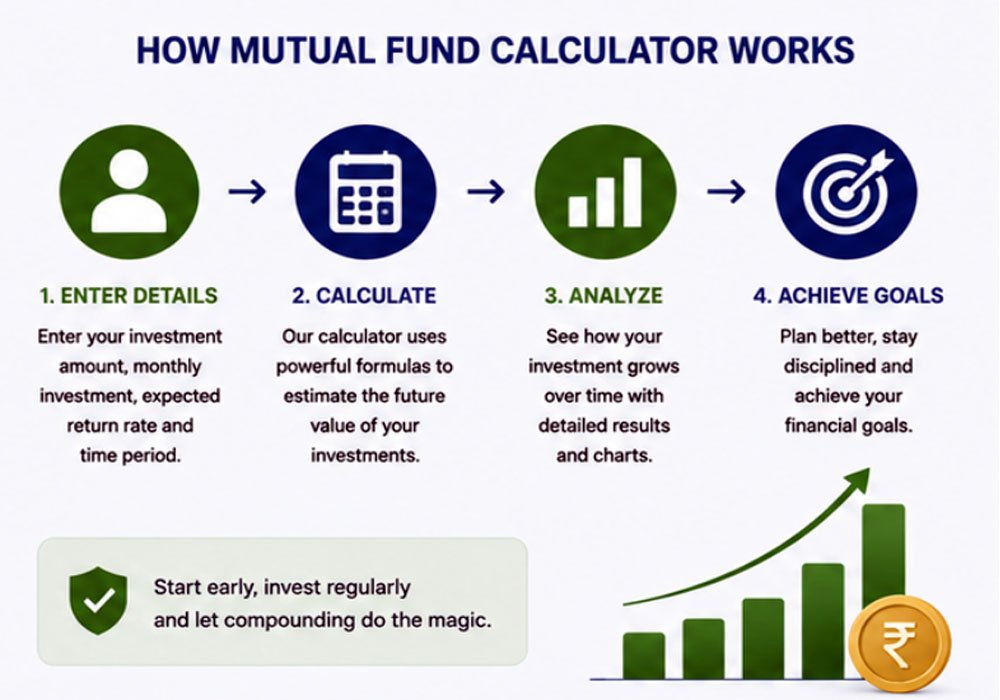
A Mutual Fund Calculator is a financial tool that helps estimate how an investment may grow over a selected period. It can calculate potential returns using factors such as the initial investment, expected rate of return, investment duration, and regular contributions. This makes it easier to understand how different investment amounts and time periods may affect the future value of a portfolio.
Investors can use a mutual fund calculator to compare a one-time investment with regular contributions and create more informed long-term investment plans. The calculator can also help illustrate the effect of compound growth, although actual mutual fund returns are influenced by market performance and are not guaranteed.

SIP and Lumpsum Mutual Fund Investments
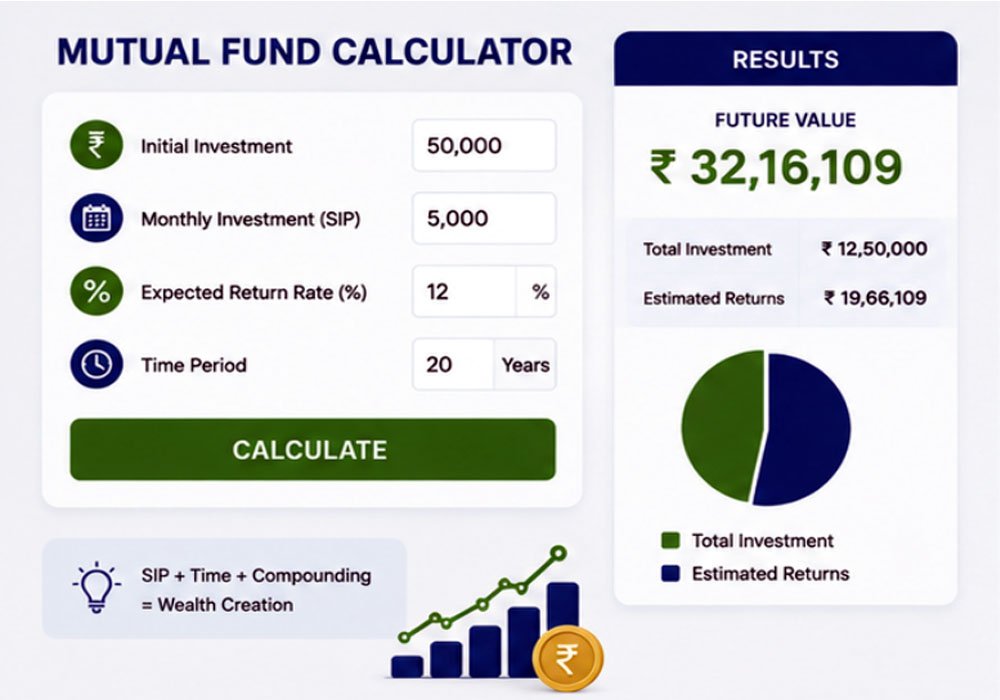
A SIP mutual fund calculator is useful for investors who contribute a fixed amount regularly, such as every month. Regular investing can help build an investment portfolio gradually while allowing returns to compound over time. In contrast, a mutual fund calculator lumpsum approach estimates the growth of a single amount invested at the beginning of the investment period.
For investors looking for a mutual fund calculator USA, the same basic principles can be applied by entering the investment amount, expected annual return, contribution frequency, and investment period. These calculations are estimates and should not be treated as guaranteed future results because mutual fund values can rise or fall with market conditions.
Mutual Fund Investment Formula
The estimated future value of a mutual fund investment depends on the starting amount, expected return, and length of the investment. When regular contributions are included, the calculation also considers the amount added during each period. Compounding can have a significant effect when investments remain active for many years.
Future Value Formula:
FV=P(1+r)n
Where FV is the future value, P is the initial investment, r is the expected rate of return per period, and n is the total number of investment periods.

Benefits of Using a Mutual Fund Calculator
A mutual fund calculator can make investment planning easier by showing how savings may develop over time. It allows users to test different investment amounts, expected returns, and time periods without performing complicated calculations manually.
- Estimate potential growth: See how an investment could increase over time.
- Compare SIP and lump-sum strategies: Evaluate different contribution approaches.
- Plan long-term goals: Estimate the investment required for future financial objectives.
- Understand compounding: See how reinvested returns can affect long-term growth.
- Adjust investment assumptions: Compare different rates, periods, and contribution amounts.
Frequently Asked Questions
The final value depends on the expected rate of return and the length of time the money remains invested. Entering $10,000 as the initial investment into a mutual fund calculator can provide an estimated future value based on your selected assumptions.
The growth of $100,000 over 30 years depends on the investment’s average annual return and whether earnings are reinvested. A longer investment period can allow compound growth to have a substantial effect on the final value.
The estimated value depends on the annual return assumed for the investment. A mutual fund calculator can calculate the potential future value of $10,000 over 10 years using the selected rate of return.
A $1,000 investment may grow over 10 years depending on market performance and the assumed return rate. Adding regular contributions during this period can increase the potential ending value significantly.
The required investment depends on the expected return, withdrawal rate, fees, taxes, and investment strategy. A mutual fund calculator can help estimate the amount needed to target approximately $3,000 per month, but investment returns are not guaranteed.
Related Calculator:
Explore more financial tools designed to simplify your calculations. Whether you’re planning a mortgage, estimating an auto loan, calculating taxes, or tracking investment growth, our free calculators provide fast and accurate results to help you make smarter financial decisions.