
Accumulation Schedule
| Year | Deposit | Interest | Ending balance |
|---|
Estimates only, based on a constant interest rate held for the full term. Early withdrawal penalties are not included. Not financial advice.
What is a CD Calculator
A Certificate of Deposit (CD) is a savings product that allows you to deposit money with a bank or financial institution for a fixed period in exchange for a predetermined interest rate. A CD Calculator helps estimate how much your deposit can grow based on the initial deposit, interest rate, APY, compounding frequency, and CD term.
What Is a Certificate of Deposit?
A Certificate of Deposit is a time deposit where money remains in the account for an agreed period. Unlike a regular savings account, withdrawing funds before maturity may result in an early withdrawal penalty. CD terms can range from a few months to several years, with common options including 3-month, 6-month, and 12-month CDs. The final interest earned depends on the deposit amount, APY, compounding schedule, and length of the term.

How Does a CD Calculator Work?
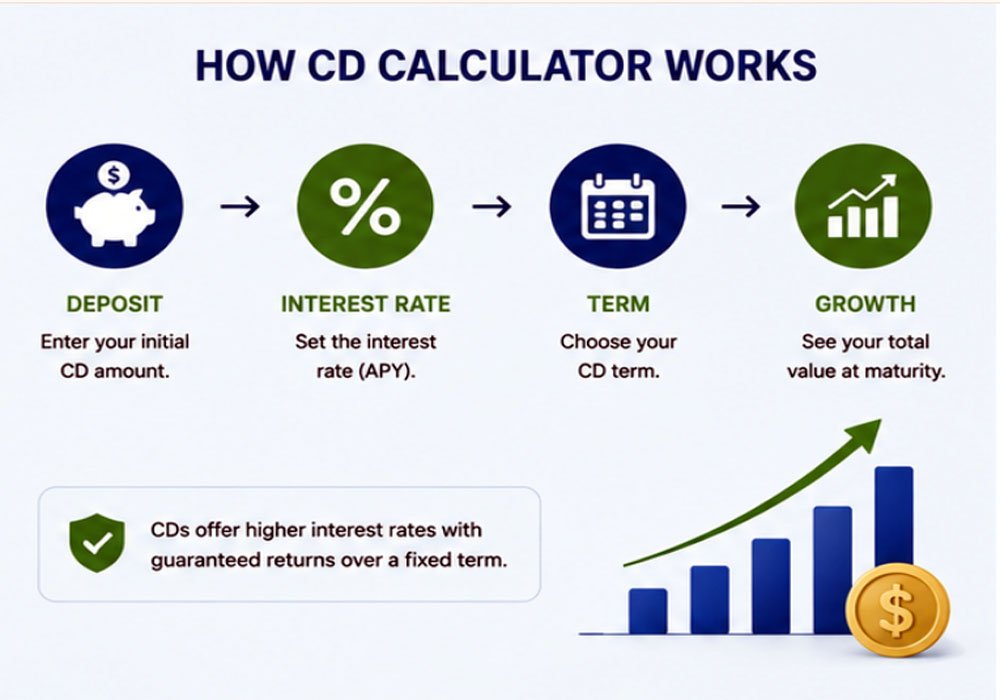
A CD calculator uses several important inputs to estimate the final account balance and interest earned. These can include the initial deposit, annual interest rate or APY, CD term, and compounding frequency. By changing these values, you can compare how different CD offers may affect your final balance.
For example, someone considering a 6-month CD calculator may enter the amount they plan to deposit, the offered APY, and a six-month term. The calculator can then estimate the interest earned and the value of the CD at maturity. This provides a quick way to compare a short-term CD with other savings options.
CD Calculator Formula
When interest is compounded periodically, the future value of a CD can be estimated using the following formula:
A = P × (1 + r/n)^(nt)
Where:
- A = Final CD balance
- P = Initial deposit
- r = Annual interest rate expressed as a decimal
- n = Number of compounding periods per year
- t = CD term in years
The estimated interest earned can then be calculated as:
Interest Earned = A − P
For example, if a deposit is compounded monthly, the number of compounding periods is 12 per year. A CD calculator can perform these calculations automatically and show the estimated maturity value without requiring manual calculations.

Benefits of Using a CD Calculator
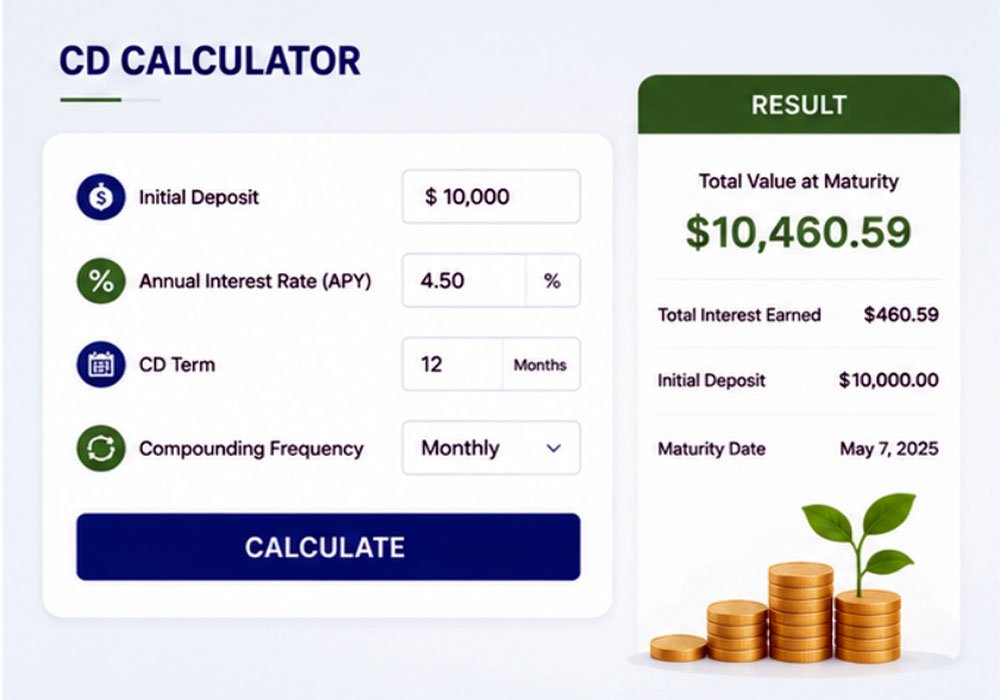
A CD calculator can make it easier to compare different savings opportunities before depositing your money. It can help you estimate the maturity balance, understand potential interest earnings, and see how the CD term or interest rate affects your return.
Some useful calculations include:
- Comparing a 3-month CD with a 6-month or 12-month CD.
- Estimating monthly or periodic interest.
- Comparing CDs with different APYs.
- Calculating the expected maturity value.
- Estimating how much interest a fixed deposit may earn.
Frequently Asked Questions
A CD can be calculated using the initial deposit, interest rate or APY, compounding frequency, and investment term. The compound interest formula can then be used to estimate the final balance and total interest earned.
The amount a $10,000 deposit earns in a six-month CD depends on the APY and the bank’s compounding method. Entering the $10,000 deposit, six-month term, and CD APY into a calculator provides an estimate of the interest and maturity value.
CD value can be calculated by applying the deposit amount, interest rate, compounding frequency, and term to a compound interest formula. A CD calculator performs this calculation automatically and provides the estimated maturity balance.
A normal CD calculator is an online tool that estimates the interest earned and final value of a certificate of deposit. It typically requires information such as the initial deposit, APY, term, and compounding frequency.
The amount earned by a $10,000 CD depends on its APY, compounding frequency, and term. A six-month CD will naturally have less time to accumulate interest than a one-year CD, while a higher APY generally produces a larger return.
For example, if a $10,000 deposit earns an annualized rate of 5% for six months, the actual interest will depend on how the financial institution calculates and compounds the return. Instead of estimating manually, a CD calculator can provide a more precise estimate based on the specific CD terms.
Related Calculator:
Explore more financial tools designed to simplify your calculations. Whether you’re planning a mortgage, estimating an auto loan, calculating taxes, or tracking investment growth, our free calculators provide fast and accurate results to help you make smarter financial decisions.