
Accumulation Schedule
| Year | Deposit | Interest | Ending Balance |
|---|
Estimates only, based on steady contributions and a constant interest rate. Actual investment returns vary and are not guaranteed. Not financial advice.
What is a Interest Calculator
Calculate Interest Accurately
An Interest Calculator is a useful financial tool for determining how much interest is earned on savings or paid on borrowed money over a specific period. Interest is the cost of using someone else’s money or the return received for allowing money to remain invested or deposited. The amount of interest depends on the principal, interest rate, time period, and whether the interest is calculated using a simple or compound method. SharpCalculator provides an easy-to-use Interest Calculator that helps users estimate total interest and understand how different rates and time periods can affect their financial results.
Simple Interest vs. Compound Interest
Interest is generally calculated using either simple interest or compound interest. Simple interest is based only on the original principal, while compound interest also considers interest that has already accumulated. Compound interest can therefore produce significantly different results over longer periods because previously earned interest begins generating additional interest. When evaluating a financial product, users should also consider the compounding frequency because interest may be compounded annually, semi-annually, quarterly, monthly, or daily. The main factors that can influence an interest calculation include:
- Principal: The original amount borrowed or invested.
- Interest rate: The percentage charged or earned over a specific period.
- Time: The length of the loan or investment.
- Compounding frequency: How often accumulated interest is added to the balance.
- Additional contributions: Regular deposits can increase the amount on which future interest is calculated.
- Taxes and inflation: These can affect the real value of interest earned over time.
Interest Formula and Example
For simple interest, the basic formula is Interest = Principal × Interest Rate × Time. For example, if $1,000 is invested at a 6% annual interest rate for three years, the simple interest would be $1,000 × 0.06 × 3 = $180. The total balance would therefore be $1,180. Compound interest works differently because each compounding period adds earned interest to the balance, allowing subsequent interest to be calculated on both the original principal and accumulated interest. The Rule of 72 can also provide a quick estimate of how long it may take an investment to double by dividing 72 by the annual interest rate. For instance, at an 8% annual rate, 72 ÷ 8 suggests approximately nine years.
Why Use Sharp Calculator Interest Calculator?
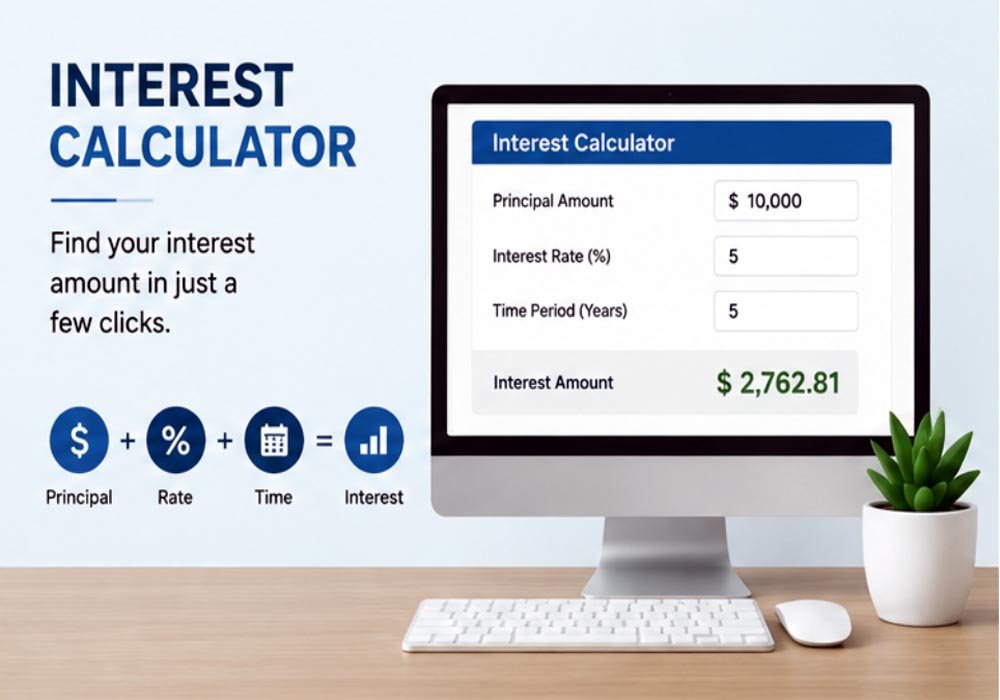
At SharpCalculator, the Interest Calculator is designed to make interest calculations faster, clearer, and more convenient than performing financial formulas manually. It can help users evaluate savings growth, estimate borrowing costs, compare different interest rates, and understand the effect of compounding over time. Interest calculations can also be influenced by regular contributions, taxes, inflation, and whether a rate is fixed or variable, so examining different scenarios can provide a more realistic financial estimate. By entering the relevant values into the calculator, users can quickly understand the potential interest and total amount associated with their chosen financial scenario.
Frequently Asked Questions
An Interest Calculator is an online tool that estimates the interest earned or paid based on factors such as the principal, interest rate, and time period. It can help users understand the total financial impact of interest.
Simple interest is calculated only on the original principal, while compound interest is calculated on the principal plus previously accumulated interest. Compound interest can therefore result in greater growth over longer periods.
Simple interest is calculated using the formula Principal × Interest Rate × Time. The result represents the interest earned or charged during the specified period.
Yes. When interest compounds more frequently, accumulated interest is added to the balance more often. This can increase the total interest earned on savings or investments when other factors remain the same.
The Rule of 72 is a quick estimation method for determining how long it may take an investment to double. You can divide 72 by the annual interest rate to estimate the number of years.
Related Calculator:
Explore more financial tools designed to simplify your calculations. Whether you’re planning a mortgage, estimating an auto loan, calculating taxes, or tracking investment growth, our free calculators provide fast and accurate results to help you make smarter financial decisions.