
IRR based on fixed cash flow
This calculator computes the IRR based on a fixed recurring cash flow or no cash flow.
IRR based on irregular cash flow
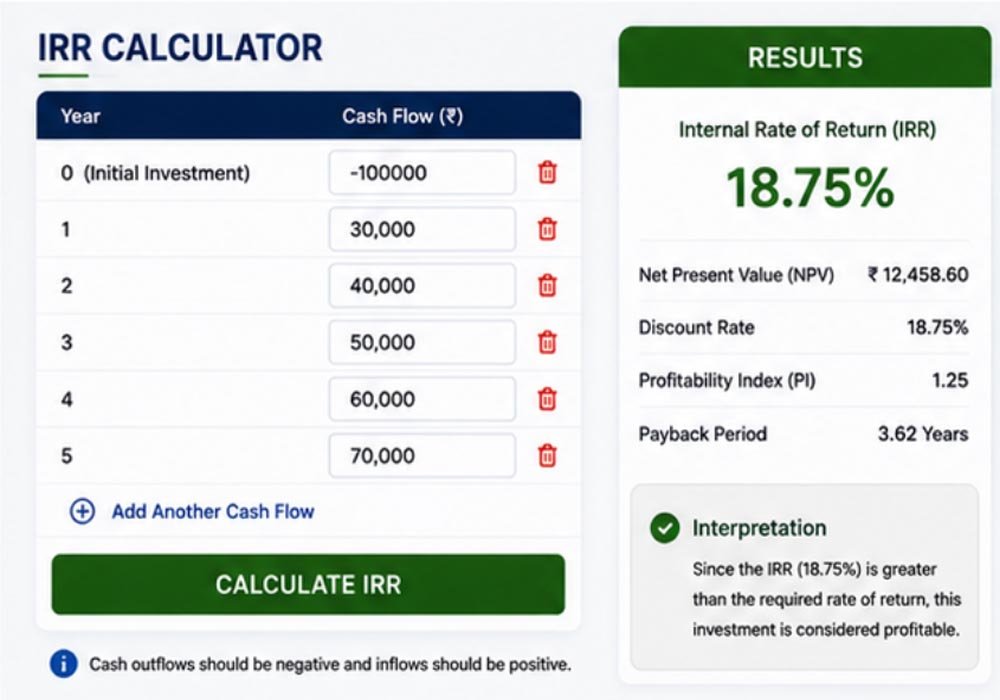
This calculator computes the IRR based on the initial investment and subsequent annual cash flows. If you want to calculate the IRR for cash flows that are not annual, please use our Average Return Calculator.
Estimates only, based on the values you enter. Not financial advice.
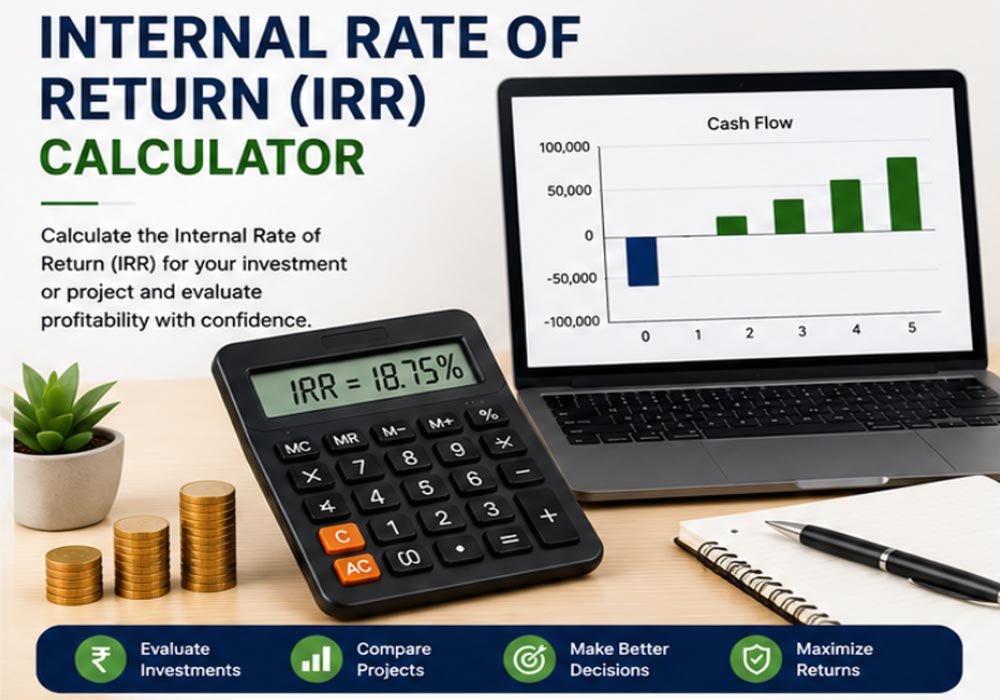
What Is Internal Rate of Return?
Internal Rate of Return is the discount rate at which the Net Present Value (NPV) of an investment becomes zero. In simple terms, it is the estimated annual rate of return that balances the present value of future cash inflows with the initial and additional cash outflows. Because money received today is generally more valuable than money received in the future, IRR accounts for the time value of money when evaluating an investment.
When the IRR is higher than the required rate of return or cost of capital, a project may be considered financially attractive. If the IRR is lower than the required return, the investment may not provide enough compensation for the capital committed and the risks involved.
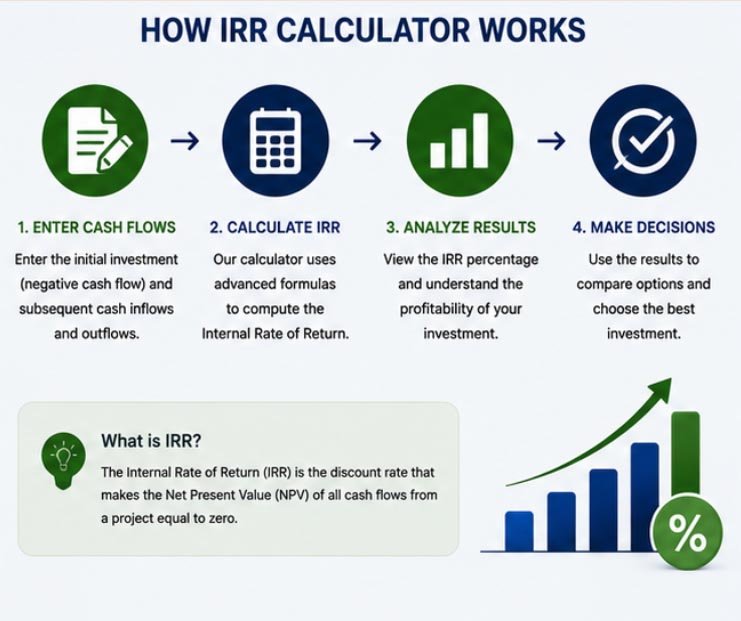
How Does an IRR Calculator Work?
IRR is found by determining the rate that makes the present value of all cash inflows and outflows equal to the initial investment. Since most real-world investments involve multiple cash flows, calculating IRR manually can be difficult and usually requires an iterative calculation.
IRR Formula:
0=t=0∑n(1+IRR)tCFt
Where CFₜ represents the cash flow in each period, t is the period number, and n is the total number of periods.
Why Use an IRR Calculator?
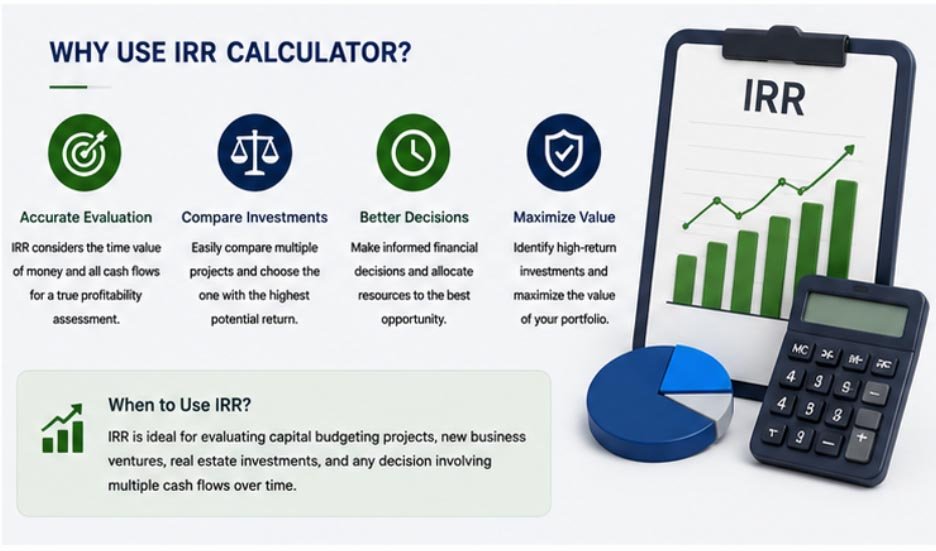
An IRR Calculator makes it easier to evaluate investments with multiple cash inflows and outflows. It can be useful for comparing business projects, real estate opportunities, equipment purchases, loans, leases, and other investments. Generally, an investment with an IRR above the required rate of return may be considered more attractive, although risk and total profitability should also be considered.
Why Is IRR Important for Investments?
IRR gives investors a single percentage that can be used to evaluate and compare different opportunities. For example, if one project has an IRR of 12% and another has an IRR of 8%, the first project may appear more attractive if both have similar risk and investment requirements. However, IRR should not be viewed independently because the size of the investment, timing of returns, risk, and total profit can all affect the overall quality of an investment.
IRR is particularly useful in capital budgeting, where businesses need to decide which projects deserve funding. It can also be applied to equipment purchases, business expansions, real estate investments, private equity projects, and other opportunities involving multiple cash inflows and outflows.
Common Uses of an IRR Calculator
An IRR Calculator can be useful in many financial situations. Businesses can use it to evaluate new projects, machinery purchases, expansions, and other capital investments. Investors can use IRR when comparing real estate opportunities, private investments, or projects with multiple future payments.
It can also help with loan and lease analysis, where cash paid and received occur at different points in time. Real estate investors may use IRR to consider purchase costs, rental income, operating expenses, and the eventual sale of a property. Private equity and venture capital professionals commonly use IRR to evaluate long-term investment performance.
Frequently Asked Questions
IRR stands for Internal Rate of Return. It is the discount rate that makes the net present value of an investment’s cash flows equal to zero.
A good IRR depends on the investment’s risk, duration, and required rate of return. Generally, an IRR above the project’s required return or cost of capital may indicate a potentially attractive investment.
Neither metric is always better. ROI provides a straightforward measure of overall gain, while IRR considers the timing of cash flows and expresses the result as an annualized rate.
Yes. A negative IRR can occur when an investment’s cash flows are insufficient to recover the initial investment. This may indicate that the project is expected to lose money under the assumptions used.
Multiple IRRs can occur when cash flows repeatedly switch between positive and negative values. In these situations, additional measures such as NPV or modified IRR may provide a clearer evaluation.
Related Calculator:
Explore more financial tools designed to simplify your calculations. Whether you’re planning a mortgage, estimating an auto loan, calculating taxes, or tracking investment growth, our free calculators provide fast and accurate results to help you make smarter financial decisions.