
Accumulation Schedule
| Year | Addition | Return | Ending balance |
|---|
Estimates only, based on steady additions and a constant growth rate. Actual investment or annuity returns vary and are not guaranteed. Not financial advice.
What is an annuity calculator?
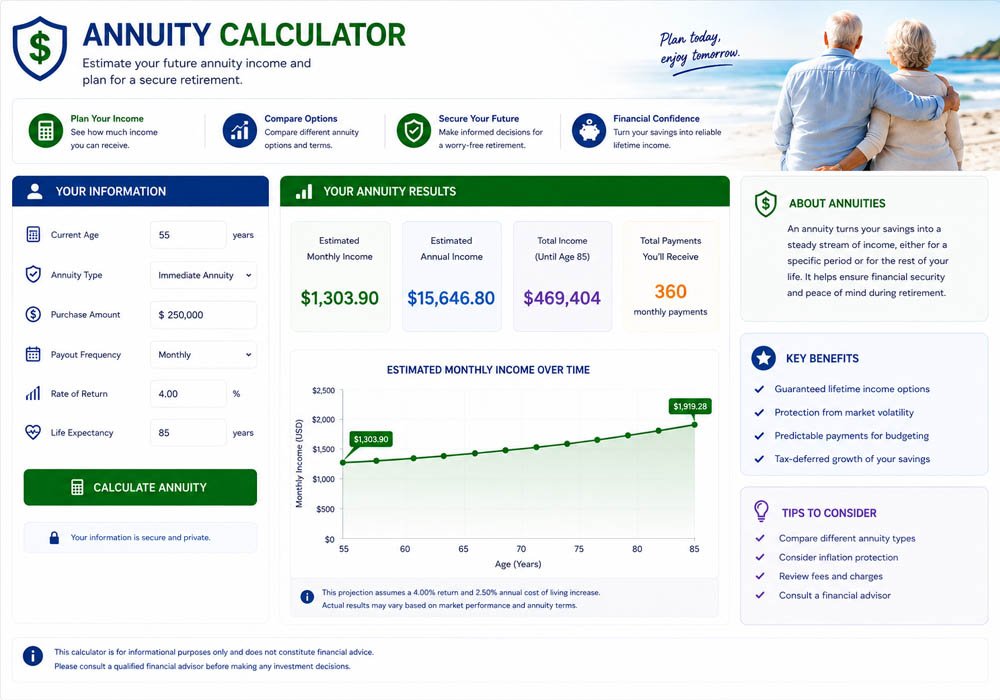
This Annuity Calculator estimates how a deferred annuity, or any account that grows at a steady rate, builds up over time. Enter a starting principal, yearly or monthly additions, a growth rate and a number of years, and it shows the ending balance and how much came from additions and from growth. This is the accumulation stage. To turn a balance into regular income, use the Annuity Payout Calculator.
How to use it
- Enter the starting principal.
- Enter any annual or monthly addition, and choose whether additions are made at the beginning (annuity due) or end (ordinary annuity) of each period.
- Enter the annual growth rate and the number of years.
- Click Calculate to see the end balance, total additions, total growth and a schedule.
How an annuity grows
An annuity is a contract, usually with an insurance company, that takes your money now and pays it back later. With a deferred annuity there are two stages: an accumulation stage, when your premiums grow, and a payout stage, when the contract pays you income. This calculator models the first stage using a constant growth rate. Real contracts may credit a fixed rate, a rate linked to an index, or returns from investments, and they can carry fees and surrender charges.
What affects how much your annuity grows
- Starting principal: the money you put in at the start.
- Additions: regular premiums or contributions.
- Timing: additions at the start of each period (annuity due) grow for one more period than additions at the end.
- Growth rate: the rate credited by the contract, after fees.
- Time: the number of years before payouts begin.
Annuity formulas
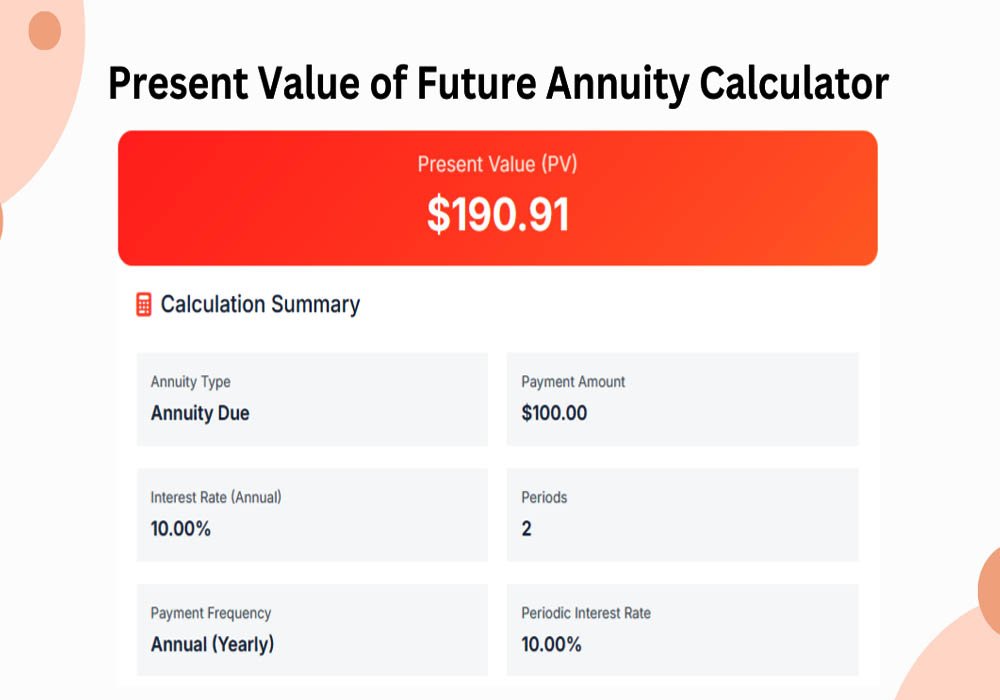
Ordinary annuity (additions at the end of each period): FV = P(1 + r)^n + PMT × [((1 + r)^n − 1) ÷ r]
Annuity due (additions at the start): multiply the PMT part by (1 + r).
Here P is the starting principal, PMT is the regular addition, r is the rate per period and n is the number of periods.
Growth examples
- $100,000 growing at 5% a year for 10 years with no additions becomes about $162,889.
- Add $5,000 at the end of each year and the balance after 10 years is about $225,779: $162,889 from the principal plus $62,889 from the additions.
- Make the same additions at the start of each year (annuity due) and it rises to about $228,923.
Tips
- Ask for the rate after fees; annual fees can cut growth noticeably.
- Check surrender charges and how long they last before you commit money you might need.
- Compare a fixed annuity’s rate with CDs and Treasury bonds of a similar term.
- Gains in a deferred annuity are taxed as ordinary income when withdrawn, and withdrawals before 59½ may carry a 10% penalty.
Frequently Asked Questions
Accumulation is the period when your annuity grows from your premiums and credited interest. Payout (or annuitization) is when the balance is turned into regular income. This calculator covers accumulation; the Annuity Payout Calculator covers payout.
At 5% a year it becomes about $162,889 after 10 years and about $265,330 after 20 years, before fees and taxes. Enter your contract’s rate to see your own figure.
An annuity due has payments at the start of each period instead of the end. Each payment earns one extra period of growth, so the final value is higher by a factor of (1 + r).
In a non-qualified deferred annuity, growth is tax-deferred and taxed as ordinary income when withdrawn. Withdrawals before age 59½ may also face a 10% additional tax.
An Annuity Calculator is an online tool that estimates the potential growth or income of an annuity. It can use inputs such as an initial investment, regular payment, interest rate, payment frequency, and time period to produce an estimate. It is useful for retirement and long-term financial planning.
Disclaimer: This calculator gives estimates for general information only. It is not financial, tax or legal advice. Results depend on the numbers you enter and on simplified assumptions, so your actual figures may differ. Check important decisions with a qualified professional or the official source.
Related Calculators
For the payout stage and other retirement planning, try these calculators.
Written by Sharp Calculator Team — we build and test every calculator on this site, checking each formula against hand-worked examples and official sources. Last updated: October 2026.