
Schedule
| Period | Start balance | Deposit | Interest | End balance |
|---|
Estimates only, based on the values you enter and a constant interest rate. Not financial advice.
What is a future value calculator?
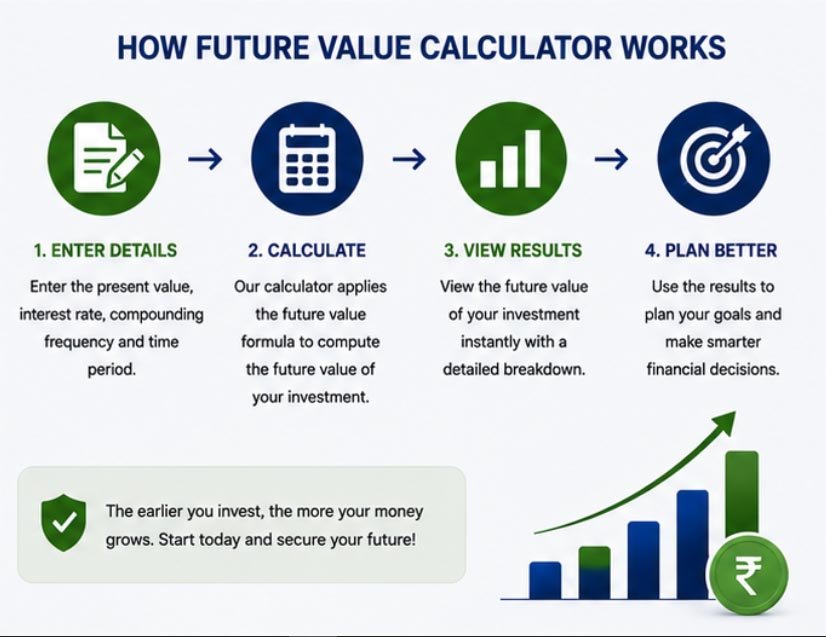
Future value (FV) is what a sum of money will grow to after earning interest for a set number of periods. This Future Value Calculator works it out for a starting amount, regular deposits or both, and shows the interest earned and a period-by-period schedule. It is useful for savings goals, investments and retirement planning.
How to use it
- Enter the number of periods (N).
- Enter the starting amount (PV).
- Enter the interest rate per period (I/Y).
- Enter any periodic deposit (PMT) and whether it is made at the beginning or end of each period.
- Click Calculate to see the future value, total deposits, total interest and the schedule.

Future Value Formula
For a single investment growing at a fixed rate, the basic future value formula is:
Here, FV is the future value, PV is the starting amount, r is the rate per period and n is the number of periods. With regular deposits at the end of each period, add PMT × [((1 + r)^n − 1) ÷ r].
Future value example
You invest $5,000 at 6% a year for 10 years:
FV = $5,000 × (1.06)^10 = $5,000 × 1.79085 ≈ $8,954.24
You earn $3,954.24 in interest. Adding $100 at the end of each year would add another $1,318.08, for a total of about $10,272.32.

Why Is Future Value Important?
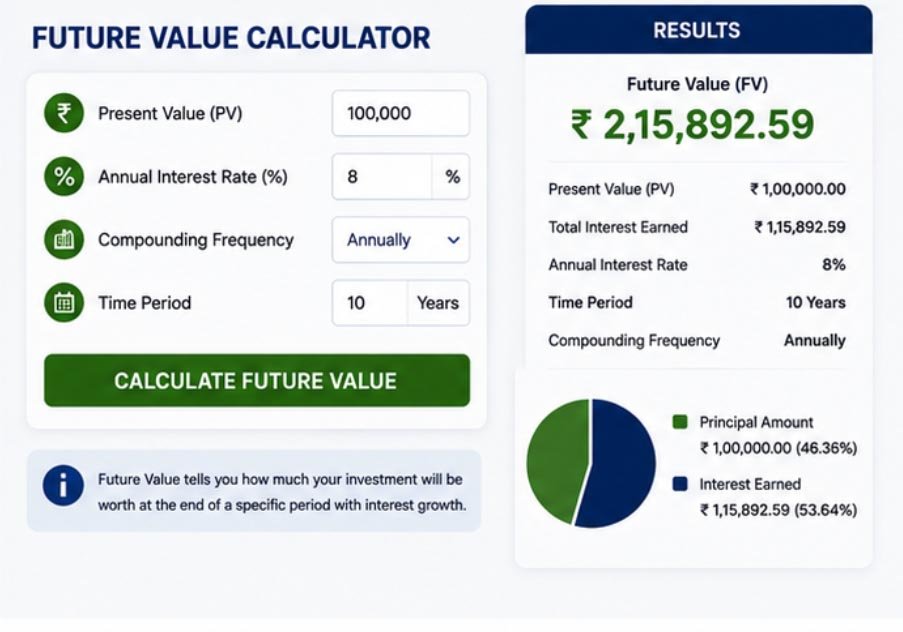
Future value helps you understand what today’s money could potentially be worth in the future. It can be used to compare different rates of return, investment periods, and contribution amounts when planning financial goals. Keep in mind that the calculated result is an estimate, and actual results may differ because of changing returns, fees, taxes, or other financial factors. Using different assumptions can help you create more realistic financial projections.
Tips
- Use the rate per period that matches N: monthly periods need a monthly rate.
- Fees and taxes lower your real growth; reduce the rate to allow for them.
- Inflation lowers what the future amount will buy.
Frequently Asked Questions
Future value is the estimated amount that a current investment or savings balance will become after earning interest or returns for a specified period. It shows the potential value of money at a future date.
The basic formula is FV = PV × (1 + r)ⁿ, where PV is the present value, r is the rate per period, and n is the number of periods. The formula is commonly used to calculate the growth of a lump-sum investment.
Future value helps estimate how current money may grow over time. It can support investment planning, savings decisions, and long-term financial goal setting. It can also help compare different investment strategies.
Yes. With compound interest, previously earned interest can also earn interest, which can increase the future value over longer periods. The effect generally becomes more noticeable as the investment period increases.
Yes. A Future Value Calculator can account for regular contributions when they are added to an investment or savings account. This can provide a more useful estimate for people who make monthly or periodic deposits.
Disclaimer: This calculator gives estimates for general information only. It is not financial, tax or legal advice. Results depend on the numbers you enter and on simplified assumptions, so your actual figures may differ. Check important decisions with a qualified professional or the official source.
Related Calculators
For related time value of money calculations, try these calculators.
Written by Sharp Calculator Team — we build and test every calculator on this site, checking each formula against hand-worked examples and official sources. Last updated: October 2026.