
| Roth IRA | Taxable account | |
|---|---|---|
| Balance at age 65 | $0 | $0 |
| Total principal | $0 | $0 |
| Total interest | $0 | $0 |
| Total tax | $0 | $0 |
—
Estimates only. Uses a simplified assumption that the taxable account pays tax on its investment gains every year; actual accounts, contribution limits, and tax treatment (capital gains vs. ordinary income, qualified dividends, etc.) are more complex. Not tax or financial advice.
What is a Roth IRA calculator?
A Roth IRA Calculator estimates how much a Roth IRA could be worth at retirement and compares it with the same savings in an ordinary taxable account. Because qualified Roth withdrawals are tax-free, the gap between the two shows what the Roth’s tax advantage could be worth to you. It suits anyone deciding whether to open or keep funding a Roth IRA.
How to use it
- Enter your current balance and the annual contribution you plan to make (the tool works with a yearly amount; $100 a month is $1,200 a year).
- Choose Maximize contributions = Yes to use the IRS yearly limit instead, including the catch-up from age 50.
- Enter your expected return, current age, retirement age and marginal tax rate.
- Click Calculate to see the balance, principal, interest and tax for the Roth IRA and the taxable account, plus a growth chart.
Roth IRA formula
FV = B × (1 + r)^t + C × [((1 + r)^t − 1) ÷ r]
where B is your current balance, C is the yearly contribution, r is the yearly return and t is the number of years. The first part grows the money you already have; the second part grows each new contribution from the year it goes in.
Example
You start from $0 and contribute $1,200 a year ($100 a month) for 30 years at a 7% return. FV = $1,200 × [(1.07^30 − 1) ÷ 0.07] ≈ $113,000, of which $36,000 is your own money and the rest is growth. If you invest $100 at the end of every month instead, the result is about $122,000, because each deposit starts growing sooner. Either way, qualified withdrawals in retirement are tax-free.
Key facts for 2026
- Contribution limit: $7,500, plus a $1,100 catch-up if you are 50 or older (total $8,600). The limit is shared across all your traditional and Roth IRAs.
- Income limits for contributing: the amount you can put in phases out between $153,000 and $168,000 of modified AGI for single filers and heads of household, and between $242,000 and $252,000 for married couples filing jointly.
(2026, source: irs.gov)
Why starting early matters
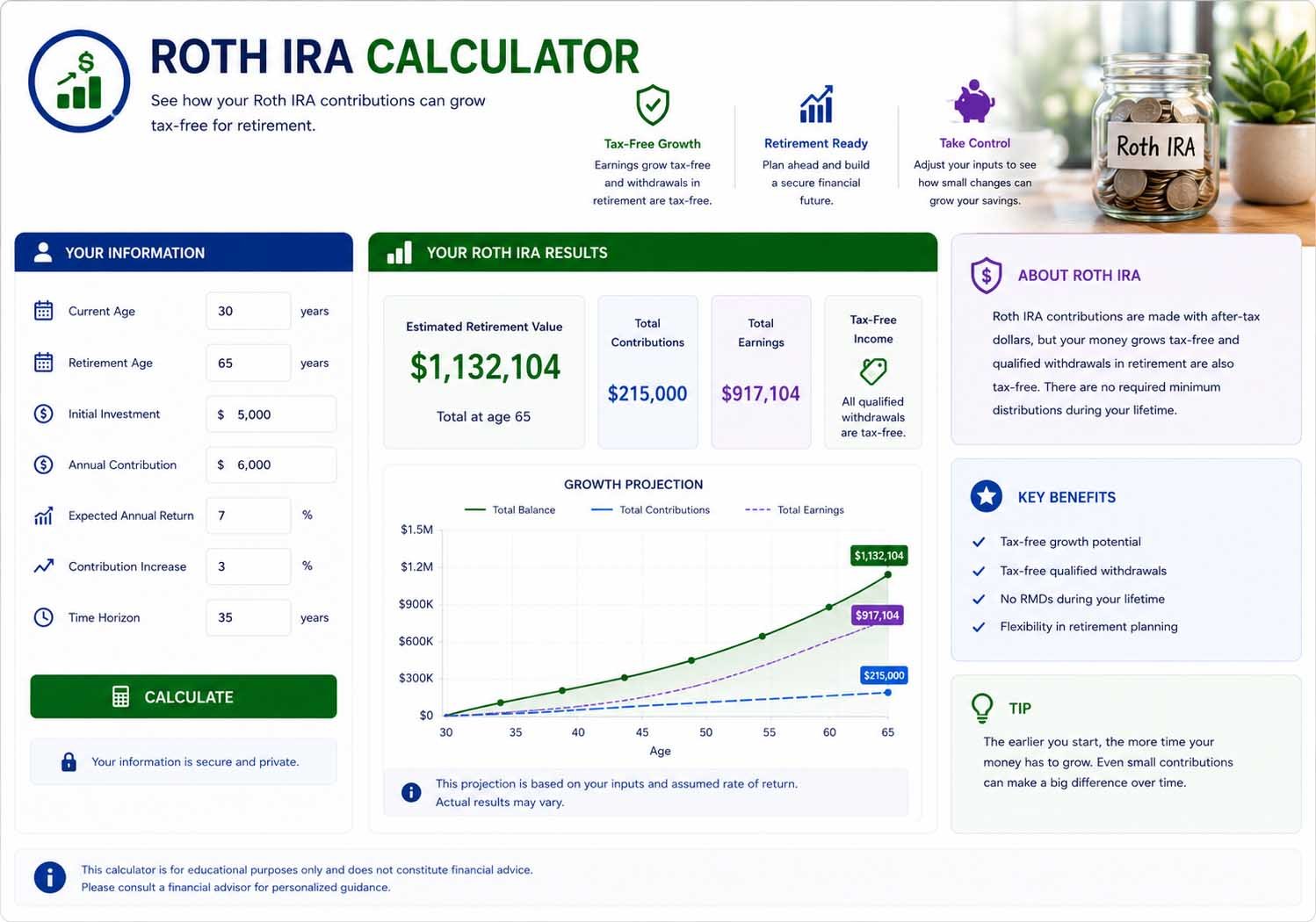
Time does most of the work in a Roth IRA. Someone who contributes $1,200 a year from 25 to 65 at 7% ends up with roughly twice as much as someone who contributes the same amount from 35 to 65, even though they only put in $12,000 more. Earlier contributions simply have more years to compound.
Roth IRA vs. 401(k)
A Roth IRA and a Roth 401(k) both offer tax-free qualified withdrawals, but they differ in other ways. A 401(k) is offered through your employer, has a much higher contribution limit and may come with a match; a Roth IRA is opened on your own, offers a wider choice of investments and has income limits. Many people contribute to a 401(k) up to the employer match first and then fund a Roth IRA.
Tips
- Contributions (not earnings) can be withdrawn at any time without tax or penalty.
- Earnings are tax-free once you are 59½ and the account has been open at least five years.
- You can make a contribution for a tax year up to the tax filing deadline the following April.
Frequently Asked Questions
Investing $100 at the end of each month for 30 years at an average 7% return grows to about $122,000. You would have put in $36,000; the other $86,000 or so is growth, and it can come out tax-free in retirement if the withdrawal is qualified. Returns are not guaranteed, so test lower rates too.
A Roth IRA can be useful for long-term retirement planning because qualified withdrawals can be tax-free. Whether it is right for you depends on your income, eligibility, tax situation, and overall retirement strategy.
Up to $7,500, or $8,600 if you are 50 or older, as long as you have at least that much earned income. The amount phases out between $153,000 and $168,000 of modified AGI for single filers and between $242,000 and $252,000 for married couples filing jointly.
It grows your balance and yearly contributions at the return you enter, year by year, and compares the result with a taxable account that pays tax on its gains each year at your marginal rate. Actual returns will vary.
Both can provide tax-free qualified retirement withdrawals, but they are different account types with different rules and contribution limits. A Roth 401(k) is offered through an employer, while a Roth IRA is generally opened individually.
Disclaimer: This calculator gives estimates for general information only. It is not financial, tax or legal advice. Results depend on the numbers you enter and on simplified assumptions, so your actual figures may differ. Check important decisions with a qualified professional or the official source.
Related Calculators
For other parts of your retirement plan, try these calculators.
Written by Sharp Calculator Team — we build and test every calculator on this site, checking each formula against hand-worked examples and official sources. Last updated: October 2026.