
Ligation Calculator
Work out the insert DNA mass for the perfect insert:vector molar ratio.
Your Results
Enter your values and press Calculate to see your results.
What Is a Ligation Calculator?
A ligation calculator tells you how many nanograms of insert DNA to add to a known amount of vector so the two fragments are mixed at the molar ratio you want. Because DNA fragments of different lengths have very different numbers of molecules per nanogram, mixing equal masses rarely gives an equal number of ends. Getting the ratio right is one of the simplest ways to improve colony yield and reduce empty-vector background in molecular cloning.
Enter your vector length, insert length, vector mass and preferred insert:vector ratio, and the calculator returns the insert mass, the amount of each fragment in femtomoles, the total DNA in the reaction and – if you add concentrations – the exact volumes to pipette.
How to Use the Ligation Calculator
- Type the vector length in base pairs (the linearised backbone, without the removed stuffer).
- Enter the insert length in base pairs.
- Enter the vector mass you plan to use, usually 50–100 ng.
- Choose the insert : vector molar ratio. 3 : 1 is the most common starting point.
- Optionally add the DNA concentrations in ng/µL to get pipetting volumes.
- Press Calculate to see the insert mass, fmol values and volumes.
Ligation Formula
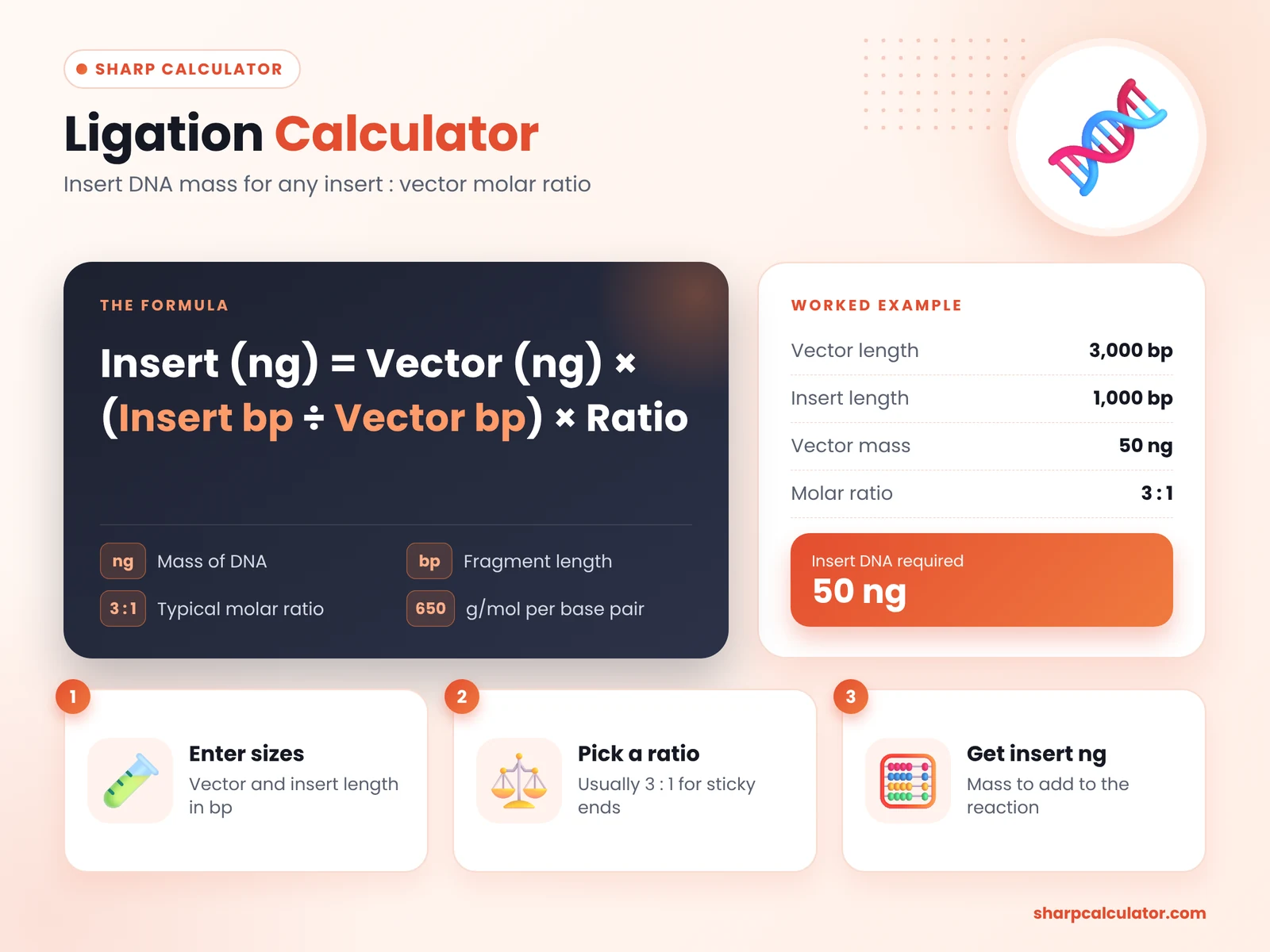
The ligation calculator converts the molar ratio into a mass ratio using fragment lengths. Since the average mass of one base pair of double-stranded DNA is about 650 g/mol, mass is proportional to length for an equal number of molecules.
Insert (ng) = Vector (ng) × (Insert bp ÷ Vector bp) × Ratio- Vector (ng) – mass of linearised vector in the reaction
- Insert bp / Vector bp – length of each fragment
- Ratio – desired insert : vector molar ratio
- pmol = ng × 1000 ÷ (bp × 650)
The femtomole values let you check the actual number of DNA ends. A 50 ng vector of 3,000 bp is about 25.6 fmol, so a 3 : 1 reaction needs roughly 77 fmol of insert.
Worked example
You have a 3,000 bp vector and a 1,000 bp insert, and you want 50 ng of vector at a 3 : 1 molar ratio.
Insert = 50 ng × (1,000 ÷ 3,000) × 3 = 50 ng. If your insert is at 25 ng/µL, you would add 2 µL. The reaction contains about 25.6 fmol of vector and 76.9 fmol of insert, or 100 ng of DNA in total.

Choosing the Right Insert : Vector Ratio
There is no single perfect ratio for every reaction, but a few rules of thumb work well. Sticky-end ligations usually succeed at 1 : 1 to 3 : 1. Blunt-end ligations are less efficient, so a slightly higher insert excess helps. Very short inserts, adapters and oligo duplexes need a larger excess, while very large inserts often work best close to 1 : 1.
If your first attempt gives few colonies, try a ratio series (1 : 1, 3 : 1 and 5 : 1) in parallel and keep a vector-only control to measure background.
For tricky clonings, Gibson assembly, In-Fusion or Golden Gate methods are alternatives that also depend on accurate molar ratios between fragments. Whichever method you use, quantify every fragment carefully and calculate the amounts in femtomoles first, then convert to nanograms with this calculator. A short, clean PCR clean-up or gel purification before ligation removes primers and salts that can lower efficiency.
| Ligation type | Suggested ratio | Notes |
|---|---|---|
| Cohesive (sticky) ends | 1 : 1 – 3 : 1 | Most standard restriction cloning |
| Blunt ends | 3 : 1 – 5 : 1 | Use fresh ligase, consider PEG |
| Short insert < 200 bp | 5 : 1 – 10 : 1 | Adapters, linkers, oligo duplexes |
| Large insert > 5 kb | 1 : 1 | Avoid concatemers |
| TA / PCR cloning | 3 : 1 | Use fresh PCR product |
Ligation Reaction Setup at a Glance
A typical 20 µL T4 DNA ligase reaction contains the vector and insert from this ligation calculator, 2 µL of 10× ligase buffer, 1 µL of T4 DNA ligase and nuclease-free water to volume. Sticky-end reactions are commonly incubated for 10 minutes to 1 hour at room temperature or overnight at 16 °C, while blunt-end reactions benefit from longer incubation. Heat-inactivate the ligase if your protocol allows it, then transform 1–5 µL into competent cells.
Tips for Successful Ligation
- Quantify DNA accurately.Use a fluorometric assay or a clean A260 reading; residual primers and dNTPs inflate PCR-product concentrations.
- Use linear vector length.Enter the size of the cut backbone, not the full parent plasmid, when a fragment was removed.
- Keep total DNA moderate.Around 50–200 ng in a 20 µL reaction is a good range for most T4 DNA ligase protocols.
- Dephosphorylate when needed.Single-enzyme or blunt vectors self-ligate easily; phosphatase treatment lowers background.
- Run controls.Vector-only and no-ligase controls show whether colonies come from real inserts.
- Test several ratios.A quick 1 : 1, 3 : 1, 5 : 1 series is cheaper than repeating a failed cloning step.
Why the Molar Ratio Matters
DNA ligase joins ends, not nanograms. If the insert is under-represented, many vector molecules close on themselves and give empty colonies. If the insert is in huge excess, multiple inserts can join together or ligate into the vector in tandem. Using a ligation calculator keeps the ratio of ends predictable from one experiment to the next, which makes troubleshooting much easier and saves time, reagents and competent cells.
Who Can Use This Tool?
This tool is designed for molecular biology students, research technicians, cloning core staff and anyone preparing recombinant plasmids. It works for restriction cloning, blunt-end cloning, TA cloning and adapter ligation, on both mobile and desktop.
Note: This ligation calculator is for research planning and education. Always follow your enzyme supplier’s protocol for buffer, temperature and incubation time.
Frequently Asked Questions
What is the best insert to vector ratio for ligation?
A 3 : 1 insert : vector molar ratio is the most common starting point. Use 1 : 1 for very large inserts and up to 10 : 1 for short fragments or adapters.
How do I calculate the insert amount for ligation?
Multiply the vector mass by the insert length divided by the vector length, then multiply by the desired molar ratio. For example, 50 ng × (1,000 ÷ 3,000) × 3 = 50 ng.
How much vector DNA should I use?
Most protocols use 50–100 ng of linearised vector in a 10–20 µL reaction. Higher amounts rarely improve results and can increase background.
Why is the molar ratio more important than the mass ratio?
Ligase works on DNA ends. Shorter fragments contain more molecules per nanogram, so equal masses do not give equal numbers of molecules.
What molecular weight is used for one base pair?
The calculator uses an average of 650 g/mol per base pair of double-stranded DNA, the standard value used in most cloning calculations.
Does this calculator work for blunt-end ligation?
Yes. The math is the same; just choose a slightly higher ratio such as 3 : 1 to 5 : 1 because blunt ends ligate less efficiently.