
Punnett Square Calculator
Predict offspring genotypes and phenotypes for a single gene.
Your Results
Enter your values and press Calculate to see your results.
What Is a Punnett Square Calculator?
A Punnett square calculator predicts the possible genotypes and phenotypes of offspring from two parents. Named after geneticist Reginald Punnett, the square places the alleles from one parent along the top and the other along the side, then combines them in each box. Every box represents an equally likely outcome for one child, kitten, puppy or plant.
This tool builds the square automatically for a single gene with complete or incomplete dominance, and includes an X-linked mode for traits such as colour blindness or haemophilia, where sons and daughters inherit differently.
How to Use the Punnett Square Calculator
- Choose the gene letter you want to use in the square.
- Select complete or incomplete / co-dominance.
- Pick the genotype of each parent: homozygous dominant, heterozygous or homozygous recessive.
- Press Calculate to see the Punnett square, genotype ratio and phenotype ratio.
- For sex-linked traits, open the X-Linked Recessive tab and choose the mother and father.
How a Punnett Square Works
Each parent passes on one of its two alleles at random. The Punnett square calculator lists both possibilities for each parent and combines them, giving four equally likely outcomes.
Probability of a genotype = boxes with that genotype ÷ 4- Homozygous dominant – two dominant alleles (AA)
- Heterozygous – one dominant, one recessive (Aa)
- Homozygous recessive – two recessive alleles (aa)
- Complete dominance – AA and Aa look the same
- Incomplete dominance – Aa shows an intermediate trait
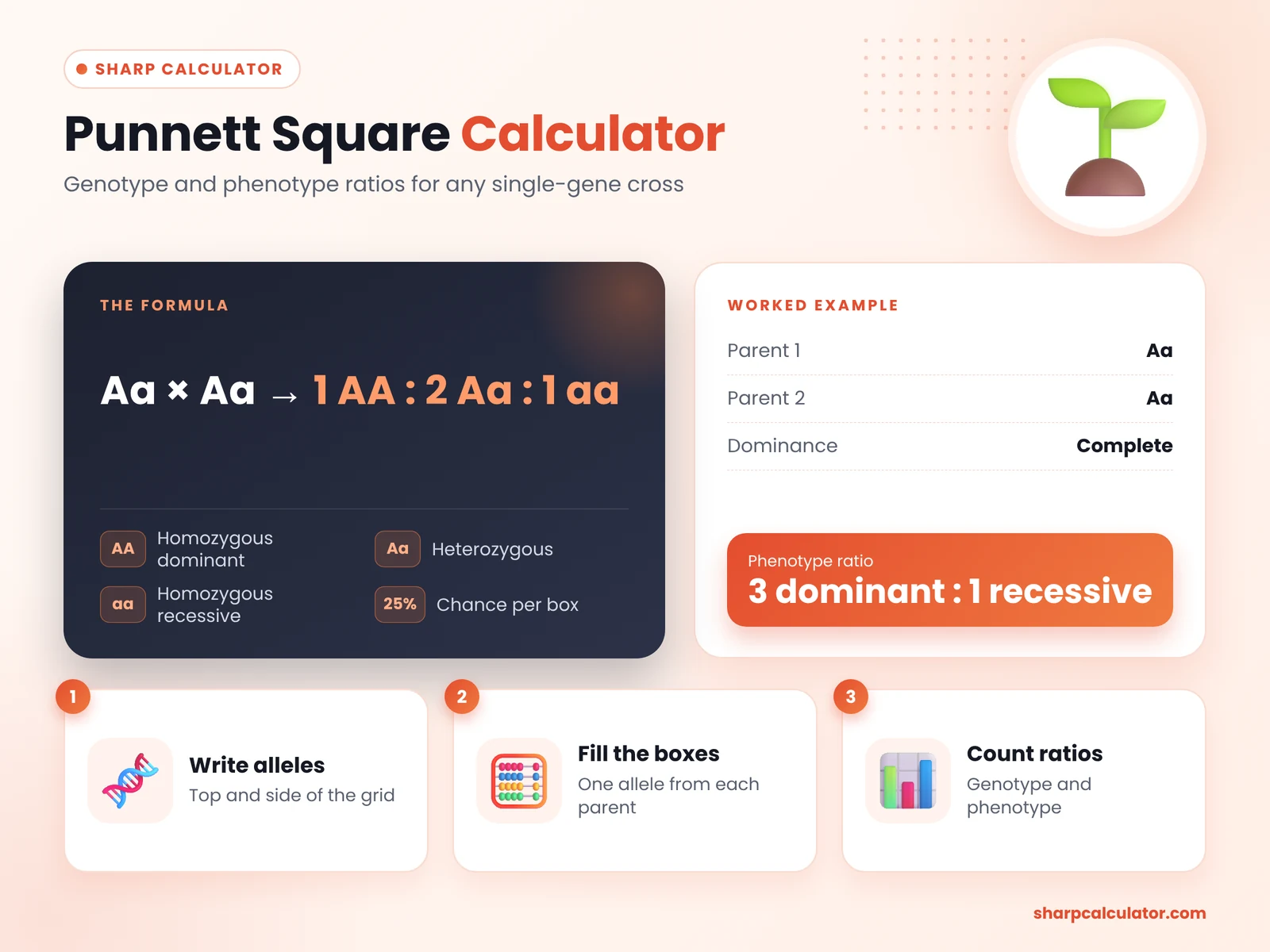
With complete dominance, Aa × Aa gives a genotype ratio of 1 : 2 : 1 and a phenotype ratio of 3 : 1. With incomplete dominance, such as red × white snapdragons giving pink, the phenotype ratio matches the genotype ratio: 1 red : 2 pink : 1 white.
Worked example
Two brown-eyed parents are both heterozygous (Bb), where brown (B) is dominant to blue (b).
The square gives BB, Bb, Bb and bb. Genotype ratio 1 : 2 : 1, phenotype ratio 3 brown : 1 blue, so each child has a 25 % chance of blue eyes.
X-Linked Inheritance
Genes on the X chromosome follow a different pattern because males have one X and one Y. A son always receives his X from his mother, so a carrier mother (XᴬXᵃ) gives each son a 50 % chance of being affected. Daughters receive one X from each parent, so they are usually carriers rather than affected unless the father is also affected.
Common X-linked recessive conditions include red–green colour blindness and haemophilia in people, and certain coat colours in cats, such as orange and tortoiseshell patterns.
Because sons inherit their only X chromosome from their mother, a carrier mother can pass an X-linked trait to her sons even when the father is unaffected. Daughters need two copies to show a recessive X-linked trait, which is why these conditions are much rarer in females. The X-linked tab in the calculator shows these differences clearly for every combination of parents. Genetic counsellors and breeders use exactly this reasoning to explain family patterns and plan matings that avoid passing on sex-linked conditions.
| Mother × Father | Affected sons | Affected daughters |
|---|---|---|
| Carrier × Unaffected | 50% | 0% (50% carriers) |
| Carrier × Affected | 50% | 50% |
| Unaffected × Affected | 0% | 0% (all carriers) |
| Affected × Unaffected | 100% | 0% (all carriers) |
Key Genetics Terms
- Allele – one version of a gene
- Genotype – the allele combination an organism carries
- Phenotype – the visible or measurable trait
- Dominant – an allele expressed with only one copy
- Recessive – an allele expressed only with two copies
- Carrier – a heterozygote who carries a hidden recessive allele
Test Cross: Finding an Unknown Genotype
If an animal or plant shows the dominant trait, you cannot tell from its appearance whether it is AA or Aa. Breeders solve this with a test cross: they mate it with a homozygous recessive (aa) partner. If any offspring show the recessive trait, the unknown parent must be Aa. If all offspring show the dominant trait across a large number of births, the parent is very likely AA. Try both options in the Punnett square calculator above to see the difference: AA × aa gives all Aa offspring, while Aa × aa gives a 1 : 1 ratio.
Tips for Accurate Results
- Write dominant first.Use Aa rather than aA so genotypes are easy to compare.
- Think in probabilities.A 3 : 1 ratio is a chance for each offspring, not a guaranteed split in a family of four.
- Check the dominance type.Incomplete dominance changes the phenotype ratio from 3 : 1 to 1 : 2 : 1.
- Use a test cross.Crossing an unknown dominant individual with aa reveals whether it is AA or Aa.
- Use the right tool for two genes.For two traits at once, use our Dihybrid Cross Calculator to get the 16-box square.
- Remember sex linkage.Traits on the X chromosome need the X-linked mode, not a standard square.
Why Punnett Squares Are Useful
Punnett squares turn the abstract idea of inheritance into a simple picture. Students use them to solve genetics problems, breeders use them to plan matings for coat colour or disease-free litters, and families use them to understand how a recessive trait can skip generations. A Punnett square calculator gives the answer instantly and shows the grid so you can learn the method at the same time.
Who Can Use This Tool?
This tool is built for school and college biology students, teachers, pet and livestock breeders, plant breeders and anyone curious about how traits are inherited. It works on mobile and desktop.
Note: This Punnett square calculator models simple Mendelian inheritance. Many real traits are influenced by several genes and the environment, and it is not a substitute for genetic counselling.
Frequently Asked Questions
What is a Punnett square?
A Punnett square is a grid that shows all possible allele combinations from two parents and the probability of each offspring genotype.
What ratio does Aa × Aa give?
A 1 : 2 : 1 genotype ratio (AA : Aa : aa) and, with complete dominance, a 3 : 1 phenotype ratio.
What is the difference between genotype and phenotype?
Genotype is the pair of alleles an organism carries. Phenotype is the trait you can observe, such as flower colour.
How do I solve incomplete dominance?
Use the same square, but treat each genotype as a separate phenotype. Rr × Rr gives 1 red : 2 pink : 1 white.
Why are X-linked traits more common in males?
Males have only one X chromosome, so a single recessive allele on that X is enough to show the trait.
Can a Punnett square predict exactly how many offspring will have a trait?
No. It gives probabilities for each offspring. Actual numbers in small families or litters often differ from the expected ratio.