
Cattle per Acre Calculator
Estimate how many cattle your pasture can carry.
Your Results
Enter your values and press Calculate to see your results.
What Is a Cattle per Acre Calculator?
A cattle per acre calculator estimates how many cattle a pasture can support without overgrazing. This number, known as the stocking rate or carrying capacity, depends on how much forage the land produces, how much of it the animals can safely eat, how big the cattle are and how long they will graze. Getting it right keeps cattle well fed, protects soil and plant health and supports long-term profitability.
Enter the pasture area, forage production, utilization rate, animal weight, daily intake and grazing days. The calculator returns the number of cattle the pasture can support, the acres needed per animal and the animal unit months (AUMs) available.
How to Use the Cattle per Acre Calculator
- Enter the pasture area in acres or hectares.
- Estimate forage production in pounds of dry matter per acre – use local extension data or clip-and-weigh samples.
- Set the utilization rate – 35 % is a conservative default.
- Enter average animal weight, daily intake and the number of grazing days.
- Press Calculate to see how many head the pasture can carry.
Stocking Rate Formula
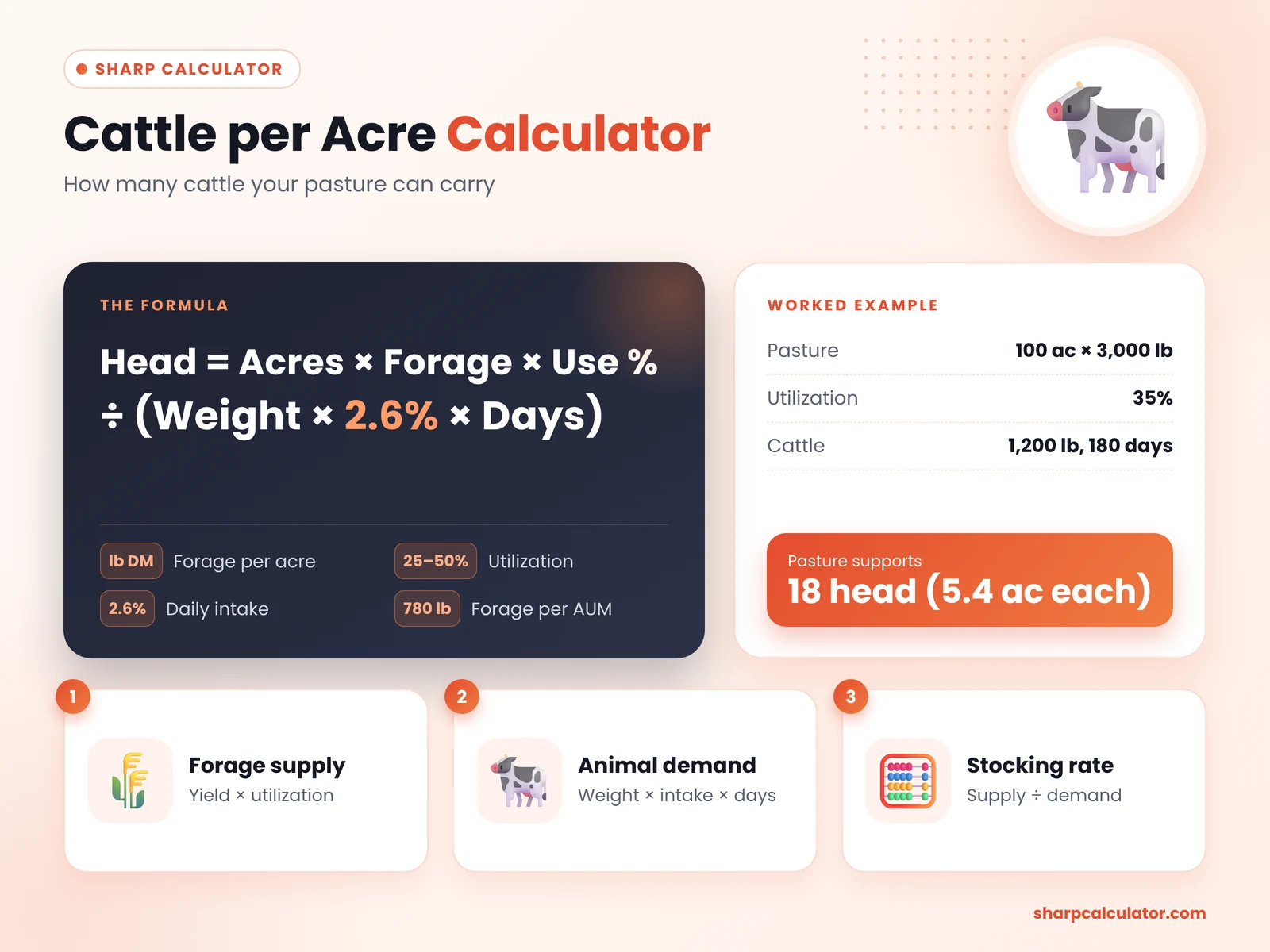
The cattle per acre calculator compares the forage available with the forage the herd needs over the grazing period.
Usable forage = Acres × Forage (lb DM/ac) × UtilizationHead = Usable forage ÷ (Weight × Intake % × Grazing days)- Forage production – total dry matter grown per acre during the season
- Utilization – share actually eaten; the rest is trampled, wasted or left for regrowth
- Intake – about 2.5–3 % of body weight per day in dry matter
- AUM – forage for one 1,000 lb cow for one month (about 780 lb)
Lactating cows eat more than dry cows, and cow–calf pairs are often counted as 1.2–1.4 animal units. Adjust the weight or intake to reflect your herd.
Worked example
A 100-acre pasture produces 3,000 lb of dry matter per acre. With 35 % utilization, 1,200 lb cows eating 2.6 % of body weight and 180 grazing days:
Usable forage = 105,000 lb. Each cow needs 1,200 × 0.026 × 180 = 5,616 lb. The pasture supports 18 cows, or about 5.4 acres per cow.
Typical Pasture Productivity
Forage yield varies dramatically with rainfall, soil, grass species and management. Irrigated or well-fertilised improved pastures can produce several times more forage than dry rangeland. Local extension services often publish typical yields and recommended stocking rates for your area.
Rainfall is the biggest driver of these numbers. A dry year can cut forage production in half, so many ranchers set their base herd size on an average or slightly below-average year and use temporary grazing, hay or early weaning to manage good and bad seasons. Measuring forage each year keeps your stocking rate realistic.
Matching herd size to pasture also protects long-term soil health. Moving cattle between smaller paddocks gives grass time to recover and can noticeably raise forage use and stocking rate. Good water access in every paddock, soil testing and adding legumes such as clover also lift productivity over time. Monitoring grass height before and after each grazing period is a practical way to check that animals are not removing too much. Many graziers move cattle when pasture falls to around 3–4 inches, leaving enough leaf for quick regrowth.
| Pasture type | Forage (lb DM/acre/yr) | Approx. acres per cow (6 months) |
|---|---|---|
| Arid rangeland | 500–1,500 | 12–35 |
| Semi-arid native grass | 1,500–3,000 | 6–12 |
| Improved humid pasture | 3,000–6,000 | 3–6 |
| Irrigated, fertilised pasture | 6,000–10,000 | 1.5–3 |
Signs of Overgrazing
- Grass grazed below 3–4 inches across most of the pasture
- Bare soil patches and increased erosion
- More weeds and less desirable plants
- Slow regrowth after grazing
- Cattle losing condition or needing extra hay early
Improving Carrying Capacity
Rotational grazing, where cattle move between smaller paddocks, allows plants to recover and can increase usable forage and stocking rates. Soil testing and fertilisation, adding legumes such as clover, controlling weeds and providing well-placed water points also raise productivity. Re-run the cattle per acre calculator each season with updated forage estimates to adjust herd size before problems develop.
Animal Units for Different Livestock
Stocking rates are often expressed in animal units (AU) so different livestock can be compared. A mature 1,000 lb cow is 1.0 AU, a 1,300 lb cow about 1.3 AU, a cow–calf pair roughly 1.2–1.4 AU, a yearling steer about 0.6–0.75 AU, a horse about 1.25 AU and a sheep about 0.2 AU. You can use these values to adapt the cattle per acre calculator for mixed grazing or other species by adjusting the average weight.
Grazing Management Tips
- Measure forage.Clip and weigh samples for a local yield estimate.
- Be conservative.Start with lower stocking rates and adjust upward.
- Plan for drought.Have a destocking or hay plan for dry years.
- Account for calves.Cow–calf pairs need more forage than dry cows.
- Rotate pastures.Rest periods improve regrowth and soil health.
- Monitor condition.Watch both grass height and cattle body condition.
Why Stocking Rate Matters
Stocking rate is one of the most important decisions in grazing management. Too many cattle damage pastures, increase feed costs and reduce animal performance; too few waste forage and income. A cattle per acre calculator gives you a data-based starting point for balancing your herd with your land.
Who Can Use This Tool?
This tool is for cattle ranchers, beef and dairy farmers, land managers, agricultural advisers and students. It works on mobile in the field.
Note: This cattle per acre calculator provides estimates. Local conditions, weather and management greatly affect real carrying capacity.
Frequently Asked Questions
How many cows can I put per acre?
It depends on forage production. In humid regions with good pasture, 1.5–3 acres per cow may be enough; arid rangeland may need 20 acres or more.
What is an animal unit?
One animal unit is a 1,000 lb cow, with or without a young calf, eating about 26 lb of dry matter per day.
What is an AUM?
An animal unit month is the forage needed to feed one animal unit for one month – about 780 lb of dry matter.
What utilization rate should I use?
25–35 % for continuous grazing and up to 50 % for well-managed rotational grazing.
How much does a cow eat per day?
About 2.5–3 % of its body weight in dry matter, so a 1,200 lb cow eats roughly 30–36 lb per day.
Does rotational grazing increase stocking rate?
Often yes, because forage recovers better and less is wasted.