
Your College Savings Plan
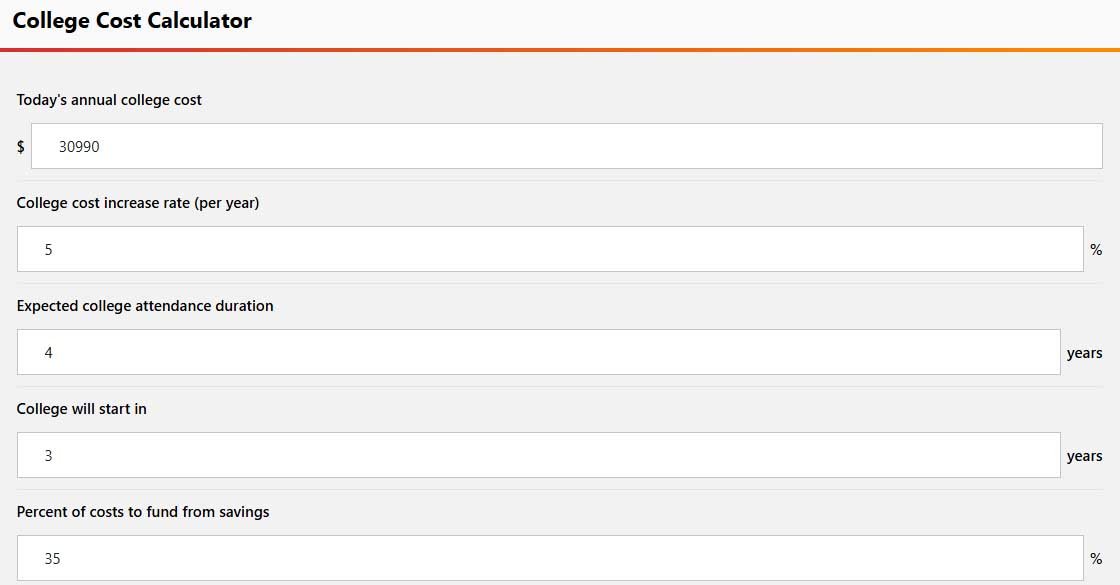
College Cost Calculator
Planning for college can be challenging because tuition is only one part of the total cost. Students and families may also need to consider housing, meals, books, transportation, fees, and other education-related expenses. A College Cost Calculator helps estimate how much college may cost and how much you may need to save.
By entering expected tuition, living expenses, financial aid, inflation, and the number of years until college, you can create a clearer estimate of future education costs. This makes it easier to plan savings and compare different schools.
How Does a College Cost Calculator Work?
A College Cost Calculator estimates the potential cost of attending college based on current expenses and assumptions about future increases. College costs can vary considerably depending on whether a student attends a public or private institution, lives on campus or at home, and qualifies for financial aid.
A College Cost Calculator by School can be particularly useful when comparing specific colleges. Looking at each school’s estimated tuition and total cost of attendance gives families a better idea of how much they may need to prepare for. The calculator can also help compare in-state and out-of-state costs where applicable.
The College Net Price Calculator is another useful concept for college planning. A net price calculation focuses on what a student may actually pay after grants and scholarships rather than looking only at the published cost.
College Cost Calculation
A basic estimate can be represented as:
Total College Cost = Tuition + Fees + Housing + Food + Books + Transportation + Other Expenses
Future costs can also be estimated by accounting for expected annual increases. The actual amount a student pays will depend on the school, financial aid, living arrangements, and personal expenses.
College Tuition, 529 Plans, and Savings
One of the biggest questions families face is how to prepare for future college expenses. A 529 College Cost Calculator can help estimate how much a 529 plan or other education savings account may need to grow to cover future costs.
A 529 plan is designed to help families save for qualified education expenses, and the amount needed depends on the expected cost of attendance and how many years remain before the money is needed. By estimating future college costs, families can compare the potential savings required today with their expected contributions.
For example, a family with a child who is several years away from college may have more time to build savings. A family with a student entering college soon may need to focus more heavily on current resources, scholarships, financial aid, and other funding sources.
How Much Is the Average College Tuition for 4 Years?
The average college tuition for 4 years depends heavily on the type of institution and whether the student qualifies for in-state tuition or financial aid. Tuition is also different from the total cost of attending college because students may have substantial expenses for housing, food, books, transportation, and other fees.
For this reason, families should avoid using one national average as their complete college budget. A better approach is to estimate the cost of the specific schools being considered and then account for expected increases over the years.
A College Cost Calculator can make this process easier by allowing you to enter an estimated annual cost and multiply it across the expected college period. You can then add other expenses and adjust the estimate for inflation.
Comparing College Costs by School
Choosing a college involves more than comparing advertised tuition. Two schools with similar tuition prices can have very different total costs because of differences in housing, fees, meal plans, transportation, and financial aid.
A College Cost Calculator by School can help families compare these expenses side by side. You can estimate the total cost of attendance for each school and then consider the potential impact of scholarships, grants, and other financial assistance.
For example, one college may have higher tuition but offer stronger financial aid, while another may have lower tuition but higher living expenses. Looking at the net cost can provide a more meaningful comparison than looking at tuition alone.
When possible, use current information published directly by the school. College costs and financial aid policies can change from year to year.

College Cost Calculator for Different Savings Goals
A College Cost Calculator can also be used to work backward from a future education goal. Instead of asking only how much college will cost, you can estimate how much you may need to save each month or year.
The calculation can consider the number of years until enrollment, expected investment growth, estimated college inflation, and the percentage of costs you want to cover through savings.
If you expect scholarships or financial aid to cover part of the cost, you can adjust your savings goal accordingly. However, it is wise to avoid assuming that future financial aid will cover a specific amount unless you have a reliable basis for the estimate.
This approach can help parents and students create a more practical education funding strategy.
Vanguard, Fidelity, and uAspire College Cost Calculators
People searching for a College Cost Calculator Vanguard, College Cost Calculator Fidelity, or College Cost Calculator uAspire may be looking for tools from specific financial or education organizations. These tools can use different assumptions and may focus on different parts of college planning.
A general College Cost Calculator is useful for understanding the basic numbers regardless of which provider you use. When comparing calculators, pay attention to the assumptions behind tuition increases, investment returns, financial aid, and other expenses.
The best college cost calculator is generally one that allows you to enter realistic information and clearly explains what is included in the estimate. A simple tool with transparent assumptions can be more useful than a complicated calculator based on assumptions that do not match your situation.
What Does College Really Cost?
The published tuition price is only one component of college expenses. Students may also have to pay mandatory fees, housing, meal plans, books, supplies, transportation, and personal expenses.
For students living away from home, room and board can represent a significant part of the overall cost. Students attending college close to home may be able to reduce expenses by living with family, although transportation and other costs still need to be considered.
Financial aid can also change the amount a family actually pays. Grants and scholarships generally reduce the amount that must be funded directly, while loans may help cover costs but create a future repayment obligation.
This is why estimating the total cost of attendance and the expected net cost is important when planning for college.
Benefits of Using a College Cost Calculator
A College Cost Calculator gives families a structured way to think about education expenses instead of relying on a single tuition number. It can be useful at different stages, from early savings planning to comparing actual college offers.
- Estimate future college expenses.
- Compare tuition and total costs between schools.
- Include housing, food, books, and other expenses.
- Estimate the effect of college cost inflation.
- Plan potential 529 savings goals.
- Compare expected costs with available savings.
- Consider scholarships and financial aid.
- Evaluate different college funding scenarios.
The more accurate your starting information is, the more useful your estimate will be. Updating the calculation as your child’s college plans become clearer can also improve the quality of your financial planning.
How to Use a College Cost Calculator
Start by estimating the current annual cost of the college or type of school you are considering. Include tuition and mandatory fees, then add expected housing, food, books, transportation, and personal expenses.
Next, consider how many years remain before enrollment. If the student is several years away from college, future costs may be higher than today’s prices. Enter an appropriate inflation assumption if the calculator provides that option.
If you already have savings, include the amount you have accumulated and any regular contributions you expect to make. You can then compare your projected resources with the estimated future cost.
For a more realistic plan, run multiple scenarios rather than relying on one estimate. You might compare a public university with a private college, different savings contributions, or different levels of financial aid.
Frequently Asked Questions
The cost varies significantly depending on the type of college, residency, and financial aid. Tuition is also only part of the total cost, so housing, food, fees, books, and other expenses should be included.
A College Net Price Calculator estimates what a student may actually pay after considering grants and scholarships. It provides a more personalized estimate than published tuition alone.
A 529 College Cost Calculator helps estimate future education expenses and the savings that may be needed to help cover those costs through a 529 plan or other resources.
Compare each school’s total estimated cost of attendance, including tuition, fees, housing, meals, books, and transportation. Then consider scholarships, grants, and other financial aid.
The best tool is one that lets you enter realistic costs, savings, inflation, and financial aid assumptions. School-specific information can make the estimate more useful.
Related Calculator:
Explore more financial tools designed to simplify your calculations. Whether you’re planning a mortgage, estimating an auto loan, calculating taxes, or tracking investment growth, our free calculators provide fast and accurate results to help you make smarter financial decisions.