
Inflation Calculator
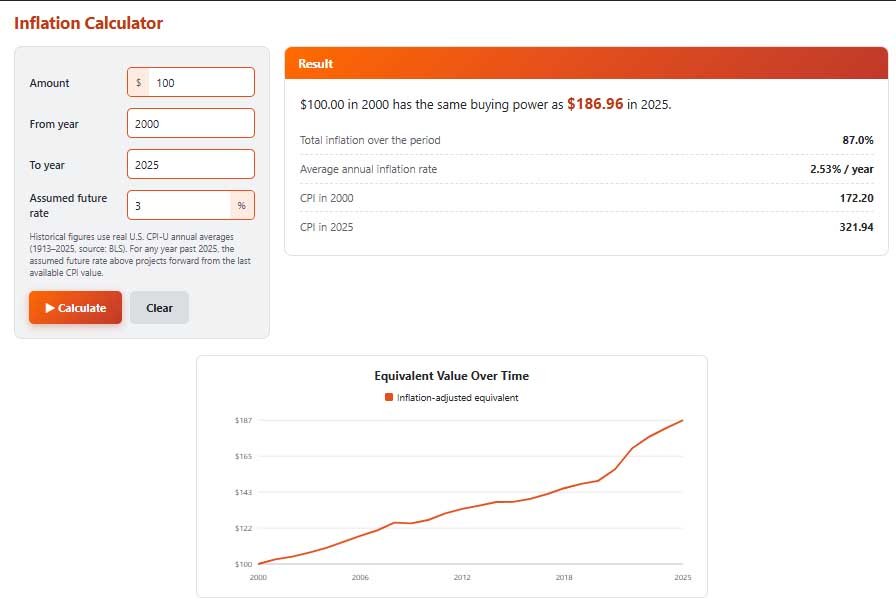
Historical figures use real U.S. CPI-U annual averages (1913–2025, source: BLS). For any year past 2025, the assumed future rate above projects forward from the last available CPI value.
Historical CPI-U annual average data from the U.S. Bureau of Labor Statistics, 1913–2025. 2025 reflects an average of the months available at time of publication. Figures beyond 2025 are projections based on the assumed future rate you enter, not official data. Estimates only — not financial advice.
Inflation Calculator
An Inflation Calculator helps you understand how the value of money changes over time because of inflation. You can compare the purchasing power of an amount in one year with its estimated value in another year.
For example, an amount that could buy many goods in the past may not buy the same amount today. An inflation calculator makes this change easier to understand by comparing prices and money values across different years.
How Does an Inflation Calculator Work?
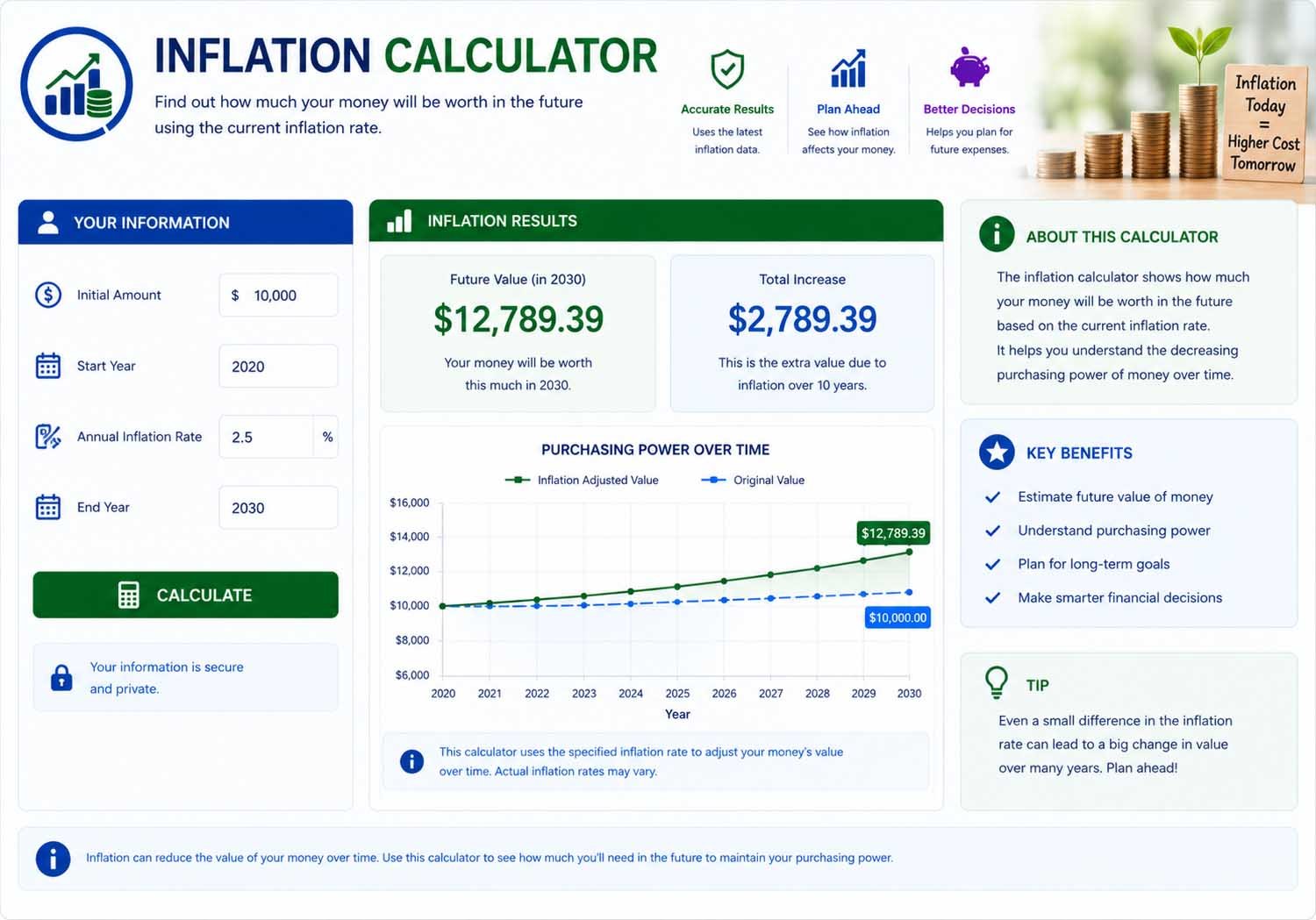
An inflation calculator uses an inflation rate or historical price index to estimate how the purchasing power of money changes over a selected period. You typically enter an amount, starting year, and ending year to get an estimated future or historical value.
The calculation can help answer questions such as how much $10,000 from the past would be worth today or how much money you may need in the future to maintain a similar standard of living.
The basic inflation calculation is:
Future Value = Present Value × (1 + Inflation Rate)ⁿ
Here, the inflation rate represents the average annual increase in prices, and n represents the number of years.
Actual inflation can vary from year to year, so calculator results should be viewed as estimates based on the selected rate or historical data.
Inflation Calculator USD
An Inflation Calculator USD helps compare the purchasing power of US dollars across different years. You can use it to understand how the value of a specific dollar amount has changed over time.
For example, comparing $50,000 from an earlier year with its equivalent value today can show how inflation has affected purchasing power.
This can be useful for comparing historical salaries, product prices, savings, investments, and household expenses.
Inflation Calculator Pakistan
An Inflation Calculator Pakistan can be used to estimate how the purchasing power of Pakistani rupees changes over time. Inflation affects everyday expenses such as food, housing, transportation, education, and other goods and services.
You can compare an amount of Pakistani rupees from one year with its estimated equivalent in another year. This can provide a clearer picture of how rising prices affect personal finances.
Because inflation rates can change considerably between years, using year-specific data can provide a more meaningful estimate than applying one constant rate to a long period.
Inflation Calculator Euro
An Inflation Calculator Euro helps estimate changes in the purchasing power of euros over time. It can be useful when comparing historical prices, wages, savings, and expenses in euro-based economies.
If you are comparing money across different countries, remember that inflation and currency exchange are separate concepts. An inflation calculator measures changes in purchasing power within an economy, while a currency calculator converts one currency into another.
Inflation Calculator Pounds
An Inflation Calculator Pounds helps compare the purchasing power of British pounds across different periods. You can use it to estimate what an amount of pounds from a previous year would represent in another year after accounting for inflation.
This can be helpful for comparing historical salaries, property prices, consumer costs, or savings amounts.
Inflation Calculator Rupiah
An Inflation Calculator Rupiah estimates how the purchasing power of Indonesian rupiah may have changed over time. By entering a starting amount and selected years, you can see how inflation affects the value of money.
The result can help users understand historical price changes and compare the cost of goods and services across different periods.
Salary Inflation Calculator
A Salary Inflation Calculator helps compare income across different years while accounting for changes in purchasing power.
For example, if you earned a certain salary several years ago, an inflation-adjusted calculation can estimate the salary that might provide similar purchasing power today. This can be useful when comparing job offers, historical wages, career earnings, or changes in living costs.
Inflation Calculator Yen
An Inflation Calculator Yen can be used to compare the purchasing power of Japanese yen across different years. It may be useful for reviewing historical prices, salaries, household expenses, or financial values.
Since inflation rates differ between countries, the appropriate country and historical data should be used when making the calculation.
Inflation Calculator Reverse
An Inflation Calculator Reverse works in the opposite direction of a typical inflation calculation. Instead of asking what an older amount would be worth today, you can estimate what today’s amount would have represented in an earlier period.
For example, if you know the current price of an item, a reverse inflation calculation can help estimate its equivalent purchasing value in a previous year.
This is useful when comparing historical financial figures or understanding how purchasing power has changed in both directions.
Why Is an Inflation Calculator Useful?
Inflation can make it difficult to compare financial amounts from different periods. An inflation calculator provides a simple way to put historical and current values into perspective.
You can use it to:
- Compare the purchasing power of money across years.
- Estimate the future cost of goods and services.
- Adjust historical salaries for inflation.
- Compare savings and financial goals.
- Understand the impact of rising prices.
- Review historical financial values.
The results can be particularly useful when planning long-term budgets because future expenses may be higher than today’s costs.
Inflation and Purchasing Power
Inflation reduces the purchasing power of money when prices increase. If your income or savings does not grow at a similar rate, the same amount of money may buy fewer goods and services over time.
For example, if everyday expenses increase by several percent each year, a fixed amount saved today may not have the same purchasing power many years from now.
This is why inflation is an important consideration when planning retirement, setting savings goals, estimating future expenses, or evaluating long-term investments.
Frequently Asked Questions
An inflation calculator estimates how the purchasing power of a specific amount changes between two periods. It can show what an amount from the past may be worth today or what today’s amount may represent in an earlier period.
When prices rise, the purchasing power of money generally decreases. This means the same amount of money may purchase fewer goods and services in the future than it does today.
Yes. A Salary Inflation Calculator can estimate how much a historical salary would need to change to have similar purchasing power in another year.
Yes, if the calculator provides the required historical inflation data. You can calculate inflation for currencies such as USD, euros, pounds, rupiah, yen, and Pakistani rupees.
No. Inflation measures changes in purchasing power and prices, while currency exchange determines how much one currency is worth compared with another currency.
Related Calculator:
Explore more financial tools designed to simplify your calculations. Whether you’re planning a mortgage, estimating an auto loan, calculating taxes, or tracking investment growth, our free calculators provide fast and accurate results to help you make smarter financial decisions.