
Estimates only, based on the values you enter. If Amount Returned is less than Amount Invested, ROI and Annualized ROI will be negative. Not financial advice.
What Is Return on Investment (ROI)?
Return on Investment (ROI) is a widely used financial metric for measuring the profitability of an investment. It compares the gain generated by an investment with the amount originally spent. Because the calculation is simple and applicable to many situations, an ROI Calculator can be useful for evaluating investments such as stocks, real estate, business projects, marketing campaigns, or other opportunities that involve a cost and a potential financial gain.
ROI provides a quick way to understand how efficiently invested money has performed. However, the result depends heavily on how the investment cost and gain are defined. Different expenses, taxes, fees, and additional cash flows can change the final ROI, so the figures used in the calculation should be selected carefully.
How to use the ROI calculator
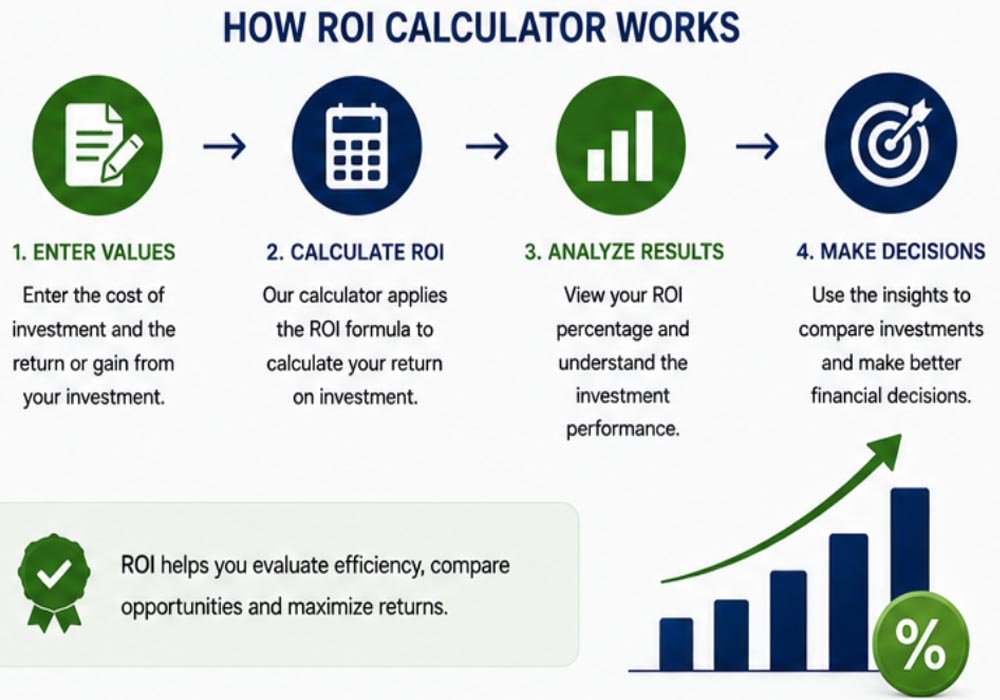
- Enter the amount invested and the amount returned (what you received or what the investment is worth now).
- Choose Use Dates and enter the start and end dates, or Use Length and enter years and months.
- Click Calculate to see the gain, ROI, annualized ROI and investment length.

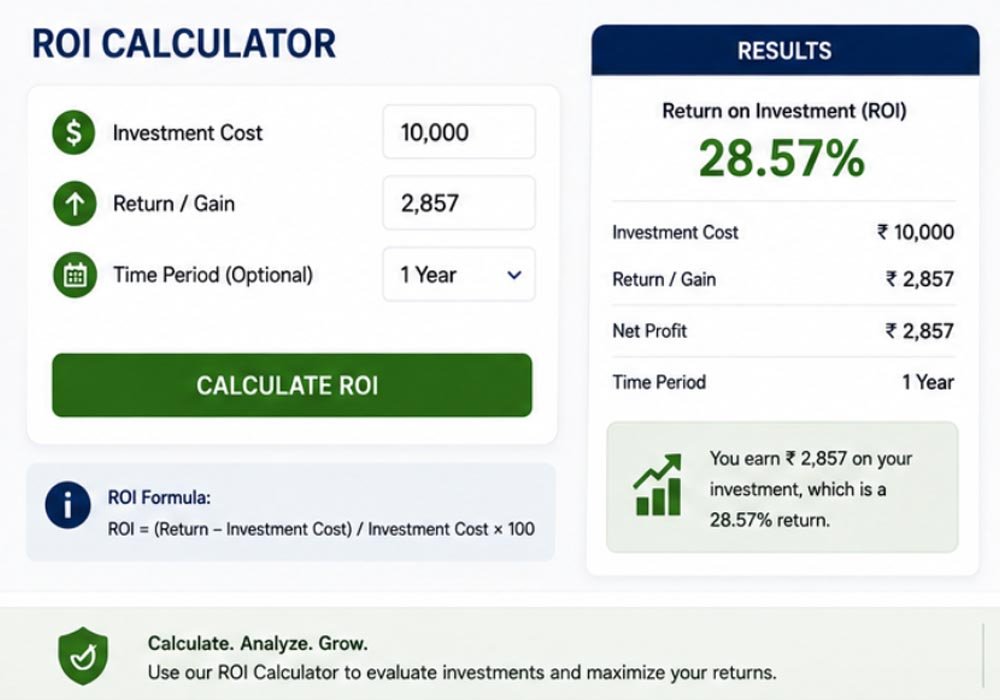
ROI formula
ROI = (Gain from investment − Cost of investment) ÷ Cost of investment × 100
Annualized ROI = (1 + ROI)^(1 ÷ years) − 1
Example
You invest $50,000 and later receive $70,000. The gain is $20,000, so:
ROI = (70,000 − 50,000) ÷ 50,000 × 100 = 40%
If that took 5 years, the annualized ROI is 1.40^(1/5) − 1 ≈ 7.0% a year. A 50% total return over 10 years works out to only (1.5)^(1/10) − 1 ≈ 4.1% a year.
ROI vs. Rate of Return
ROI is sometimes confused with Rate of Return (ROR), but the two terms are not always interchangeable. ROI generally focuses on the overall gain compared with the investment cost, while rate of return can refer to the return earned over a particular period, such as a year.
This distinction becomes important when comparing investments held for different lengths of time. An investment with a high ROI may not necessarily be better than another investment with a lower ROI if the first investment required substantially more time to produce its return.

Understanding Annualized ROI
One of the major limitations of traditional ROI is that it does not include the investment period. For example, an investment producing a 50% ROI in one year is very different from an investment producing the same 50% ROI over ten years.
Annualized ROI helps address this issue by expressing the return on a yearly basis. This can make comparisons between investments with different holding periods more meaningful. The ROI Calculator can use the investment time to provide an annualized perspective, helping users better understand how quickly an investment generated its return.
Tips
- Always compare investments by annualized ROI when their holding periods differ.
- ROI ignores the timing of cash flows in between; for regular deposits or withdrawals, use the IRR or Average Return Calculator.
- Consider risk as well as return.
Frequently Asked Questions
Subtract the cost from what you got back, divide by the cost and multiply by 100. For example, $50,000 invested that returns $70,000 is a 40% ROI.
There is no single ROI percentage that is considered good for every investment. A suitable ROI depends on the investment period, risk, costs, and the return available from alternative opportunities.
No. Traditional ROI does not include a specific timeframe, while an annualized return expresses investment performance on a yearly basis. This makes annualized return more useful when comparing investments held for different periods.
Two ROI calculations can produce different results when investors define costs and gains differently. Taxes, fees, operating expenses, additional investments, and other cash flows can all affect the final ROI.
Yes, if you want the true return. Add purchase costs and fees to the cost, and subtract selling costs and taxes from the amount returned. Leaving them out makes ROI look better than it was.
Disclaimer: This calculator gives estimates for general information only. It is not financial, tax or legal advice. Results depend on the numbers you enter and on simplified assumptions, so your actual figures may differ. Check important decisions with a qualified professional or the official source.
Related Calculators
To measure returns in other ways, try these calculators.
Written by Sharp Calculator Team — we build and test every calculator on this site, checking each formula against hand-worked examples and official sources. Last updated: October 2026.