
Accumulation Schedule
| Year | Deposit | Interest | Ending balance |
|---|
Estimates only, based on a constant interest rate held for the full term. Early withdrawal penalties are not included. Not financial advice.
What is a CD calculator?
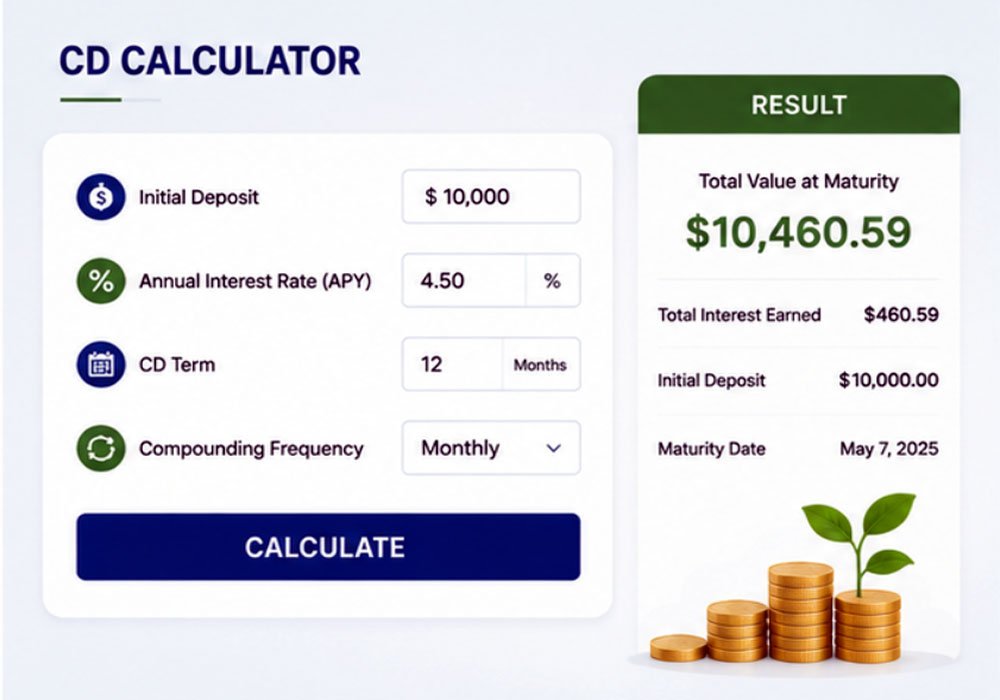
A CD Calculator estimates how much a certificate of deposit will be worth when it matures and how much interest it will earn. Enter the deposit, rate, compounding frequency and term, and it shows the end balance, total interest and a schedule. It helps savers compare CD offers with different rates and terms, or compare a CD with a savings account.
What is a certificate of deposit?
A CD is a bank or credit union deposit that you agree to leave untouched for a fixed term, from a few months to several years, in return for a fixed rate. Taking the money out early usually costs a penalty, often a few months of interest.
How to use it
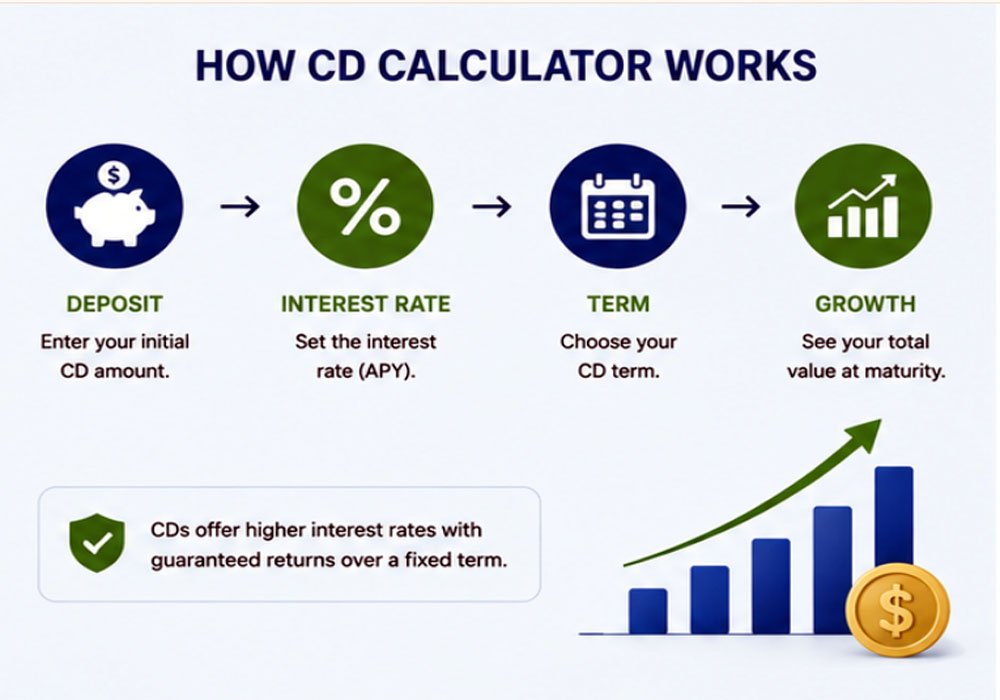
- Enter the initial deposit.
- Enter the interest rate. If the bank quotes an APY, choose annually (APY) as the compounding option.
- Enter the deposit length in years and months.
- Optionally enter your marginal tax rate to see the after-tax interest.
- Click Calculate.
Example
You put $10,000 in a 6-month CD paying 5% APY. Because APY already includes compounding, the value at maturity is $10,000 × 1.05^0.5 ≈ $10,247, so you earn about $247 in interest. The same $10,000 in a 12-month CD at 5% APY would earn $500.
CD Calculator Formula
When interest is compounded periodically, the future value of a CD can be estimated using the following formula:
A = P × (1 + r/n)^(nt)
Where:
- A = Final CD balance
- P = Initial deposit
- r = Annual interest rate expressed as a decimal
- n = Number of compounding periods per year
- t = CD term in years
The estimated interest earned can then be calculated as:
Interest Earned = A − P
For example, if a deposit is compounded monthly, the number of compounding periods is 12 per year. A CD calculator can perform these calculations automatically and show the estimated maturity value without requiring manual calculations.
Tips for choosing a CD
- Compare offers by APY, which includes compounding.
- Only lock up money you will not need before maturity, and check the early withdrawal penalty.
- Consider a CD ladder: split your money across several terms so some of it matures every year.
- Check that the bank is FDIC-insured or the credit union is NCUA-insured.
- CD interest is usually taxable in the year it is earned.
Frequently Asked Questions
A CD can be calculated using the initial deposit, interest rate or APY, compounding frequency, and investment term. The compound interest formula can then be used to estimate the final balance and total interest earned.
At 5% APY, $10,000 in a 6-month CD earns about $247, for a maturity value of about $10,247. At 4% APY it would earn about $198.
CD value can be calculated by applying the deposit amount, interest rate, compounding frequency, and term to a compound interest formula. A CD calculator performs this calculation automatically and provides the estimated maturity balance.
A 12-month CD earns its APY over the year: at 5% APY, $10,000 earns $500; at 4% APY, $400. Interest is usually taxable.
Most banks charge an early withdrawal penalty, commonly a set number of months of interest. On a short CD the penalty can wipe out much of what you earned, so check the terms before you open one.
Disclaimer: This calculator gives estimates for general information only. It is not financial, tax or legal advice. Results depend on the numbers you enter and on simplified assumptions, so your actual figures may differ. Check important decisions with a qualified professional or the official source.
Related Calculators
To compare a CD with other ways of saving, try these calculators.
Written by Sharp Calculator Team — we build and test every calculator on this site, checking each formula against hand-worked examples and official sources. Last updated: October 2026.