
| Traditional, SIMPLE, or SEP IRA | Roth IRA | Regular Taxable Savings | |
|---|---|---|---|
| Balance at age 65 | $0 | $0 | $0 |
| Balance at age 65 (after tax) | $0 | $0 | $0 |
—
Annual Schedule
| Age | Traditional/SIMPLE/SEP IRA (Before Tax) |
Traditional/SIMPLE/SEP IRA (After Tax) |
Roth IRA (After Tax) |
Regular Taxable Savings (After Tax) |
||||
|---|---|---|---|---|---|---|---|---|
| Start | End | Start | End | Start | End | Start | End | |
Estimates only. Assumes a simplified model: the taxable account pays tax on its gains every year at your current marginal rate, and the Traditional/SIMPLE/SEP IRA's after-tax value simply applies your expected retirement tax rate to its before-tax balance. Actual accounts, contribution limits, and tax rules are more complex and may change. Not tax or financial advice.
What is an IRA calculator?
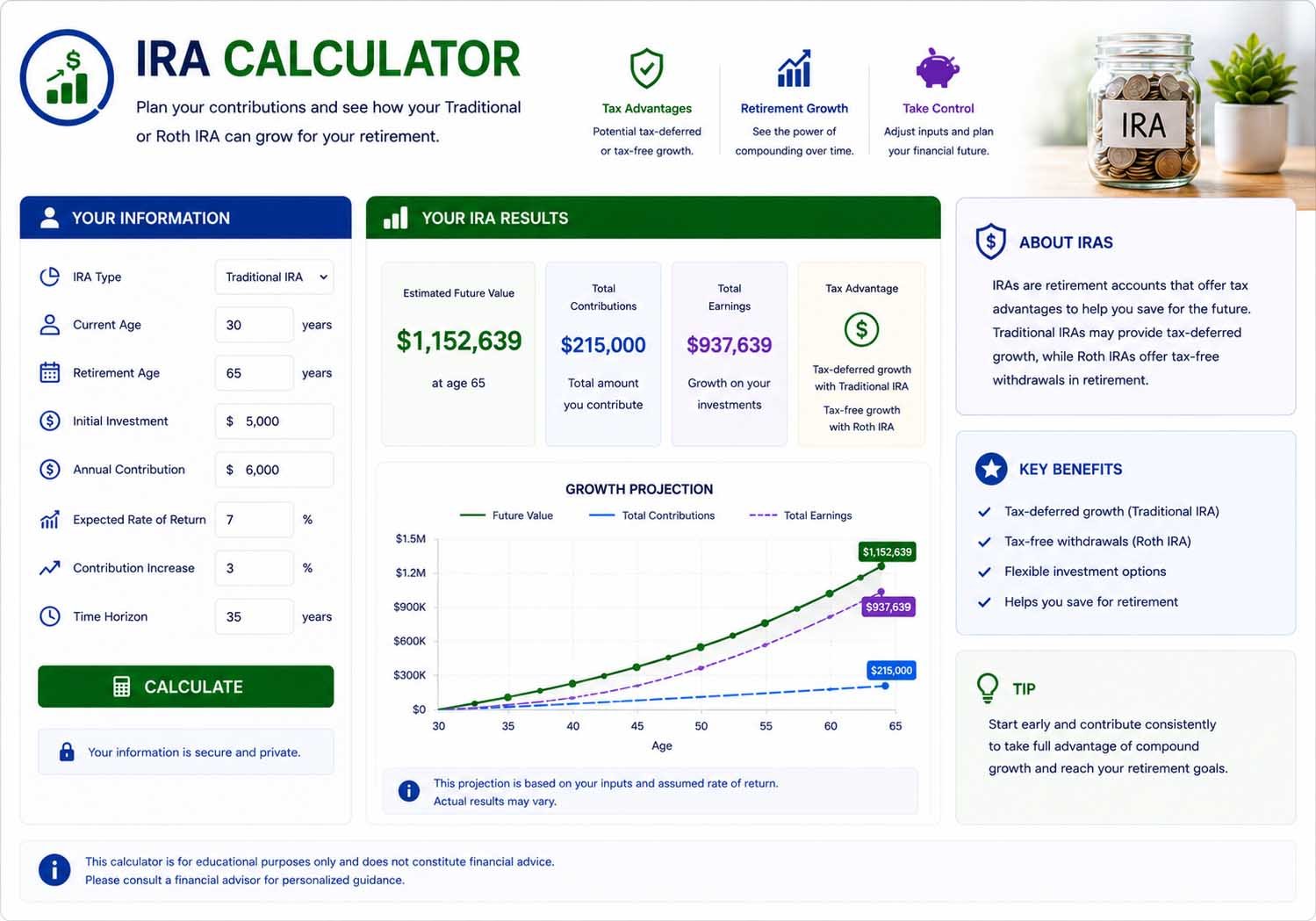
An IRA Calculator projects how much an individual retirement account could be worth at retirement and compares three ways of saving the same money: a traditional IRA (the same math covers SIMPLE and SEP IRAs), a Roth IRA, and an ordinary taxable account. It shows both the balance and its value after tax, so you can see which account type may leave you with more to spend.
How to use it
- Enter your current balance and the annual amount you plan to contribute before tax.
- Enter your expected rate of return, current age and retirement age.
- Enter your current marginal tax rate and the rate you expect in retirement.
- Click Calculate to see each account’s balance at retirement, before and after tax, along with a chart and a year-by-year schedule.
IRA formula
FV = B × (1 + r)^t + C × [((1 + r)^t − 1) ÷ r]
where B is the current balance, C is the yearly contribution, r is the yearly return and t is the number of years until retirement.
Example
You have $20,000 in an IRA, add $7,000 a year and earn 7% a year for 20 years:
- Starting balance: $20,000 × 1.07^20 ≈ $77,400
- Contributions: $7,000 × [(1.07^20 − 1) ÷ 0.07] ≈ $287,000
- Total: about $364,000
You would have put in $160,000 in total; the rest is investment growth. In a traditional IRA that balance is taxed when you withdraw it; in a Roth IRA qualified withdrawals are tax-free.
Key facts for 2026
- IRA contribution limit: $7,500, plus a $1,100 catch-up at age 50 or older. The limit is shared between traditional and Roth IRAs.
- If you or your spouse are covered by a workplace plan, the deduction for traditional IRA contributions phases out at higher incomes, for example between $81,000 and $91,000 of modified AGI for a single filer covered at work.
(2026, source: irs.gov)
A SIMPLE IRA or SEP IRA is opened through an employer or by the self-employed and has its own, higher limits. The growth math is the same, so the calculator’s traditional column also works for them; just enter your expected yearly contribution.
Traditional or Roth?
A traditional IRA may give you a tax deduction now and taxes withdrawals later. A Roth IRA gives no deduction now but qualified withdrawals are tax-free. As a rule of thumb, if you expect your tax rate in retirement to be lower than today, the traditional IRA tends to come out ahead; if you expect it to be higher, the Roth tends to win. Enter both tax rates in the calculator to compare them for your situation.
Tips
- Contribute early in the year when you can; the money gets more time to grow.
- You can make a contribution for a tax year until the filing deadline the following April.
- Keep fees low: a 1% yearly fee can reduce a 30-year balance by a large amount.
- Withdrawals from a traditional IRA before 59½ usually carry a 10% penalty plus income tax.
Can you retire with $500,000 in an IRA?
Using the 4% rule as a starting point, $500,000 could support withdrawals of about $20,000 a year (about $1,667 a month) with a good chance of lasting 30 years. Whether that is enough depends on your spending, Social Security and other income, and taxes: a traditional IRA withdrawal is taxable income, so the amount you can spend will be lower.
Frequently Asked Questions
It depends on what you start with, what you add and the return. Starting with $20,000, adding $7,000 a year and earning 7% a year, the balance after 20 years is about $364,000. With a 5% return it would be about $284,000.
An IRA calculator provides an estimate based on the information and expected return you enter. It cannot predict actual investment performance, so your real account balance may be higher or lower than the calculated amount.
The appropriate contribution depends on your income, expenses, retirement goals, and other savings. Contributing consistently and increasing contributions when possible can help build retirement savings over time.
Yes. It shows how much your IRA could grow and what it may be worth after tax. For a full plan, also consider Social Security, pensions, other savings and your expected spending, for example with our Retirement Calculator.
Neither account is automatically better for everyone. IRAs and 401(k)s have different contribution rules, tax treatment, investment choices, and employer benefits. Comparing both based on your circumstances can help determine how they fit into your retirement strategy.
Disclaimer: This calculator gives estimates for general information only. It is not financial, tax or legal advice. Results depend on the numbers you enter and on simplified assumptions, so your actual figures may differ. Check important decisions with a qualified professional or the official source.
Related Calculators
To see the rest of your retirement picture, try these calculators.
Written by Sharp Calculator Team — we build and test every calculator on this site, checking each formula against hand-worked examples and official sources. Last updated: October 2026.