
RMD Calculator
Your RMD for 2026 is $0.
The distribution period for your case is: 0.
If you only withdraw the RMD at the end of each year and your return rate is 5% per year, your future account balance and RMDs will look like the following.
RMD Schedule
| Year | Your Age | Distribution Period | RMD | End of Year Balance |
|---|
RMD Calculator
An RMD Calculator helps you estimate your Required Minimum Distribution (RMD), the amount you may need to withdraw from certain retirement accounts each year. It can make retirement planning easier by showing an estimated withdrawal based on your account balance and applicable IRS life-expectancy factors.
An RMD calculator is especially useful when you are approaching the age when required distributions begin or when you need to calculate your distribution for the current year.
How Does an RMD Calculator Work?
An RMD is generally calculated by dividing your retirement account balance by a life-expectancy factor from the applicable IRS table. The calculation can vary depending on your age, account type, and circumstances.
An RMD Calculator by Age allows you to enter your age and account balance to estimate the amount you may need to withdraw. Your previous year-end account balance is generally important when determining the current year’s RMD.
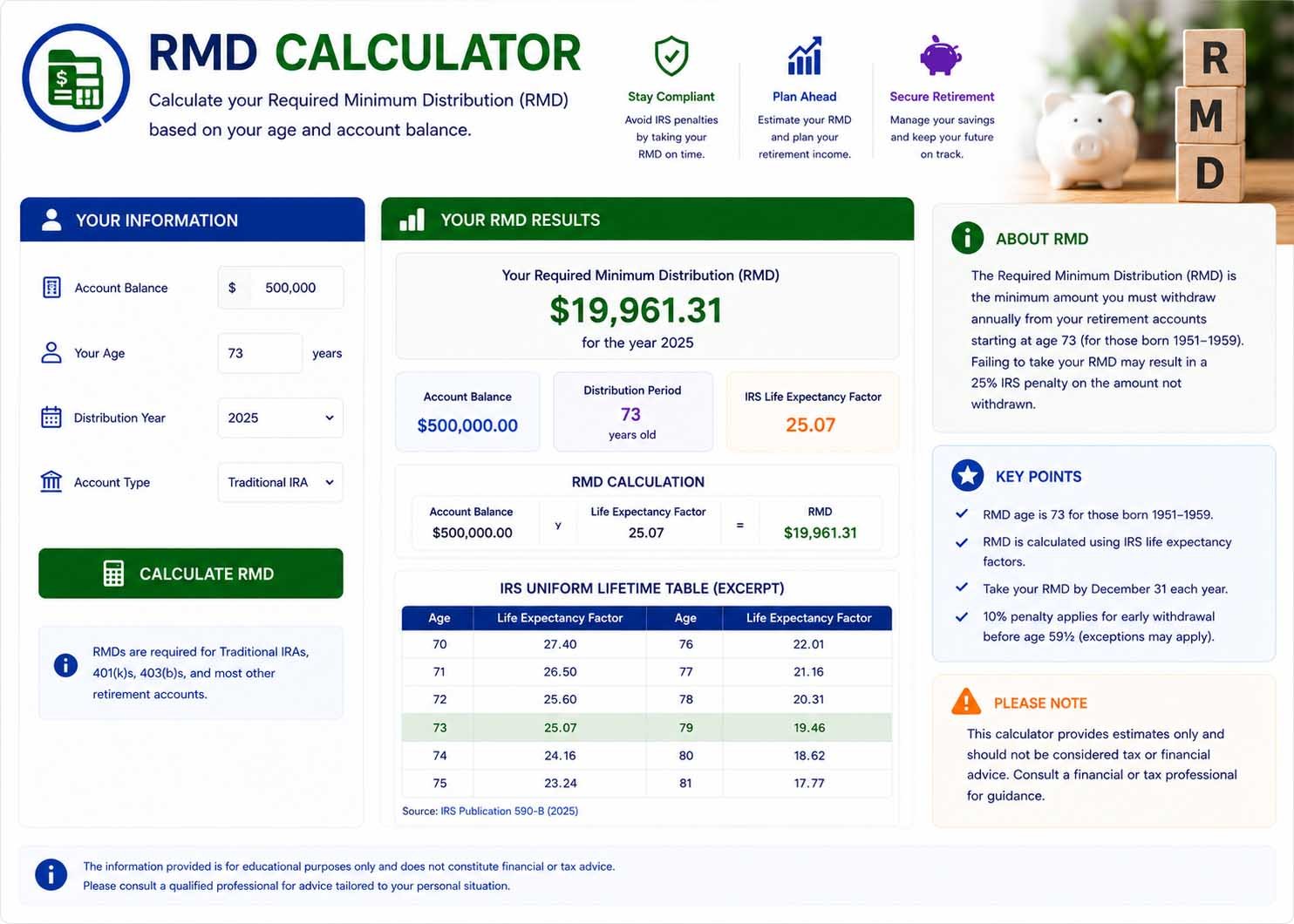
RMD Calculator 2026
An RMD Calculator 2026 can help estimate your required distribution for the 2026 tax year. Current RMD rules should always be checked because retirement distribution laws can change.
The age at which RMDs begin depends on your birth year under current rules. Because of these changes, older references such as a New RMD Calculator Age 72 may not apply to everyone.
For an accurate calculation, use the applicable IRS table for your age and account type rather than relying on an outdated RMD table.
RMD Calculator Table
An RMD Calculator Table shows the life-expectancy factors used to determine required distributions. The IRS provides different tables for different situations, including the Uniform Lifetime Table, Joint Life and Last Survivor Expectancy Table, and Single Life Expectancy Table.
A 2026 RMD Calculator Table can be useful when checking the factor that applies to your age. However, the table should be matched with the correct account and beneficiary circumstances.
Searches for an RMD Calculator 2026 Table PDF are also common because some people prefer keeping a printable reference. Always make sure the table is from a reliable and current source.
Inherited IRA RMD Calculator
An Inherited IRA RMD Calculator is used for retirement accounts inherited from another person. The rules for inherited IRAs can be different from those for your own traditional IRA or 401(k).
The required distribution may depend on factors such as when the original owner died, your relationship to the account owner, and the applicable distribution rules.
Because inherited retirement account rules can be complicated, an online calculator should be treated as an estimate. Check the applicable IRS rules or consult a qualified tax professional for your specific situation.
How Much Are RMDs at Age 73?
The RMD amount at age 73 depends on your retirement account balance and the applicable life-expectancy factor.
For example, someone with a larger account balance will generally have a larger required distribution than someone with a smaller balance, assuming the same applicable factor.
An RMD calculator can make this calculation easier by using your account balance and age to estimate the required withdrawal.
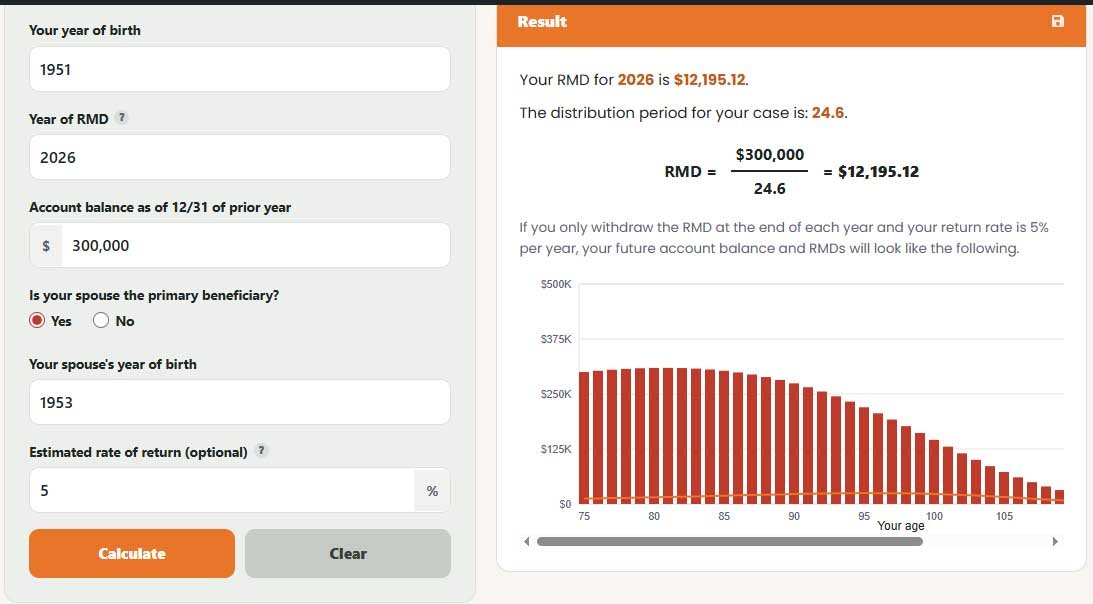
RMD Formula
RMD = Previous Year-End Account Balance ÷ Applicable Life-Expectancy Factor
The applicable factor comes from the IRS life-expectancy tables and depends on your age and situation.
What Are the New RMD Age Tables?
RMD age rules have changed over time because of federal retirement legislation. This is why older information may refer to beginning RMDs at age 70½ or 72, while newer rules use different starting ages for different birth years.
The RMD calculator by age should therefore use the current rules applicable to your birth year rather than automatically assuming that everyone starts at the same age.
The life-expectancy tables used for the calculation have also been updated, making it important to use the appropriate current table.
How Do I Calculate My RMD for This Year?
To calculate an RMD, you generally need your retirement account balance from the end of the previous year and the applicable life-expectancy factor for your age.
Divide the previous year-end balance by the factor to get the estimated RMD. If you have multiple retirement accounts, the rules for calculating and taking distributions can differ depending on the type of account.
An RMD Calculator 2026 can simplify the process by performing the calculation automatically after you enter the required information.
What Is the 4% Rule for RMDs?
The 4% rule and RMD calculation are not the same thing. The 4% rule is a retirement withdrawal guideline sometimes used to estimate how much someone might withdraw from savings each year.
An RMD, on the other hand, is a required distribution determined under tax rules for applicable retirement accounts. Your RMD may be higher or lower than 4% depending on your age, account balance, and applicable life-expectancy factor.
RMD Calculator AARP and Other Online Tools
People often search for an RMD Calculator AARP when looking for a retirement distribution estimate. Different financial websites may offer calculators with slightly different layouts and inputs.
Whether you use an AARP calculator, another financial website, or a simple online tool, the result should be checked against the applicable current rules and your account information.
The most important part is using the correct age, account balance, and life-expectancy factor for your circumstances.
Final Thoughts
An RMD Calculator provides a convenient way to estimate required retirement account distributions and understand how much you may need to withdraw each year.
Using your correct age, previous year-end balance, and applicable life-expectancy factor can give you a useful estimate. Since RMD rules can change and inherited accounts have additional considerations, verify important calculations with current IRS guidance or a qualified professional.
Frequently Asked Questions
The starting age for RMDs depends on your birth year and the current retirement distribution rules. Older rules may mention age 72, but that does not apply to everyone under current law.
Yes. An RMD calculator by age can estimate your required distribution using your age, account balance, and the applicable life-expectancy factor.
Some calculators specifically support inherited IRAs, but inherited IRA rules can be more complicated. The calculation may depend on the original owner’s age, date of death, beneficiary status, and other factors.
RMDs from traditional tax-deferred retirement accounts are generally included in taxable income, although the tax treatment can vary depending on the account and your circumstances.
Generally, you can withdraw more than the required minimum from an applicable retirement account. However, taking more than the RMD can increase your taxable income, so consider the tax consequences before making additional withdrawals.
Related Calculator:
Explore more financial tools designed to simplify your calculations. Whether you’re planning a mortgage, estimating an auto loan, calculating taxes, or tracking investment growth, our free calculators provide fast and accurate results to help you make smarter financial decisions.