
Simple Interest Calculator
Balance Accumulation Graph
Breakdown
Simple interest only — interest is calculated on the original principal alone and does not compound. Not financial advice.
What Is Simple Interest?
Simple interest is the amount charged or earned based only on the initial principal amount. The interest rate is usually expressed as an annual percentage, while the time represents how long the money is borrowed or invested. Because the calculation does not add previous interest to the principal, the interest amount remains consistent for each equal period when the rate and principal stay unchanged.
For example, if you borrow $10,000 at a 5% annual simple interest rate for five years, the interest can be calculated directly from the original $10,000 principal. This makes simple interest easier to understand and calculate compared with compound interest.


Simple Interest Formula
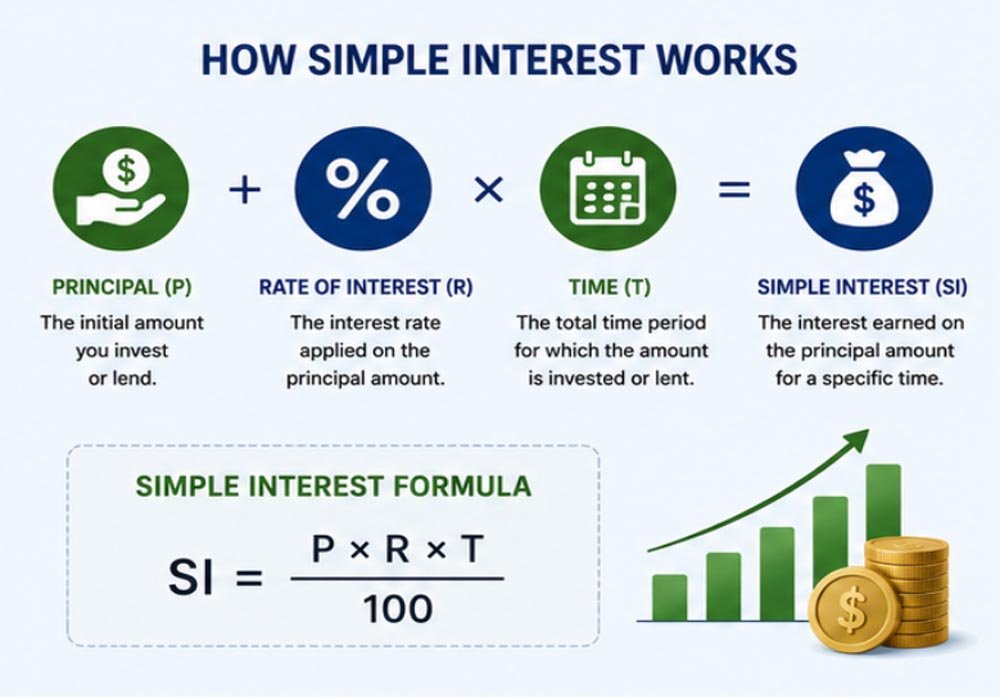
The standard formula for calculating simple interest is:
I = P × r × t
Where:
- I = Total simple interest
- P = Principal amount
- r = Annual interest rate expressed as a decimal
- t = Time in years
For example, a $10,000 loan at a 5% annual rate for 5 years would produce:
I = $10,000 × 0.05 × 5 = $2,500
The total repayment would therefore be:
Total Amount = Principal + Interest
$10,000 + $2,500 = $12,500
Simple Interest for Different Time Periods
The simple interest formula can also be used when the loan or investment period is measured in months, days, or other intervals. The important point is that the interest rate and time period must use the same frequency. For instance, when calculating monthly interest, the annual rate should be converted to a monthly rate, and the number of months should be used as the number of periods.
Simple interest can be useful for comparing borrowing costs, estimating returns, and understanding how much interest will accumulate over a fixed period. However, many modern financial products use compound interest instead, where accumulated interest can also generate additional interest over time.

Simple Interest vs. Compound Interest
The main difference between simple and compound interest is the balance on which interest is calculated. Simple interest applies the rate only to the original principal, while compound interest calculates interest on the principal plus previously accumulated interest. As a result, compound interest can produce higher earnings for investors but may also result in higher borrowing costs.
For borrowers, simple interest can be easier to predict because the interest calculation does not grow as previously accumulated interest is added to the balance. For savings and investments, compound interest can provide greater long-term growth because returns are reinvested and can themselves generate additional returns.
Frequently Asked Questions
Simple interest is interest calculated only on the original principal amount. It does not include previously accumulated interest when calculating future interest.
The basic formula is I = P × r × t, where I represents interest, P is the principal, r is the interest rate, and t is the time period in years.
Is simple interest better than compound interest?
It depends on the situation. Simple interest can be less expensive for borrowers because interest is calculated only on the original principal, while compound interest can provide greater growth for investors over time.
Yes. Simple interest can be calculated monthly or using another period, provided that the interest rate and time period are expressed using the same frequency.
A Simple Interest Calculator uses the principal, interest rate, and time period to calculate the total interest. It can then add the interest to the principal to determine the total amount payable or accumulated.
Related Calculator:
Explore more financial tools designed to simplify your calculations. Whether you’re planning a mortgage, estimating an auto loan, calculating taxes, or tracking investment growth, our free calculators provide fast and accurate results to help you make smarter financial decisions.