
Bond Calculator
Please enter any four values into the fields below to calculate the remaining value of a bond. This calculator is for bonds issued/traded at the coupon date. Leave the value you want solved for blank.
—
Bond pricing calculator
Use this calculator to value the price of bonds not traded at the coupon date. It provides the dirty price, clean price, and accrued interest.
Estimates only. Bond pricing assumes a flat yield curve and standard coupon-period conventions. Not financial or investment advice.
Bond Calculator
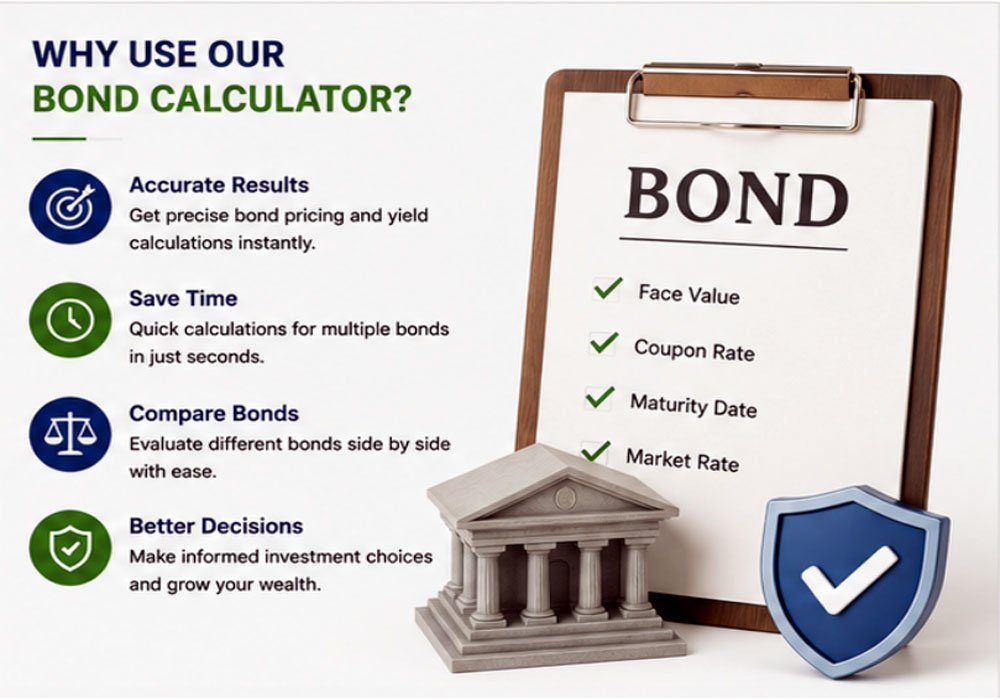
A Bond Calculator is a useful financial tool for estimating the value and potential return of a bond. It can help investors understand coupon payments, interest earnings, bond prices, and yield based on the bond’s face value, interest rate, market price, and maturity period. Whether you are evaluating government or corporate bonds, these calculations can make it easier to compare different investment opportunities. It can also help you estimate how much a bond may earn over its investment period.
Bond Calculator Formula
The basic bond pricing formula can be represented as:
Bond Price = Σ [Coupon Payment ÷ (1 + r)ᵗ] + [Face Value ÷ (1 + r)ⁿ]
Here, the coupon payment is the periodic interest received, r is the required rate of return, t represents each payment period, and n is the total number of periods until maturity. The calculator performs these calculations automatically to provide an estimated bond value. This makes it easier to understand the relationship between bond payments, interest rates, and the final value.
Types of Bonds
Different types of bonds can have different payment structures, maturity periods, and levels of risk. A Treasury bond calculator can help estimate returns from government-issued bonds, while a corporate bond calculator can be useful for evaluating company-issued debt. A savings bond calculator may be used to estimate the value of savings bonds, while specialized tools such as a construction bond calculator can be designed for construction-related guarantees. Each type of bond may have different terms, rates, and repayment conditions.
Understanding Bond Interest and Yield
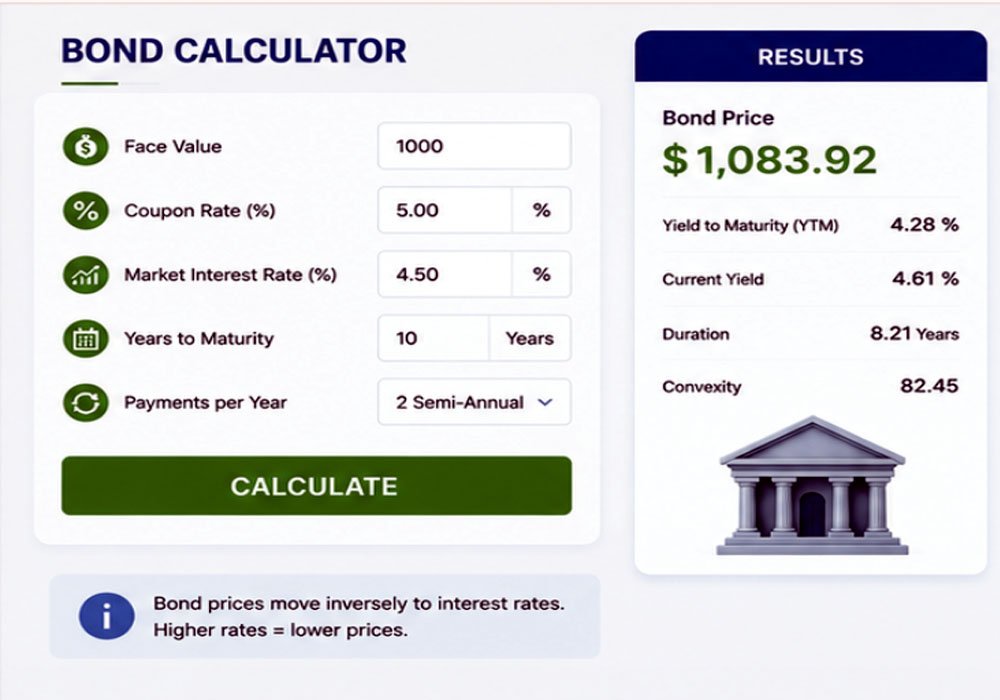
Bond returns are commonly influenced by coupon interest, purchase price, and market interest rates. When market interest rates change, the value of existing bonds can also change. A bond calculator interest calculation can help estimate the income generated from coupon payments, while yield calculations can provide a better understanding of the potential return when a bond is purchased at a price different from its face value. Understanding these factors can help investors make more informed comparisons before purchasing a bond.
Frequently Asked Questions
A bond can be valued using its face value, coupon payments, market interest rate, and remaining time to maturity. A bond calculator combines these inputs to estimate its current value and potential return.
A 12% YTM means the estimated annual return is 12% if the bond is purchased at its current price and held until maturity, assuming the expected payments are made as scheduled.
Enter the bond’s face value, coupon rate, current price, yield, payment frequency, and remaining term into the calculator. The results can help estimate the bond’s value, interest income, and yield.
Current yield is calculated by dividing the bond’s annual coupon payment by its current market price. It shows the income generated by the bond relative to what it currently costs.
Yes. Most VA loans allow borrowers to make additional principal payments without prepayment penalties, which may reduce the total interest paid and shorten the loan term.
Related Calculator:
Explore more financial tools designed to simplify your calculations. Whether you’re planning a mortgage, estimating an auto loan, calculating taxes, or tracking investment growth, our free calculators provide fast and accurate results to help you make smarter financial decisions.