
Calculate Average Annual and Cumulative Returns easily
Cash Flow Activities
Results
Enter return percentages and holding period (years/months) for each interval.
Results
What Is an Average Return Calculator?
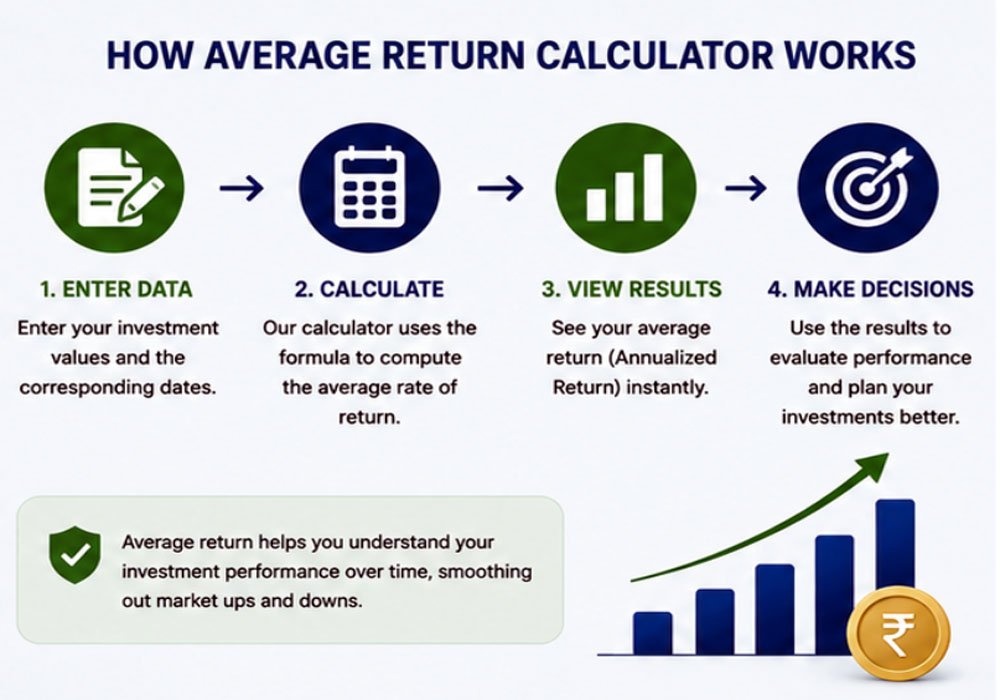
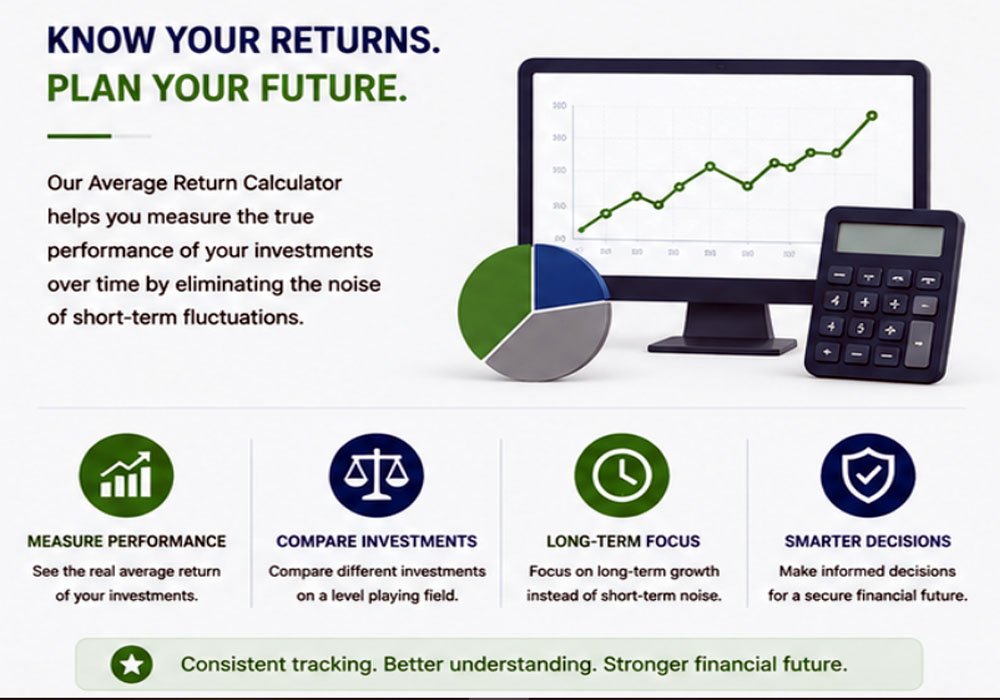
An Average Return Calculator is a useful financial tool for estimating the average performance of an investment over a specific period. It can help investors evaluate stocks, mutual funds, portfolios, and other investments by comparing their returns across different periods. Instead of calculating each return manually, the calculator provides a quick way to understand the overall performance of an investment.
Investors can use an Average Return Calculator S&P 500 to study historical market performance or an Average Return Calculator Stock to estimate the average return of an individual investment. The results can be useful for comparing investment strategies, although historical returns do not guarantee future performance.
How to Calculate Average Return?
Average return measures the typical return earned over multiple investment periods. The calculation can be based on annual, monthly, or other periodic returns. For example, if an investment produces different returns each year, adding those returns together and dividing by the number of periods provides the arithmetic average return.
Average Return Formula:
Average Return=nR1+R2+R3+⋯+Rn
Where R represents the return for each period and n represents the total number of periods.
Monthly and Investment Returns
A Monthly Average Return Calculator can help investors analyze performance using monthly returns rather than annual figures. Monthly calculations may be useful when an investment has frequent price changes or when investors want to examine shorter periods. A similar approach can be used with an Average Return Calculator Mutual Fund to compare historical fund performance.
A Rate of Return Calculator can also be useful when you want to determine the percentage gain or loss from an investment. For example, if an investment increases from $10,000 to $12,000, the return is based on the change relative to the original investment amount. Investors should also consider contributions, withdrawals, fees, and dividends when evaluating actual investment performance.
How to Calculate Average Annual Return in Excel
Investors can calculate average annual returns in Excel by entering the annual return percentages into separate cells and using the AVERAGE function. For example, if annual returns are entered in cells B2 through B6, the basic calculation can be written as:
=AVERAGE(B2:B6)
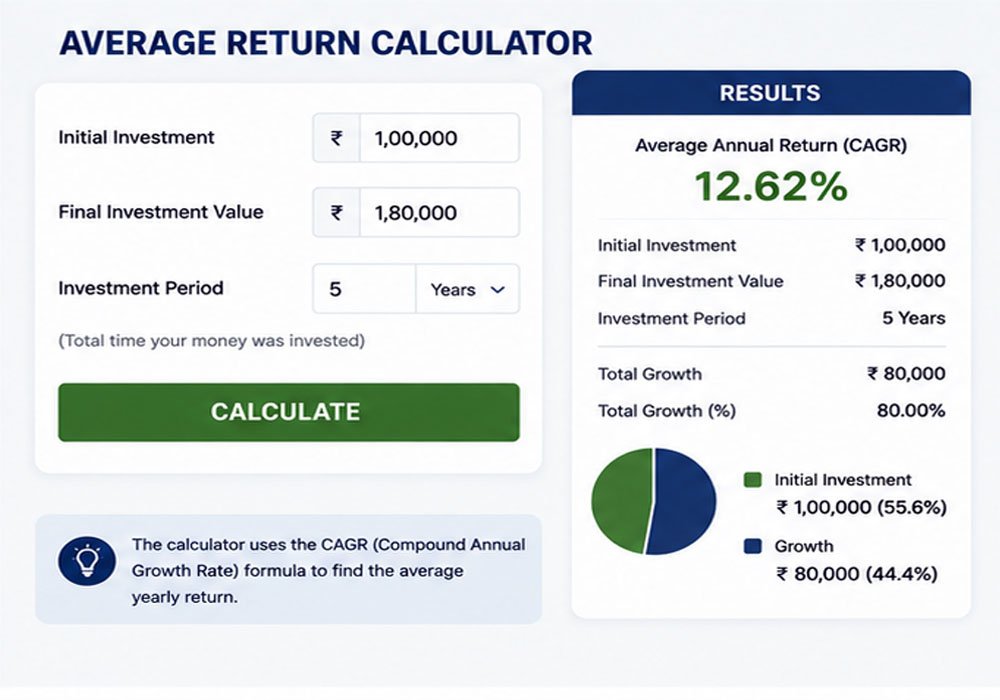
This method provides the arithmetic average of the listed annual returns. However, when measuring investment growth over several years, investors may also consider compound annual growth rate (CAGR), which accounts for the effect of compounding and may provide a different perspective on long-term performance.
Frequently Asked Questions
The future value of $100,000 depends on the assumed annual rate of return and whether returns are reinvested. A long investment period can allow compound growth to significantly increase the value, but actual market returns can vary from year to year.
A 7% annual return can be used as a hypothetical long-term assumption for some investment calculations, but it is not guaranteed. Actual returns depend on the investment, market conditions, fees, taxes, inflation, and the period being analyzed.
Add the returns for all periods together and divide the total by the number of periods. The Average Return Formula is: Average Return = Sum of Periodic Returns ÷ Number of Periods.
The result would depend on the exact investment date, ending date, dividends, fees, and whether dividends were reinvested. An S&P 500 investment calculator can be used to estimate the historical value using the selected dates and assumptions.
The future value depends on the assumed annual return and whether investment earnings remain invested. Using different return assumptions can produce significantly different results, so an Average Return Calculator can help compare several possible scenarios.
Related Calculator:
Explore more financial tools designed to simplify your calculations. Whether you’re planning a mortgage, estimating an auto loan, calculating taxes, or tracking investment growth, our free calculators provide fast and accurate results to help you make smarter financial decisions.