
Estimates only, based on the values you enter. If Amount Returned is less than Amount Invested, ROI and Annualized ROI will be negative. Not financial advice.
What Is Return on Investment (ROI)?
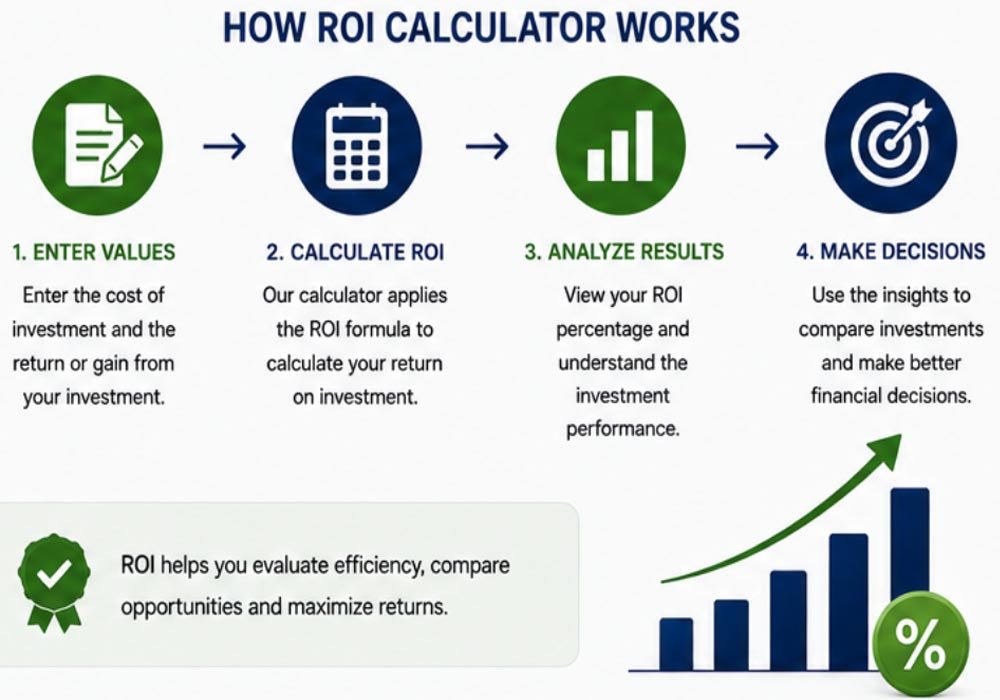
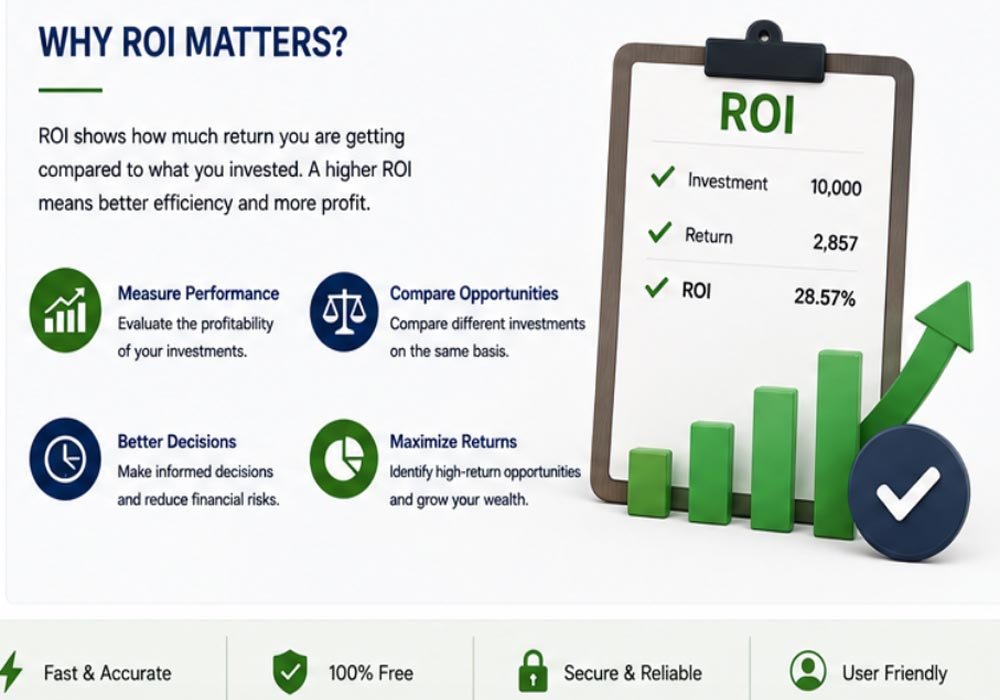
Return on Investment (ROI) is a widely used financial metric for measuring the profitability of an investment. It compares the gain generated by an investment with the amount originally spent. Because the calculation is simple and applicable to many situations, an ROI Calculator can be useful for evaluating investments such as stocks, real estate, business projects, marketing campaigns, or other opportunities that involve a cost and a potential financial gain.
ROI provides a quick way to understand how efficiently invested money has performed. However, the result depends heavily on how the investment cost and gain are defined. Different expenses, taxes, fees, and additional cash flows can change the final ROI, so the figures used in the calculation should be selected carefully.

ROI Formula
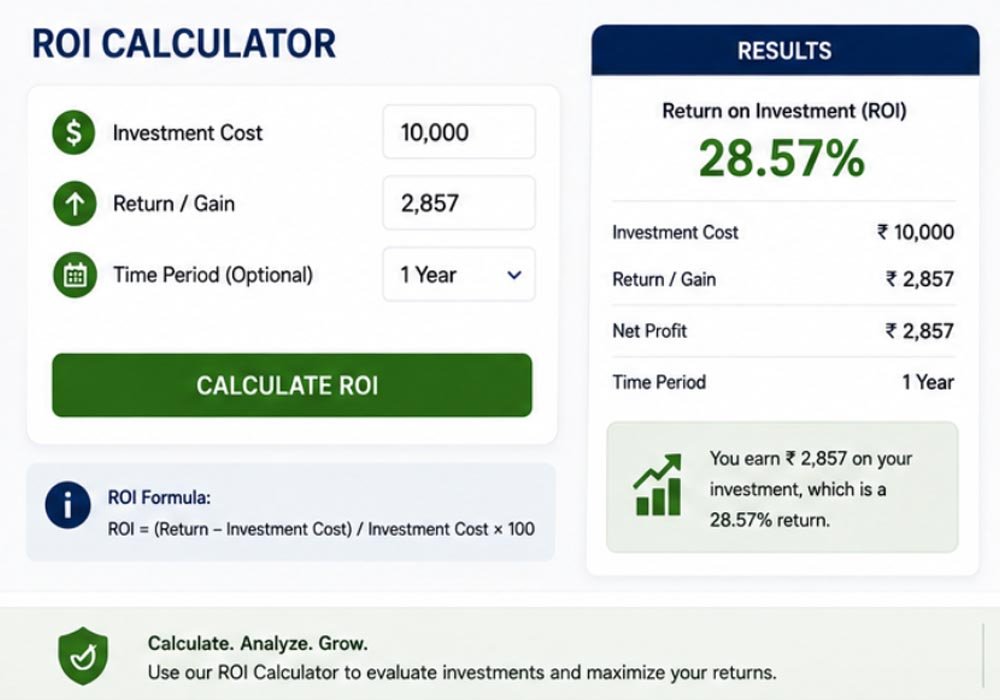
The basic formula for calculating return on investment is:
ROI=Cost of InvestmentGain from Investment−Cost of Investment×100
For example, suppose an investor spends $50,000 on an investment and eventually receives $70,000. The gain is $20,000, so the ROI would be:
ROI=50,00070,000−50,000×100=40%
This means the investment generated a return equal to 40% of the original investment cost.
ROI vs. Rate of Return
ROI is sometimes confused with Rate of Return (ROR), but the two terms are not always interchangeable. ROI generally focuses on the overall gain compared with the investment cost, while rate of return can refer to the return earned over a particular period, such as a year.
This distinction becomes important when comparing investments held for different lengths of time. An investment with a high ROI may not necessarily be better than another investment with a lower ROI if the first investment required substantially more time to produce its return.
Understanding Annualized ROI
One of the major limitations of traditional ROI is that it does not include the investment period. For example, an investment producing a 50% ROI in one year is very different from an investment producing the same 50% ROI over ten years.
Annualized ROI helps address this issue by expressing the return on a yearly basis. This can make comparisons between investments with different holding periods more meaningful. The ROI Calculator can use the investment time to provide an annualized perspective, helping users better understand how quickly an investment generated its return.
Frequently Asked Questions
Subtract the investment cost from the investment gain, divide the result by the investment cost, and multiply by 100.
There is no single ROI percentage that is considered good for every investment. A suitable ROI depends on the investment period, risk, costs, and the return available from alternative opportunities.
No. Traditional ROI does not include a specific timeframe, while an annualized return expresses investment performance on a yearly basis. This makes annualized return more useful when comparing investments held for different periods.
Two ROI calculations can produce different results when investors define costs and gains differently. Taxes, fees, operating expenses, additional investments, and other cash flows can all affect the final ROI.
ROI shows the overall return compared with the original investment, while annualized ROI considers the investment period. Annualized ROI can be more useful when comparing investments held for different lengths of time.
Related Calculator:
Explore more financial tools designed to simplify your calculations. Whether you’re planning a mortgage, estimating an auto loan, calculating taxes, or tracking investment growth, our free calculators provide fast and accurate results to help you make smarter financial decisions.