
| Unadjusted | Holidays & vacation days adjusted |
|---|
"Unadjusted" assumes you're paid for every working day of the year. "Holidays & vacation days adjusted" reflects your effective rate if holidays and vacation days are unpaid. Estimates only.
What Is a Salary Calculator?
A Salary Calculator helps you estimate your earnings based on your annual salary, hourly rate, working hours, or pay frequency. It can convert your income into monthly, weekly, biweekly, daily, and hourly amounts, making it easier to understand your overall compensation. Whether you are reviewing a job offer, planning a budget, or comparing different salary options, a salary calculator provides a quick way to estimate your earnings.
How Does a Salary Calculator Work?
Salary calculations depend on factors such as annual income, hours worked, pay frequency, and the number of working days. For example, an annual salary can be divided by the number of pay periods in a year to estimate each paycheck. The calculator can also work in reverse, allowing you to estimate an annual salary from an hourly wage and regular working schedule.


Gross Salary vs. Take-Home Pay
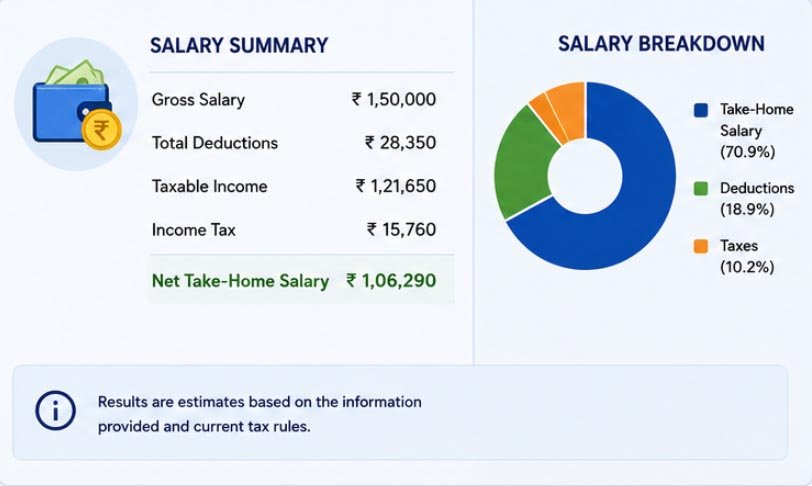
It is important to distinguish between gross salary and take-home pay. Gross salary is the amount earned before taxes, insurance, retirement contributions, and other deductions are removed. Take-home pay is the amount that actually reaches your bank account after applicable deductions. The final amount can vary depending on tax rates, benefits, location, filing status, and other personal circumstances.
A Salary Calculator is useful for estimating gross earnings and comparing compensation, but an exact paycheck may differ because deductions and taxes are not the same for everyone. For a more detailed estimate, salary information can be combined with applicable tax and payroll deductions.
Salary Conversion Formula
For a basic hourly-to-annual salary calculation, the formula is:
Annual Salary = Hourly Rate × Hours Worked per Week × Weeks Worked per Year
For example, if you earn $25 per hour, work 40 hours per week, and work 52 weeks per year:
$25 × 40 × 52 = $52,000
This gives an estimated annual salary before taxes and other deductions.

Salary Calculation and Pay Frequency
Your salary may be quoted as an annual amount, but you may receive your earnings weekly, biweekly, semi-monthly, or monthly. Understanding the difference between these pay schedules is useful when planning regular expenses and comparing job offers. A salary calculator can quickly convert the same income into different pay periods, helping you see approximately how much you earn from each paycheck.
Some common salary calculations include:
- Annual salary — total earnings before deductions for one year.
- Monthly salary — estimated annual salary divided across monthly pay periods.
- Biweekly salary — annual income divided by 26 typical biweekly pay periods.
- Weekly salary — annual income divided by 52 weeks.
- Hourly rate — estimated earnings for each hour worked.
Frequently Asked Questions
Multiply your hourly rate by the number of hours you work each week and then by the number of weeks you work each year. For a standard full-time schedule, 40 hours per week and 52 weeks per year are commonly used as a basic estimate.
A $50,000 annual salary divided by 12 months is approximately $4,166.67 per month before taxes and other deductions. Your actual take-home pay may be lower depending on applicable payroll deductions.
Gross salary is your earnings before taxes and other deductions. Net salary, often called take-home pay, is the amount remaining after taxes, insurance, retirement contributions, and other applicable deductions have been taken out.
To estimate an hourly rate, divide your annual salary by the total number of hours you expect to work in a year. For example, a standard 40-hour workweek for 52 weeks equals 2,080 working hours per year.
A basic Salary Calculator primarily estimates gross earnings. Take-home pay requires additional information such as taxes, deductions, benefits, and location, so the exact amount may vary from one person to another.
Related Calculator:
Explore more financial tools designed to simplify your calculations. Whether you’re planning a mortgage, estimating an auto loan, calculating taxes, or tracking investment growth, our free calculators provide fast and accurate results to help you make smarter financial decisions.